

aaa-0004.html
Text Version
Howells of Muskingum County, Ohio: Correlating and Interpreting Evidence to Reconstruct a Family
By Carmen J. Finley, c.g.*
When all existing records seem to point to a conclusion, yet troubling discrepancies remain . . . such discrepancies can often be quieted by consulting the prevailing legal statutes.
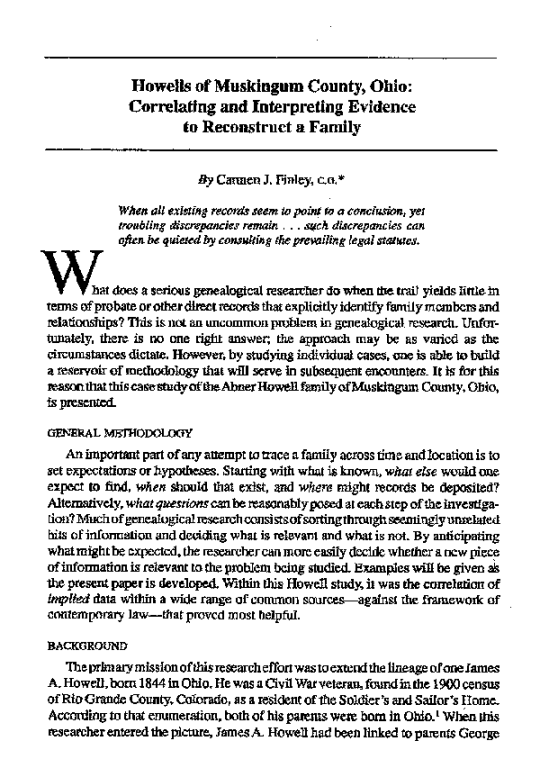
What does a serious genealogical researcher do when the trail yields little in terms of probate or other direct records that explicitly identify family members and relationships? This is not an uncommon problem in genealogical research. Unfortunately, there is no one right answer; the approach may be as varied as the circumstances dictate. However, by studying individual cases, one is able to build a reservoir of methodology that will serve in subsequent encounters. It is for this reason that this case study of the Abner Howell family of Muskingum County, Ohio, is presented.
GENERAL METHODOLOGY
An important part of any attempt to trace a family across time and location is to set expectations or hypotheses. Starting with what is known, what else would one expect to find, when should that exist, and where might records be deposited? Alternatively, what questions can be reasonably posed at each step of the investigation? Much of genealogical research consists of sorting through seemingly unrelated bits of information and deciding what is relevant and what is not. By anticipating what might be expected, the researcher can more easily decide whether a new piece of information is relevant to the problem being studied. Examples will be given as the present paper is developed. Within this Howell study, it was the correlation of implied data within a wide range of common sources—against the framework of contemporary law—that proved most helpful.
BACKGROUND
The primary mission of this research effort was to extend the lineage of one James A. Howell, born 1844 in Ohio. He was a Civil War veteran, found in the 1900 census of Rio Grande County, Colorado, as a resident of the Soldier’s and Sailor’s Home. According to that enumeration, both of his parents were born in Ohio.1 When this researcher entered the picture, James A. Howell had been linked to parents George
Howells: Correlating and Interpreting Evidence
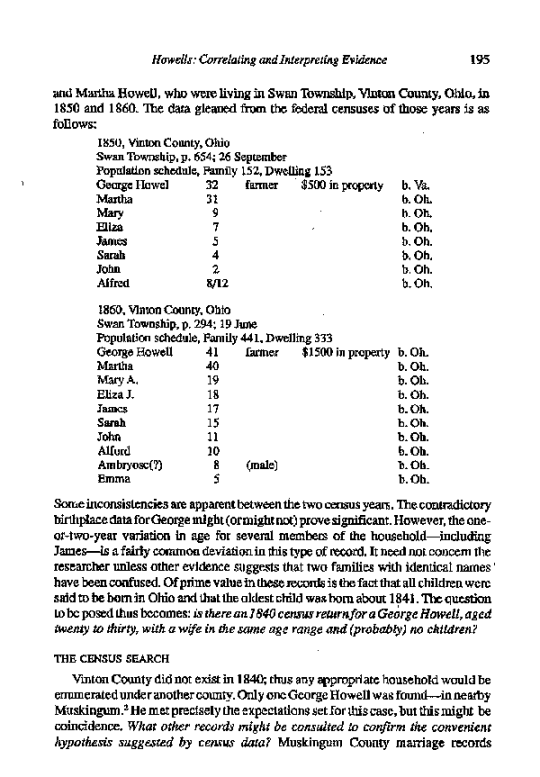
and Martha Howell, who were living in Swan Township, Vinton County, Ohio, in 1850 and 1860. The data gleaned from the federal censuses of those years is as follows:
1850, Vinton County, Ohio
Swan Township, p. 654; 26 September
Population schedule, Family 152, Dwelling 153
George Howel 32 farmer $300 in property b. Va.
Martha 31 b. Oh.
Mary 9 b. Oh.
Eliza 7 b. Oh.
James 5 b. Oh.
Sarah 4 b. Oh.
John 2 b. Oh.
Alfred 8/12 b. Oh.
1860, Vinton County, Ohio
Swan Township, p. 294; 19 June
Population schedule, Family 441, Dwelling 333
George Howell 41 farmer $1500 in property b. Oh.
Martha 40 b. Oh.
Mary A. 19 b. Oh.
Eliza J. 18 b. Oh.
James 17 b. Oh.
Sarah 15 b. Oh.
John 11 b. Oh.
Alfred 10 b. Oh.
Ambrose(?) 8 (male) b. Oh.
Emma 5 b. Oh.
Some inconsistencies are apparent between the two census years. The contradictory birthplace data for George might (or might not) prove significant. However, the one- or two-year variation in age for several members of the household—including James—is a fairly common deviation in this type of record. It need not concern the researcher unless other evidence suggests that two families with identical names have been confused. Of prime value in these records is the fact that all children were said to be born in Ohio and that the oldest child was born about 1841. The question to be posed thus becomes: is there an 1840 census return for a George Howell, aged twenty to thirty, with a wife in the same age range and (probably) no children?
THE CENSUS SEARCH
Vinton County did not exist in 1840; thus any appropriate household would be enumerated under another county. Only once George Howell was found—in nearby Muskingum. He met precisely the expectations set for his case, but this might be coincidence. What other records might be consulted to confirm the convenient hypothesis suggested by census data? Muskingum County marriage records
National Genealogical Society Quarterly
yielded two pieces of verifying data:3
1840 29 January George Howell and Martha Early
1828 1 May Frances Howell to Samuel Pyle
As previously shown, George Howell and wife Martha of Vinton produced their first child in 1841. Two doors from them in Vinton, 1850, was the family of Samuel and Frances A. Pyles, born circa 1791 and 1812, respectively.
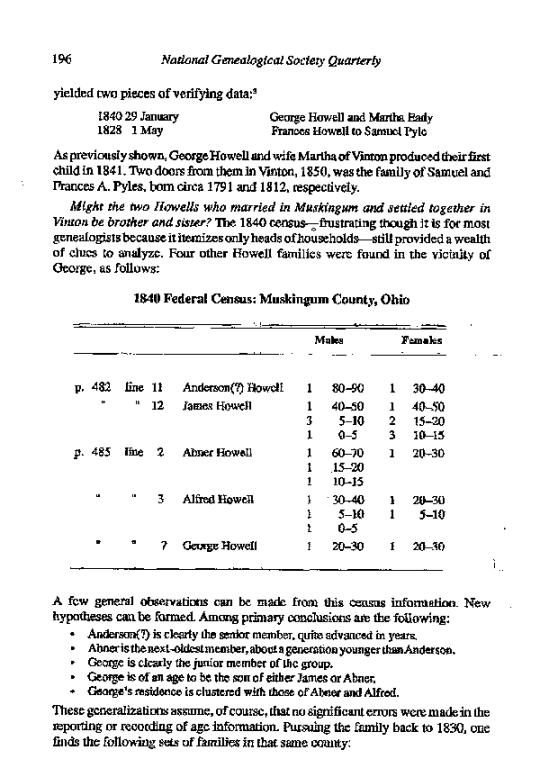
Might the two Howells who married in Muskingum and settled together in Vinton be brother and sister? The 1840 census—frustrating though it is for most genealogists because it itemizes only heads of households—still provided a wealth of clues to analyze. Four other Howell families were found in the vicinity of George, as follows:
1840 Federal Census: Muskingum County, Ohio
| Page | Name | Males | Females |
|---|---|---|---|
| p. 482 | line 11 Anderson(?) Howell | 1 30–40 | 1 30–40 |
| line 12 James Howell | 1 40–50 3 5–10 1 0–5 | 1 40–50 2 15–20 3 10–15 | |
| p. 485 | line 2 Abner Howell | 1 60–70 1 15–20 1 10–15 | 1 20–30 |
| line 3 Alfred Howell | 1 30–40 1 5–10 1 0–5 | 1 20–30 1 5–10 | |
| line 7 George Howell | 1 20–30 | 1 20–30 |
A few general observations can be made from this census information. New hypotheses can be formed. Among primary conclusions are the following:
- Anderson(?) is clearly the senior member, quite advanced in years.
- Abner is the next oldest member, about a generation younger than Anderson.
- George is clearly the junior member of the group.
- George is of an age to be the son of either James or Abner.
- George’s residence is clustered with those of Abner and Alfred.
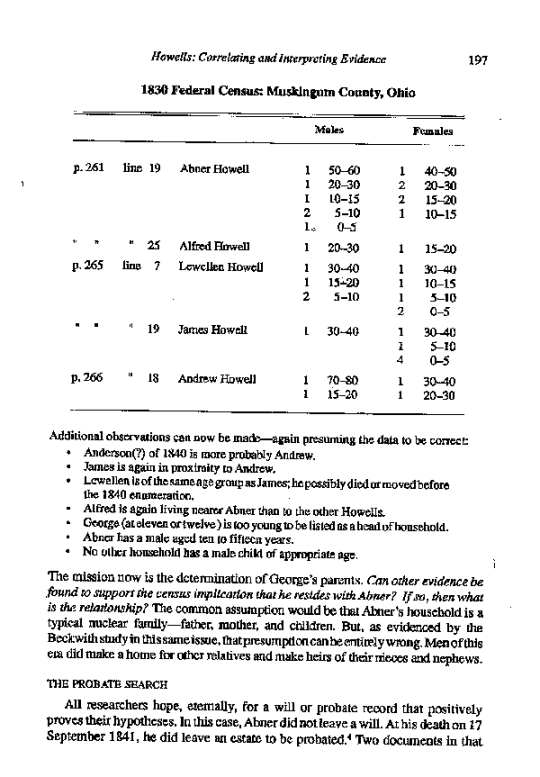
These generalizations assume, of course, that no significant errors were made in the reporting or recording of age information. Pursuing the family back to 1830, one finds the following sets of families in that same county:
Howells: Correlating and Interpreting Evidence
1830 Federal Census: Muskingum County, Ohio
| Males | Females | ||
|---|---|---|---|
| p. 261 | line 19 Abner Howell | 1 50–60 1 20–30 1 10–15 2 5–10 1 0–5 | 1 40–50 2 20–30 2 15–20 1 10–15 |
| line 25 Alfred Howell | 1 20–30 | 1 15–20 | |
| p. 265 | line 7 Lewellen Howell | 1 30–40 1 15–20 2 5–10 | 1 30–40 1 10–15 2 5–10 2 0–5 |
| line 19 James Howell | 1 30–40 | 1 30–40 1 5–10 4 0–5 | |
| p. 266 | line 18 Andrew Howell | 1 70–80 1 15–20 | 1 30–40 1 20–30 |
Additional observations can now be made—again presuming the data to be correct:
- Anderson(?) of 1840 is more probably Andrew.
- James is again in proximity to Andrew.
- Lewellen is of the same age group as James; he possibly died or moved before the 1840 enumeration.
- Alfred is again living nearer Abner than to the other Howells.
- George (at eleven or twelve) is too young to be listed as a head of household.
- Abner has a male aged ten to fifteen years.
- No other household has a male child of appropriate age.
The mission now is the determination of George’s parents. Can other evidence be found to support the census implication that he resides with Abner? If so, then what is the relationship? The common assumption would be that Abner’s household is a typical nuclear family—father, mother, and children. But, as evidenced by the Beckwith study in this same issue, that presumption can entirely wrong. Men of this era did make a home for other relatives and make heirs of their nieces and nephews.
THE PROBATE SEARCH
All researchers hope, eternally, for a will or probate record that positively proves their hypothesis. In this case, Abner did not leave a will. At his death on 17 September 1841, he did leave an estate to be probated.4 Two documents in that
National Genealogical Society Quarterly
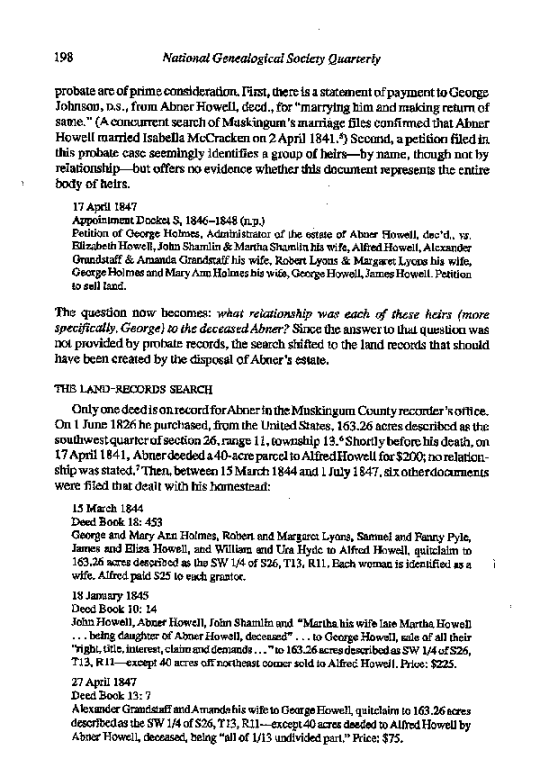
probate are of prime consideration. First, there is a statement of payment to George Johnson, B.S., from Abner Howell, dec’d., for “marrying him and making return of same.” (A concurrent search of Muskingum’s marriage files confirmed that Abner Howell married Isabella McCracken on 2 April 1841.5) Second, a petition filed in his probate case seemingly identifies a group of heirs—by name, though not by relationship—but offers no evidence whether this document represents the entire body of heirs.
17 April 1847
Appointment Docket S, 1846–1848 (n.p.)
Petition of George Holmes, Administrator of the estate of Abner Howell, dec’d., vs. Elizabeth Howell, John Shaulin & Martha Shaulin his wife, Alfred Howell, Alexander Ormiston & Amanda Ormiston his wife, Robert Lyons & Margaret Lyons his wife, George Holmes and Mary Ann Holmes his wife, George Howell, James Howell. Petition to sell land.
The question now becomes: what relationship was each of these heirs (more specifically, George) to the deceased Abner? Since the answer to that question was not provided by probate records, the search shifted to the land records that should have been created by the disposal of Abner’s estate.
THE LAND–RECORDS SEARCH
Only one deed is on record for Abner in the Muskingum County recorder’s office. On 1 June 1826 he purchased, from the United States, 163.26 acres described as the southwest quarter of section 26, range 11, township 13.6 Shortly before his death, on 17 April 1841, Abner deeded a 40-acre parcel to Alfred Howell for $200; no relationship was stated.7 Then, between 15 March 1844 and 1 July 1847, six other documents were filed that dealt with his homestead:
15 March 1844
Deed Book 18: 453
George and Mary Ann Holmes, Robert and Margaret Lyons, Samuel and Fanny Pyle, James and Eliza Howell, and William and Ura Hyre to Alfred Howell, quitclaim to 163.26 acres described as the SW 1/4 of S26, T13, R11. Each woman is identified as a wife. Alfred paid $25 to each grantor.
18 January 1845
Deed Book 10: 14
John Howell, Abner Howell, John Shaulin and “Martha his wife late Martha Howell being daughter of Abner Howell, deceased” … to George Howell, sale of all their “right, title, interest, claim and demands … to 163.26 acres described as SW 1/4 of S26, T13, R11 … except 40 acres off northeast corner sold to Alfred Howell. Price: $225.
27 April 1847
Deed Book 13: 7
Alexander Grandsaff and Amanda his wife to George Howell, quitclaim to 163.26 acres described as the SW 1/4 of S26, T13, R11—except 40 acres deeded to Alfred Howell by Abner Howell, deceased, being “all of 1/13 undivided part.” Price: $75.
Howells: Correlating and Interpreting Evidence
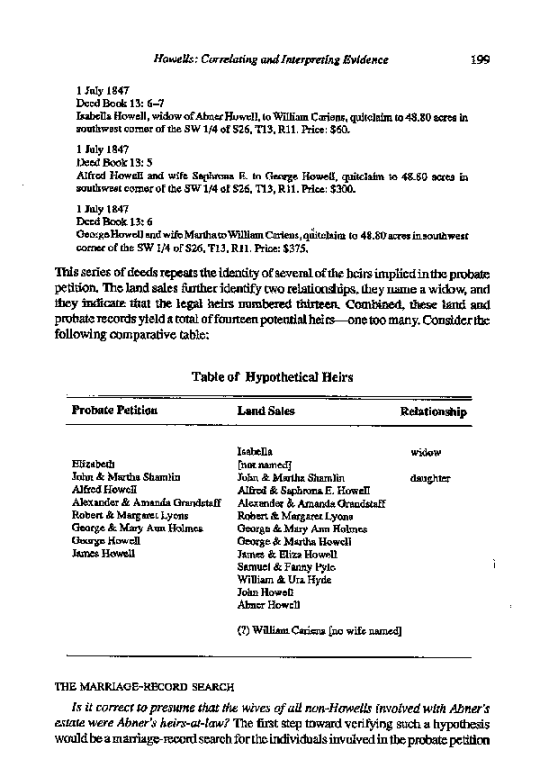
1 July 1847
Deed Book 13: 6–7
Isabella Howell, widow of Abner Howell, to William Crites, quitclaim to 48.80 acres in southwest corner of the SW 1/4 of S26, T13, R11. Price: $50.
1 July 1847
Deed Book 13: 5
Alfred Howell and wife Sophronia E. to George Howell, quitclaim to 48.80 acres in southwest corner of the SW 1/4 of S26, T13, R11. Price: $300.
1 July 1847
Deed Book 13: 6
George Howell and wife Martha to William Crites, quitclaim to 48.80 acres in southwest corner of the SW 1/4 of S26, T13, R11. Price: $375.
This series of deeds repeats the identity of several of the heirs implied in the probate petition. The land sales further identify two relationships, they name a widow, and they indicate that the legal heirs numbered thirteen. Consider: these land and probate records yield a total of fourteen potential heirs—one too many. Consider the following comparative table:
Table of Hypothetical Heirs
| Probate Petition | Land Sales | Relationship |
|---|---|---|
| Elizabeth | Isabella [not named] | widow |
| John & Martha Shaulin | John & Martha Shaulin | daughter |
| Alfred Howell | Alfred & Sophronia E. Howell | |
| Alexander & Amanda Grandsaff | Alexander & Amanda Grandsaff | |
| Robert & Margaret Lyons | Robert & Margaret Lyons | |
| George & Mary Ann Holmes | George & Mary Ann Holmes | |
| George Howell | George & Martha Howell | |
| James Howell | James & Eliza Howell Samuel & Fanny Pyle William & Ura Hyde John Howell Abner Howell (?) William Crites (no wife named) |
THE MARRIAGE–RECORD SEARCH
Is it correct to presume that the wives of all non-Howells involved with Abner’s estate were Abner’s heirs-at-law? The first step toward verifying such a hypothesis would be a marriage-record search for the individuals involved in the probate petition
National Genealogical Society Quarterly
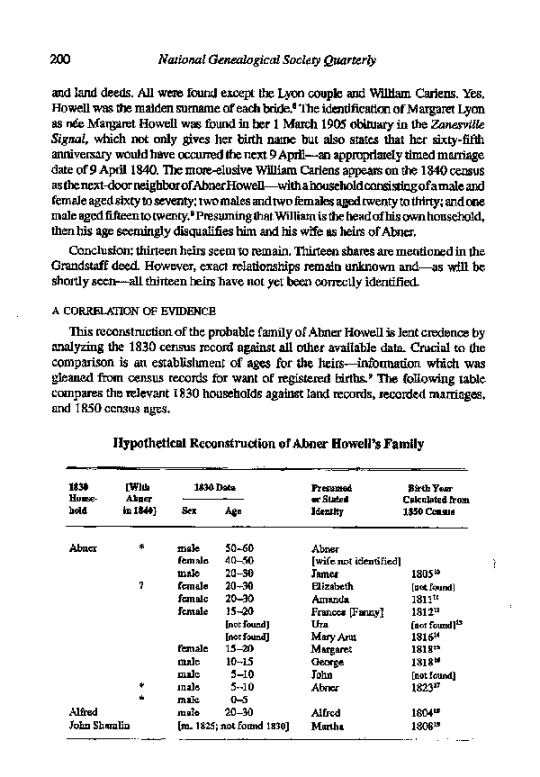
and land deeds. All were found except the Lyon couple and William Crites. Yes, Howell was the maiden surname of each bride.8 The identification of Margaret Lyon as née Margaret Howell was found in her 1 March 1905 obituary in the Zanesville Signal, which not only gives her birth name but also states that her sixty-fifth anniversary would have occurred the next 9 April—an appropriately timed marriage date of 9 April 1840. The more-elusive William Crites appears on the 1840 census as the next-door neighbor of Abner Howell—with a household consisting of a male and female aged sixty to seventy, two males and two females aged twenty to thirty, and one male aged fifteen to twenty.9 Presuming that William is the head of his own household, then his age seemingly disqualifies him and his wife as heirs of Abner.
Conclusion: thirteen heirs seem to remain. Thirteen shares are mentioned in the Grandsaff deed. However, exact relationships remain unknown and—as will be shortly seen—all thirteen heirs have not yet been correctly identified.
A CORRELATION OF EVIDENCE
This reconstruction of the probable family of Abner Howell is lent credence by analyzing the 1830 census record against all other available data. Crucial to the comparison is an establishment of ages for the heirs—information which was gleaned from census records for want of registered births. The following table compares the relevant 1830 households against land records, recorded marriages, and 1850 census ages.
Hypothetical Reconstruction of Abner Howell’s Family
| 1830 House- hold | [Wife Abner in 1844] | 1830 Data Sex Age | Presumed or Stated Identity | Birth Year Calculated from 1850 Census |
|---|---|---|---|---|
| Abner | * | male 50–60 | Abner | |
| female 40–50 | [wife not identified] | |||
| male 20–30 | James | 180510 | ||
| ? | female 20–30 | Elizabeth | [not found] | |
| female 20–30 | Amanda | 181211 | ||
| female 15–20 | Frances [Fanny] | 181212 | ||
| [not found] | Ura | [not found]13 | ||
| not found | Mary Ann | 181614 | ||
| female 15–20 | Margaret | 181815 | ||
| male 10–15 | George | 181816 | ||
| * | male 5–10 | John | [not found] | |
| * | male 5–10 | Abner | 182317 | |
| * | male 0–5 | |||
| Alfred | male 20–30 | Alfred | 180418 | |
| John Shaulin | [m. 1825; not found 1830] | Martha | 180819 |
Howells: Correlating and Interpreting Evidence
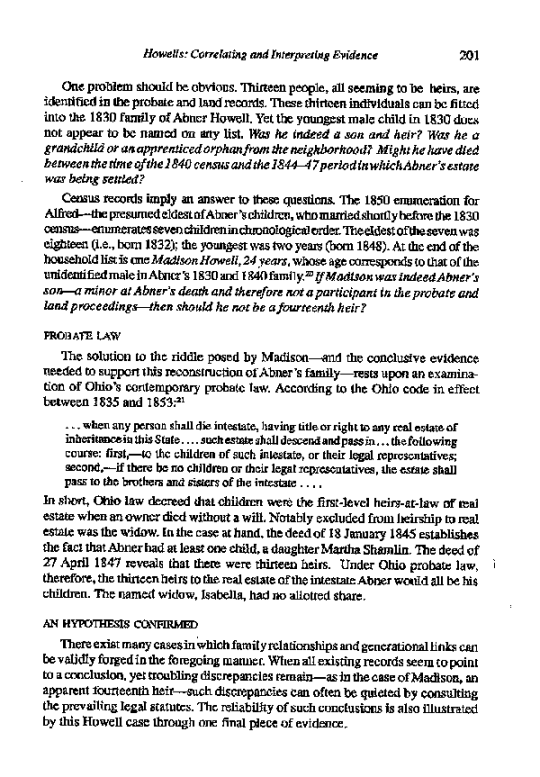
One problem should be obvious. Thirteen people, all seeming to be heirs, are identified in the probate and land records. These thirteen individuals can be fitted into the 1830 family of Abner Howell. Yet, the youngest male child in 1830 does not appear to be named on any list. Was he indeed a son and heir? Was he a grandchild or an apprenticed orphan from the neighborhood? Might he have died between the time of the 1840 census and the 1844–47 period in which Abner’s estate was being settled?
Census records imply an answer to these questions. The 1850 enumeration for Alfred—the presumed eldest of Abner’s children, who married shortly before the 1830 census—enumerates seven children in chronological order. The eldest of the seven was eighteen (i.e., born 1832); the youngest was two years (born 1848). At the end of the household list is one Madison Howell, 29 years, whose age corresponds to that of the unidentified male in Abner’s 1830 and 1840 family. If Madison was indeed Abner’s son—a minor at Abner’s death and therefore not a participant in the probate and land proceedings—then should he not be a fourteenth heir?
PROBATE LAW
The solution to the riddle posed by Madison—and the conclusive evidence needed to support this reconstruction of Abner’s family—rests upon an examination of Ohio’s contemporary probate law. According to the Ohio code in effect between 1835 and 1853:21
. . . when any person shall die intestate, leaving title or right to any real estate of inheritance in this State . . . such estate shall descend and pass in . . . the following course: first,—to the children of such intestate, or their legal representatives; second,—if there be no children or their legal representatives, the estate shall pass to the brothers and sisters of the intestate . . . .
In short, Ohio law decreed that children were the first-level heirs-at-law of real estate when an owner died without a will. Notably excluded from heirship to real estate was the widow. In the case at hand, the deed of 18 January 1845 establishes the fact that Abner had at least one child, a daughter Martha Shaulin. The deed of 27 April 1847 reveals that there were thirteen heirs. Under Ohio probate law, therefore, the thirteen heirs to the real estate of the intestate Abner would all be his children. The named widow, Isabella, had no allotted share.
AN HYPOTHESIS CONFIRMED
There exist many cases in which family relationships and generational links can be validly forged in the foregoing manner. When all existing records seem to point to a conclusion, yet troubling discrepancies remain—as in the case of Madison, an apparent fourteenth heir—such discrepancies can often be quieted by consulting the prevailing legal statutes. The reliability of such conclusions is also illustrated by this Howell case through one final piece of evidence.
National Genealogical Society Quarterly
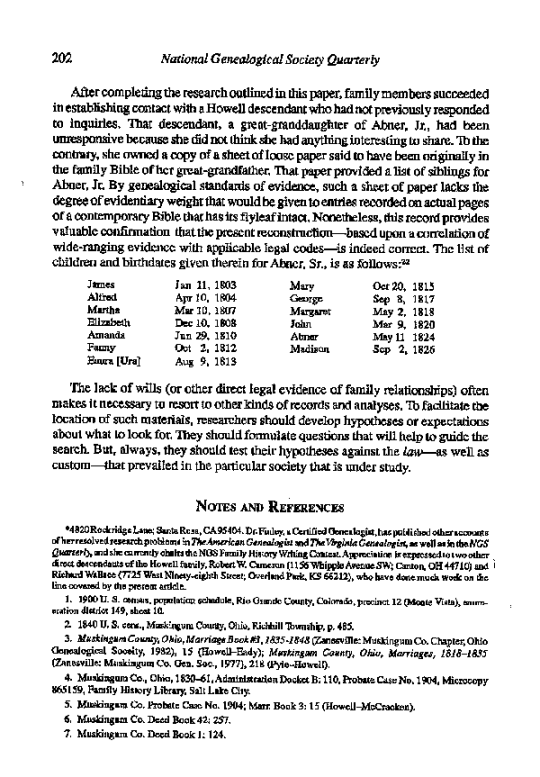
After completing the research outlined in this paper, family members succeeded in establishing contact with a Howell descendant who had not previously responded to inquiries. That descendant, a great-granddaughter of Abner, Jr., had been unresponsive because she did not think she had anything interesting to share. In the contrary, she owned a copy of a sheet of loose paper said to have been originally in the family Bible of her great-grandfather. That paper provided a list of siblings for Abner, Jr. By genealogical standards of evidence, such a sheet of paper lacks the degree of evidentiary weight that would be given to entries recorded on actual pages of a contemporary Bible that has its flyleaf intact. Nonetheless, this record provides valuable confirmation that the present reconstruction—based upon a correlation of wide-ranging evidence with applicable legal codes—is indeed correct. The list of children and birthdates given therein for Abner, Sr., is as follows:22
James Jan 11, 1803
Alfred Apr 10, 1804
Martha Mar 10, 1807
Elizabeth Dec 10, 1808
Amanda Jun 29, 1810
Fanny Oct 2, 1812
Laura [Ura] Aug 9, 1813
Mary Oct 20, 1815
George Sep 8, 1817
Margaret May 2, 1818
John Mar 9, 1820
Abner May 11, 1824
Madison Sep 2, 1826
The lack of wills (or other direct legal evidence of family relationships) often makes it necessary to resort to other kinds of records and analyses. To facilitate the location of such materials, researchers should develop hypotheses or expectations about what to look for. They should formulate questions that will help to guide the search. But, always, they should test their hypotheses against the law—as well as custom—that prevailed in the particular society that is under study.
Notes and References
*4820 Rockridge Lane; Santa Rosa, CA 95404. Dr. Finley, a Certified Genealogist, has published other accounts of her resolved research problems in The American Genealogist and The Virginia Genealogist, as well as in the NGS Quarterly, and she currently chairs the NGS Family History Writing Contest. Appreciation is expressed to two other direct descendants of the Howell family, Robert W. Carreon (1156 Whipple Avenue SW; Canton, OH 44710) and Richard Wilbur (725 West Honeycutt Street; Overland Park, KS 66212), who gave documents which for one line covered by the present article.
- 1900 U. S. census, population schedule, Rio Grande County, Colorado, precinct 12 (Monte Vista), enumeration district 149, sheet 10.
- 1840 U. S. census, Muskingum County, Ohio, Richhill Township, p. 485.
- Muskingum County, Ohio, Marriage Book #3, 1835–1848 (Zanesville: Muskingum Co. Chapter, Ohio Genealogical Society, 1982), 15 (Howell–Early); Marriage County, Ohio, Marriages, 1818–1835 (Zanesville: Muskingum Co. Gen. Soc., 1977), 216 (Pyle–Howell).
- Muskingum Co., Ohio, 1830–61, Administrator Dockets B:110, Probate Case No. 1904, Microcopy 665159, Family History Library, Salt Lake City.
- Muskingum Co., Probate Case No. 1904; Marr. Book 3:15 (Howell–McCracken).
- Muskingum Co. Deed Book 42: 257.
- Muskingum Co. Deed Book 1: 124.
National Genealogical Society Quarterly
After completing the research outlined in this paper, family members succeeded in establishing contact with a Howell descendant who had not previously responded to inquiries. That descendant, a great-granddaughter of Abner, Jr., had been unresponsive because she did not think she had anything interesting to share. In the contrary, she owned a copy of a sheet of loose paper said to have been originally in the family Bible of her great-grandfather. That paper provided a list of siblings for Abner, Jr. By genealogical standards of evidence, such a sheet of paper lacks the degree of evidentiary weight that would be given to entries recorded on actual pages of a contemporary Bible that has its flyleaf intact. Nonetheless, this record provides valuable confirmation that the present reconstruction—based upon a correlation of wide-ranging evidence with applicable legal codes—is indeed correct. The list of children and birthdates given therein for Abner, Sr., is as follows:22
James Jan 11, 1803
Alfred Apr 10, 1804
Martha Mar 10, 1807
Elizabeth Dec 10, 1808
Amanda Jun 29, 1810
Fanny Oct 2, 1812
Laura [Ura] Aug 9, 1813
Mary Oct 20, 1815
George Sep 8, 1817
Margaret May 2, 1818
John Mar 9, 1820
Abner May 11, 1824
Madison Sep 2, 1826
The lack of wills (or other direct legal evidence of family relationships) often makes it necessary to resort to other kinds of records and analyses. To facilitate the location of such materials, researchers should develop hypotheses or expectations about what to look for. They should formulate questions that will help to guide the search. But, always, they should test their hypotheses against the law—as well as custom—that prevailed in the particular society that is under study.
Notes and References
*4820 Rockridge Lane; Santa Rosa, CA 95404. Dr. Finley, a Certified Genealogist, has published other accounts of her resolved research problems in The American Genealogist and The Virginia Genealogist, as well as in the NGS Quarterly, and she currently chairs the NGS Family History Writing Contest. Appreciation is expressed to two other direct descendants of the Howell family, Robert W. Carreon (1156 Whipple Avenue SW; Canton, OH 44710) and Richard Wilbur (725 West Honeycutt Street; Overland Park, KS 66212), who gave documents which for one line covered by the present article.
- 1900 U. S. census, population schedule, Rio Grande County, Colorado, precinct 12 (Monte Vista), enumeration district 149, sheet 10.
- 1840 U. S. census, Muskingum County, Ohio, Richhill Township, p. 485.
- Muskingum County, Ohio, Marriage Book #3, 1835–1848 (Zanesville: Muskingum Co. Chapter, Ohio Genealogical Society, 1982), 15 (Howell–Early); Marriage County, Ohio, Marriages, 1818–1835 (Zanesville: Muskingum Co. Gen. Soc., 1977), 216 (Pyle–Howell).
- Muskingum Co., Ohio, 1830–61, Administrator Dockets B:110, Probate Case No. 1904, Microcopy 665159, Family History Library, Salt Lake City.
- Muskingum Co., Probate Case No. 1904; Marr. Book 3:15 (Howell–McCracken).
- Muskingum Co. Deed Book 42: 257.
- Muskingum Co. Deed Book 1: 124.
Howells: Correlating and Interpreting Evidence
- 1840 U. S. census, Muskingum Co., Richhill Township, p. 485.
- Muskingum’s birth registration began in 1857.
- 1850 U. S. census, pop. sch., Muskingum Co., Highland Twp., p. 422, dwelling 328, family 334.
- 1850 U. S. census, pop. sch., Hocking Co., Ohio, Benton Twp., p. 437, dwell. 190, fam. 192.
- 1850 U. S. census, pop. sch., Vinton Co., Swan Twp., p. 654, dwell. 150, fam. 151.
- On 26 September 1833, Urey Howell married William Hyde; see Muskingum County, Ohio, Marriages, 1818–1835, 218. She has not been located in 1850.
- 1850 U. S. census, pop. sch., Muskingum Co., Hopewell Twp., p. 88, dwell. 259, fam. 259.
- 1850 U. S. census, pop. sch., Muskingum Co., Richhill Twp., p. 480, dwell. 135, fam. 135.
- 1850 U. S. census, pop. sch., Vinton Co., Swan Twp., p. 654, dwell. 152, fam. 153.
- 1850 U. S. census, pop. sch., Guernsey Co., Ohio, p. 480, dwell. 1045, fam. 1356.
- 1850 U. S. census, pop. sch., Muskingum Co., Richhill Twp., p. 484, dwell. 194, fam. 194.
- 1850 U. S. census, pop. sch., Muskingum Co., Perry Twp., p. 305, dwell. 104, fam. 104.
- Ibid.
- Acts of Local Nature, passed at the first session of the State of Ohio, begun and held in the City of Columbus, December 1, 1834 . . . vol. 33 (Columbus: James B. Gardner, 1835), 43.
- Original in possession of Mrs. Mae Morris, Rt. 1, Kimbolton, OH 43749.
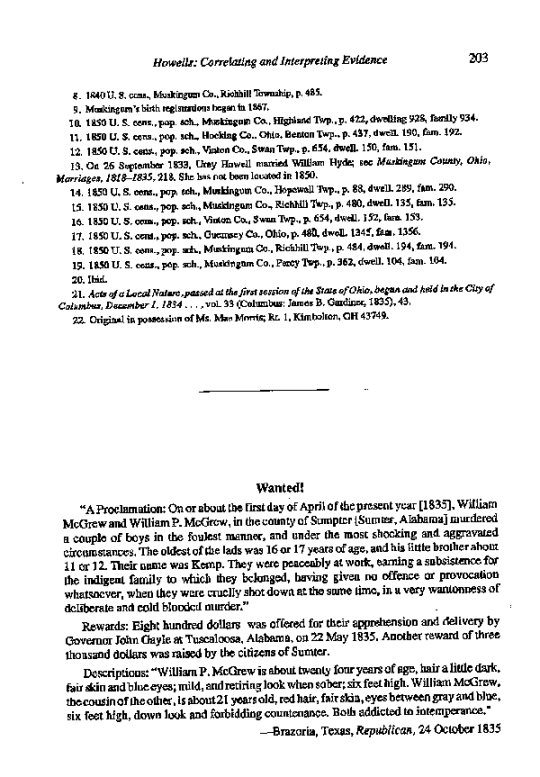
Wanted!
“A Proclamation: On or about the first day of April of the present year [1835], William McGrew and William P. McGrew, in the county of Sumter [Sumter], Alabama, murdered a couple of boys in the foulest manner, and under the most shocking and aggravated circumstances. The oldest of the lads was 16 or 17 years of age, and his little brother about 11 or 12. Their name was Kemp. They were peaceably at work, earning a subsistence for the indigent family to which they belonged, having given no offence or provocation whatsoever, when they were cruelly shot down at the same time, in a very wantonness of deliberate and cold blooded murder.”
Rewards: Eight hundred dollars was offered for their apprehension and delivery by Governor John Gayle at Tuscaloosa, Alabama, on 22 May 1835. Another reward of three thousand dollars was raised by the citizens of Sumter.
Description: “William P. McGrew is about twenty four years of age, hair a little dark, fair skin and blue eyes; mild, unassuming look when sober; six feet high. William McGrew, the cousin of the other, is about 21 years old, red hair, fair skin, eyes between gray and blue, six feet high, down look and forbidding countenance. Both addicted to intemperance.”
—Brazoria, Texas, Republican, 24 October 1835
Howells: Correlating and Interpreting Evidence
- 1840 U. S. census, Muskingum Co., Richhill Township, p. 485.
- Muskingum’s birth registration began in 1857.
- 1850 U. S. census, pop. sch., Muskingum Co., Highland Twp., p. 422, dwelling 328, family 334.
- 1850 U. S. census, pop. sch., Hocking Co., Ohio, Benton Twp., p. 437, dwell. 190, fam. 192.
- 1850 U. S. census, pop. sch., Vinton Co., Swan Twp., p. 654, dwell. 150, fam. 151.
- On 26 September 1833, Urey Howell married William Hyde; see Muskingum County, Ohio, Marriages, 1818–1835, 218. She has not been located in 1850.
- 1850 U. S. census, pop. sch., Muskingum Co., Hopewell Twp., p. 88, dwell. 259, fam. 259.
- 1850 U. S. census, pop. sch., Muskingum Co., Richhill Twp., p. 480, dwell. 135, fam. 135.
- 1850 U. S. census, pop. sch., Vinton Co., Swan Twp., p. 654, dwell. 152, fam. 153.
- 1850 U. S. census, pop. sch., Guernsey Co., Ohio, p. 480, dwell. 1045, fam. 1356.
- 1850 U. S. census, pop. sch., Muskingum Co., Richhill Twp., p. 484, dwell. 194, fam. 194.
- 1850 U. S. census, pop. sch., Muskingum Co., Perry Twp., p. 305, dwell. 104, fam. 104.
- Ibid.
- Acts of Local Nature, passed at the first session of the State of Ohio, begun and held in the City of Columbus, December 1, 1834 . . . vol. 33 (Columbus: James B. Gardner, 1835), 43.
- Original in possession of Mrs. Mae Morris, Rt. 1, Kimbolton, OH 43749.
Wanted!
“A Proclamation: On or about the first day of April of the present year [1835], William McGrew and William P. McGrew, in the county of Sumter [Sumter], Alabama, murdered a couple of boys in the foulest manner, and under the most shocking and aggravated circumstances. The oldest of the lads was 16 or 17 years of age, and his little brother about 11 or 12. Their name was Kemp. They were peaceably at work, earning a subsistence for the indigent family to which they belonged, having given no offence or provocation whatsoever, when they were cruelly shot down at the same time, in a very wantonness of deliberate and cold blooded murder.”
Rewards: Eight hundred dollars was offered for their apprehension and delivery by Governor John Gayle at Tuscaloosa, Alabama, on 22 May 1835. Another reward of three thousand dollars was raised by the citizens of Sumter.
Description: “William P. McGrew is about twenty four years of age, hair a little dark, fair skin and blue eyes; mild, unassuming look when sober; six feet high. William McGrew, the cousin of the other, is about 21 years old, red hair, fair skin, eyes between gray and blue, six feet high, down look and forbidding countenance. Both addicted to intemperance.”
—Brazoria, Texas, Republican, 24 October 1835