

aaa-0026.html
Text Version
TENNESSEE ANCESTORS
A Publication of the East Tennessee Historical Society
VOLUME 9
APRIL 1993
NUMBER 1
CONTENTS:
Tennesseans Found in the Indian-Pioneer Papers of Oklahoma
Mitesiah L. Nored and John R. Lovett ........................................ 3
The Winds of Missouri: The Lands of Venison and Wild Honey
E. V. Smalley .............................................................................. 30
Still No Happy
The John Finley of Knox County, Tennessee
Carmen J. Finley ................................................................. 33
Petitions to the Tennessee State Legislature from Morgan County,
1820-1861
Charles Bohn Henderson ..................................................... 44
Col. Alexander Lowrey: Misjudging the Legend
Jane Gray Buchanan .......................................................... 57
Tennessee Family and Bible Records
Carruthers Family ................................................................. 81
Shaner Family ........................................................................ 82
Gahagan Family ..................................................................... 83
Ramsey Family ....................................................................... 84
David Hatfield Family ............................................................ 85
Harrell-Lochard Family ........................................................ 86
Sartain Family ........................................................................ 87
Orrick Family ......................................................................... 88
Evans Family .......................................................................... 89
Recent Publications of Historical Interest
Elizabeth Jordan .................................................................... 71
Queries ...................................................................................... 77
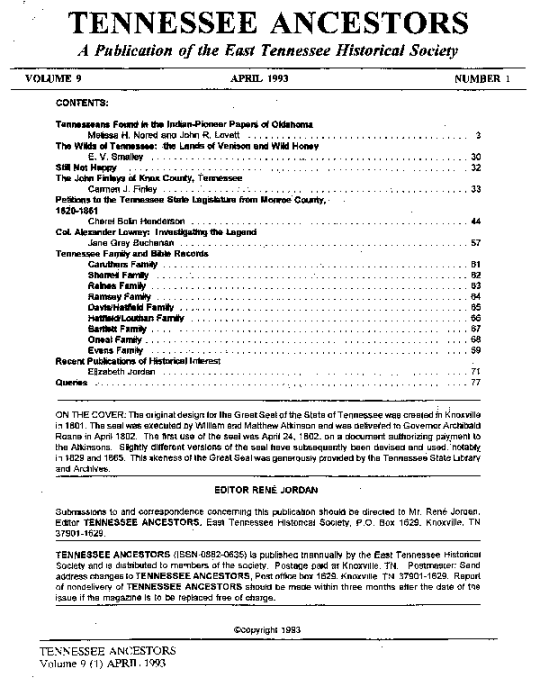
ON THE COVER: The original design for the Great Seal of the State of Tennessee was created in Knoxville in 1801. The seal was executed by William and Matthew Atkinson and delivered to Governor Archibald Roane in April 1802. The first use of the seal was April 24, 1802, on a document authorizing payment to the Atkinsons. Slightly different versions of the seal have subsequently been devised and used; notably in 1829 and 1865. This likeness of the Great Seal was generously provided by the Tennessee State Library and Archives.
EDITOR RENÉ JORDAN
Submissions to and correspondence concerning this publication should be directed to Mr. René Jordan, Editor TENNESSEE ANCESTORS, East Tennessee Historical Society, P.O. Box 1629, Knoxville, TN 37901-1629.
TENNESSEE ANCESTORS (ISSN: 0882-0635) is published biannually by the East Tennessee Historical Society and is distributed to members of the society. Postage paid at Knoxville, TN. Postmaster: Send address changes to TENNESSEE ANCESTORS, Post office box 1629, Knoxville, TN 37901-1629. Report of nondelivery of TENNESSEE ANCESTORS should be made within three months after the date of the issue if the magazines is to be replaced free of charge.
Copyright 1993
TENNESSEE ANCESTORS
Volume 9 (1) APRIL 1993
THE JOHN FINLEYS OF KNOX COUNTY, TENNESSEE
By
Carmen J. Finley, C.G., Ph.D.
Santa Rosa, CA
Most readers have probably experienced the frustration of trying to sort out persons or families with common surnames like Smith, Johnson, Moore, Brown, Miller and the like. While the surname Finley is not quite as common, it does, when combined with the given name “John,” create almost as many challenges and frustrations. There were, for example, 27 (more or less) John Finleys who served in the American Revolution.1
The original impetus for this study of the John Finleys living in Knox County came through the study of six John Finleys living in Augusta County, Virginia, during the mid-to late-1700s. Specifically, a John Finley, suspected of belonging to the Augusta County group, sold his property on Wallace’s Branch of the Holston River in Washington County, Virginia, on 31 October 1792. At that time he was described as “of Knox County, Territory South West of River Ohio.”2 In attempting to trace this John Finley in Knox County, at least two other John Finleys were also discovered living in the area in that general time period. While the John Finley who formerly lived in Washington County could not be positively identified, the study was able to eliminate two of the three and leave one still a viable candidate for the John Finley of primary interest. It also demonstrates a useful set of genealogical research techniques that should be of interest to the family historian who is faced with the problem of sorting persons or families with common given names and surnames.
John Finley Records of Knox County
Records were readily found for several John Finleys in Knox County. A marriage record between John Finley and Margaret Kerr was found 13 November 1793; while another was found between John Finley and Liddy Grove on 12 June 1804.3 Military records were found for the period 1792-1794.4 Tax records were available for the years 1804 through 1812 [except for 1805], indicating there were at least two John Finleys during that period of time. Between 1795 and 1812, there were 21 deeds in which a John Finley was either grantor or grantee. In addition, a John Finley had 78 acres, 2 rods in the District
1 William Hock Frantz, John Finleys in the Revolution (Seattle: Author, 1960).
2 Washington County, VA Deed Book 1:305.
3 Roscoe Carlisle and Virginia Carlisle Arpunda, comps., Knox County Marriage Records, 1792-1900 (Knoxville Family Record Society, 1971), 33.
4 Virgil D. White, Index to Volunteer Soldiers, 1784-1811 (Waynesboro, TN: National Historical Publishing Co., 1987), 218.
5 Knox County, TN Tax Records, Tennessee State Archives, Nashville.
TENNESSEE ANCESTORS
Volume 9 (1) APRIL 1993 —33—
THE JOHN FINLEYS OF KNOX COUNTY, TENNESSEE
South of the French Broad and the Holston Rivers surveyed in 1807 and received a grant in 1810.6 Court records revealed a John Finley as plaintiff in a number of suits between 1794 and 1802, often represented by an “assignee.” He also appeared as a defendant in 1804 and 1806. The first problem was to sort as much of this information as possible into groups which could be associated with a unique individual.
One of the documents, John Hunter vs. John Findly, Jesse Wallace and James Knox, was most helpful in identifying one of the John Finleys as belonging to a group of Finleys in Franklin County, Pennsylvania. It was a land dispute from which the following selected portion has been extracted:
. . . that he [Finley] resided in or about Knoxville the whole of the year 1796 and about the tenth day of March 1797 he left Knoxville and went to Franklin County in Pennsylvania where his father resides, that intending to return to Knoxville had a deposition to purchase. . . .8
Additional research verified this John Finley was the son of James and Jane [Rippey] Finley of Greene Township [formerly Letterkenny township] in Franklin County [formerly Cumberland County]. Important relationships were established which enabled the various land purchases and sales in Knox County to be separated. Two of John’s sisters had married men also involved in a number of the Knox County deeds. Elizabeth had married Stephen Duncan and Isabel had married James Galbraith, as stated in James Finley’s will of 9 July 1809.9 In addition, Patrick Jack, with whom John had a number of Knox County dealings, was his uncle-in-law, having married Martha Finley, his father’s sister [according to the will of James [father, John, 9 August 1783]10 and other documents]. Of the three identifiable Knox County John Finleys, he was the only one for which significant family ties could be proved. They will be presented following his general methodology section.
Of the 21 deeds in Knox County involving a John Finley as a grantor or grantee, 12 also involved one or more of the Franklin County relatives [i.e. Patrick Jack, and/or son, John Finley Jack, Stephen Duncan or James Galbraith]. Three of these were lots in and around the town of Knoxville. An additional two grantee deeds involved lots in or around Knoxville and most likely belong to this John Finley, since that was one of the known areas where he was typically buying. These lots were sold [three by the Sheriff] between 1802
6 Tennessee Land Grants, 1801-1814, vol. 3, grant #1790, LDS film #1012794.
7 Knox County, TN General Index to County Court Minutes, p. 69, 70.
8 Knox County, TN Deed Book N, vol. 1:149-156.
9 Franklin County, PA Will Book C:76.
10 Franklin County, PA Will Book D:38.
TENNESSEE ANCESTORS
Volume 9 (1) APRIL 1993 —34—
THE JOHN FINLEYS OF KNOX COUNTY, TENNESSEE
and 1812.11 Notice was found in the Knoxville Gazette of sale of lots in Knoxville belonging to John Finley on 15 August 1804 for unpaid taxes.12 Stephen Duncan, brother-in-law of the Franklin County John Finley, suffered the same fate 7 February 1807, regarding property in Anderson County.13 In addition, the Knoxville Gazette carried notices of letters remaining in the Knoxville Post Office for John Finley on 16 April 1800, and for John Finley and Stephen Duncan on 1 January 1801.14 The Hunter vs. Findly et al suit was dated 14 October 1807, but referred retroactively to John’s being in Knoxville all of 1796, but having left about 10 March 1797.15 So it would seem that the Franklin County John Finley was pretty much gone at the turn of the century although the disposal of his property continued until 1812. That left only three other transactions to be accounted for.
Four hundred acres on the Holston River on the West Fork of Third Creek, belonging to a Samuel and John Finley were sold for debt on 28 January 1799.16 This property had been granted by North Carolina to Thomas King. No other mention of a Samuel and John Finley pair has been found in Knox County, although the Franklin County John did have an older brother, Samuel.17 Since Third Creek is located just west of downtown Knoxville, it seems likely this transaction can also be ascribed to the Franklin County John Finley.
On 24 January 1799, a John Finley bought 400 acres on Wool River from Thomas Dix.18 This property was described as being part of a 1000 acre tract from Francis Mayberry to Thomas Dix. This property proved illusive since there is no Wool River, or any name resembling it in Knox County. However, a deed from Thomas Dix to Francis Mayberry, witnessed by a John Finley, for 200 acres in the “Middle District on Wolf River,” was found in Knox County records.19 Wolf River is today in Pickett County and north
11 Knox County, TN Court Minutes carried notices of delinquent taxes for John Finley in 1803, 1804, and 1806; Books 4:151, 4:173, 4:260, 5:79.
12 Brenda K. Edlemon, Genealogical Abstracts from Tennessee Newspapers, 1791-1808 (Bowie, MD: Heritage Books, 1988), 290.
13 Ibid., 296.
14 Ibid., 295, 206.
15 Knox County, TN Deed Book N, vol. 1:149.
16 Knox County, TN Deed Book E2, vol. 1:496.
17 Named in father’s will, Franklin County, PA Will Book C:76.
18 Knox County, TN Deed Book E2, vol. 1:149.
19 Knox County, TN Deed Book E2, vol. 2:234.
TENNESSEE ANCESTORS
Volume 9 (1) APRIL 1993 —35—
THE JOHN FINLEYS OF KNOX COUNTY, TENNESSEE
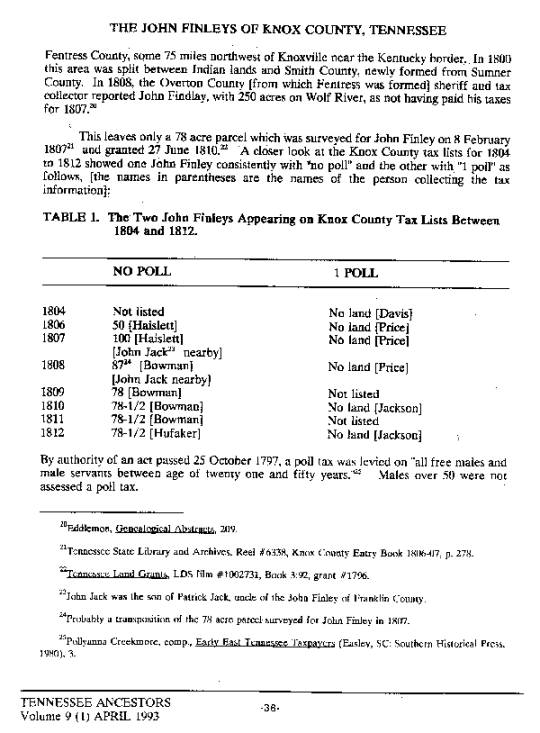
Fentress County, some 75 miles northwest of Knoxville near the Kentucky border. In 1800 this area was split between Indian lands and Smith County, newly formed from Sumner County. In 1808, the Overton County [from which Fentress was formed], sheriff and tax collector reported John Findlay, with 250 acres on Wolf River, as not having paid his taxes for 1807.20
This leaves only a 78 acre parcel which was surveyed for John Finley on 8 February 180721 and granted 27 June 1810.22 A closer look at the Knox County tax lists for 1804 to 1812 showed one John Finley consistently with “no poll” and the other with “1 poll” as follows, [the names in parentheses are the names of the person collecting the tax information]:
TABLE 1. The Two John Finleys Appearing on Knox County Tax Lists Between 1804 and 1812.
| NO POLL | 1 POLL |
|---|---|
| 1804 Not listed | No land [Davis] |
| 1806 50 [Haislett] | No land [Price] |
| 1807 100 [Haislett] [John Jack] nearby 8724 [Bowman] [John Jack] nearby | No land [Price] |
| 1808 | No land [Price] |
| 1809 78 [Bowman] | Not listed |
| 1810 78-1/2 [Bowman] | No land [Jackson] |
| 1811 78-1/2 [Bowman] | Not listed |
| 1812 78-1/2 [Huffaker] | No land [Jackson] |
By authority of an act passed 25 October 1797, a poll tax was levied on “all free males and male servants between the age of twenty one and fifty years.”25 Males over 50 were not assessed a poll tax.
20 Edlemon, Genealogical Abstracts, 201.
21 Tennessee State Library and Archives, Reel #6339, Knox County Entry Book 1816-47, p. 278.
22 Tennessee Land Grants, LDS film #1012733, Book 3:92, grant #1796.
23 John Jack was the son of Patrick Jack, uncle of the John Finley of Franklin County.
24 Probably a transposition of the 78 acre parcel surveyed for John Finley in 1807.
25 Pollyanna Creekmore, comp., Early East Tennessee Taxpayers (Easley, SC: Southern Historical Press, 1990), 3.
TENNESSEE ANCESTORS
Volume 9 (1) APRIL 1993 —36—
THE JOHN FINLEYS OF KNOX COUNTY, TENNESSEE
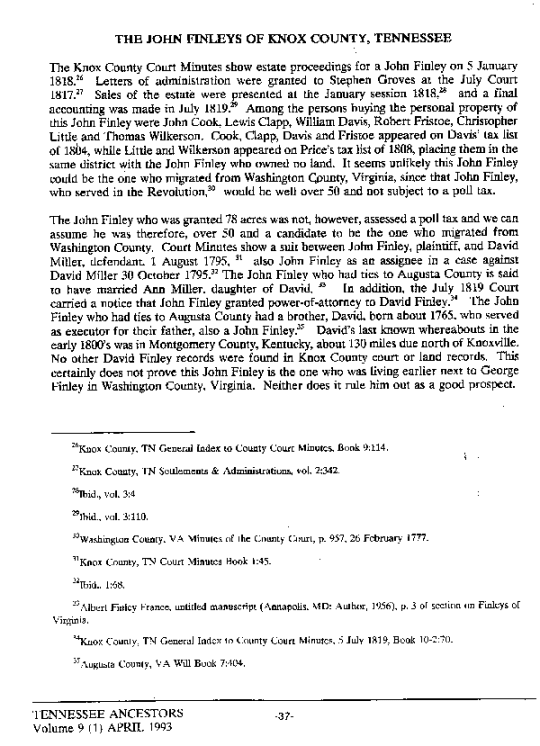
The Knox County Court Minutes show estate proceedings for a John Finley on 5 January 1818.26 Letters of administration were granted to Stephen Groves at the July Court 1817.27 Sales of the estate were presented at the January session 1818,28 and a final accounting was made in July 1819.29 Among the persons buying the personal property of this John Finley were John Cook, Lewis Clapp, William Davis, Robert Friscoe, Christopher Little and Thomas Wilkerson. Cook, Clapp, Davis and Friscoe appeared on Davis’ tax list of 1804, while Little and Wilkerson appeared on Price’s tax list of 1806, placing them in the same district with the John Finley who owned no land. It seems unlikely this John Finley could be the one who migrated from Washington County, Virginia, since that John Finley, who served in the Revolution,30 would be well over 50 and not subject to a poll tax.
The John Finley who was granted 78 acres was not, however, assessed a poll tax and we can assume he was therefore, over 50 and a candidate to be the one who migrated from Washington County. Court Minutes show a suit between John Finley, plaintiff, and David Miller, defendant, 1 August 1795,31 also John Finley as an assignee in a case against David Miller 30 October 1795.32 The John Finley who had ties to Augusta County is said to have married Ann Miller, daughter of David.33 In addition, the July 1819 Court carried a notice that John Finley granted power-of-attorney to David Finley.34 The John Finley who had ties to Augusta County had a brother, David, born about 1765, who served as executor for their father, also a John Finley.35 David’s last known whereabouts in the early 1800’s was in Montgomery County, Kentucky, about 130 miles due north of Knoxville. No other David Finley records were found in Knox County court or land records. This certainly does not prove this John Finley is the one who was living earlier next to George Finley in Washington County, Virginia. Neither does it rule him out as a good prospect.
26 Knox County, TN General Index to County Court Minutes, Book 9:114.
27 Knox County, TN Settlements & Administrations, vol. 2:342.
28 Ibid., vol. 3:34.
29 Ibid., vol. 3:110.
30 Washington County, VA Minutes of the County Court, p. 957, 26 February 1777.
31 Knox County, TN Court Minutes Book 1:45.
32 Ibid., 1:68.
33 Albert Finley France, untitled manuscript (Annapolis, MD: Author, 1956), p. 3 of section on Finleys of Virginia.
34 Knox County, TN General Index to County Court Minutes, 5 July 1819, Book 10:2-70.
35 Augusta County, VA Will Book 7:404.
TENNESSEE ANCESTORS
Volume 9 (1) APRIL 1993 —37—
THE JOHN FINLEYS OF KNOX COUNTY, TENNESSEE
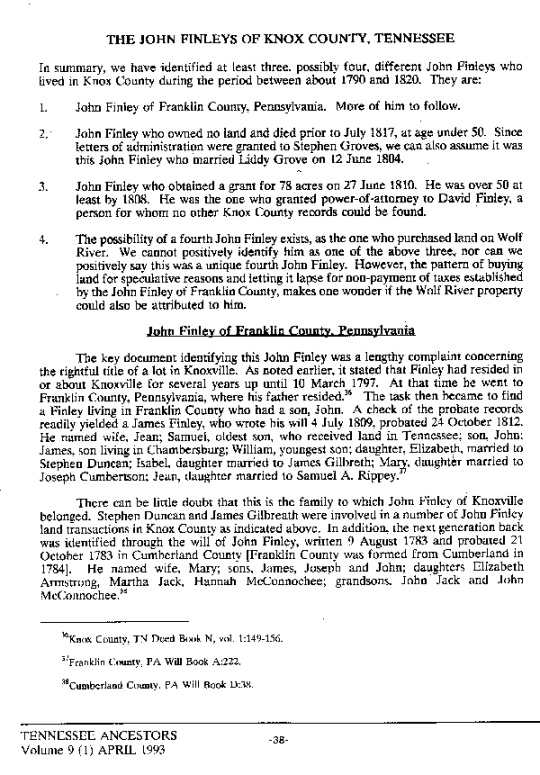
In summary, we have identified at least three, possibly four, different John Finleys who lived in Knox County during the period between about 1790 and 1820. They are:
1. John Finley of Franklin County, Pennsylvania. More of him to follow.
2. John Finley who owned no land and died prior to July 1817, at age under 50. Since letters of administration were granted to Stephen Groves, we can also assume it was this John Finley who married Liddy Grove on 12 June 1804.
3. John Finley who obtained a grant for 78 acres on 27 June 1810. He was over 50 at least by 1808. He was the one who granted power-of-attorney to David Finley, a person for whom no other Knox County records could be found.
4. The possibility of a fourth John Finley exists, as the one who purchased land on Wolf River. We cannot positively identify him as one of the above three, nor can we positively say this was a unique fourth John Finley. However, the pattern of buying land for speculative reasons and letting it lapse for non-payment of taxes established by the John Finley of Franklin County, makes one wonder if the Wolf River property could also be attributed to him.
John Finley of Franklin County, Pennsylvania
The key document identifying this John Finley was a lengthy complaint concerning the rightful title of a lot in Knoxville. As noted earlier, it stated that Finley had resided in or about Knoxville for several years up until 10 March 1797. At that time he went to Franklin County, Pennsylvania, where his father resided.36 The task then became to find a John Finley living in Franklin County who had a son, John. A check of the probate records readily yielded a James Finley, who wrote his will 4 July 1809, probated 24 October 1812. He named wife, Jean; Samuel, oldest son, who received land in Tennessee; son, John; James, son living in Chambersburg; William, youngest son; daughter, Elizabeth, married to Stephen Duncan; Isabel, daughter married to James Gilbreth; Mary, daughter married to Joseph Cumberson; Jean, daughter married to Samuel A. Rippey.37
There can be little doubt that this is the family to which John Finley of Knoxville belonged. Stephen Duncan and James Gilbreath were involved in a number of John Finley land transactions in Knox County as indicated above. In addition, the next generation back was identified through the will of John Finley, written 9 August 1783 and probated 21 October 1783 in Cumberland County [Franklin County was formed from Cumberland in 1784]. He named wife, Mary; sons, James, Joseph and John; daughters Elizabeth Armstrong, Martha Jack, Hannah McConnochee; grandsons, John Jack and John McConnochee.38
36 Knox County, TN Deed Book N, vol. 1:149-156.
37 Franklin County, PA Will Book A:222.
38 Cumberland County, PA Will Book 1:38.
TENNESSEE ANCESTORS
Volume 9 (1) APRIL 1993 —38—
THE JOHN FINLEYS OF KNOX COUNTY, TENNESSEE
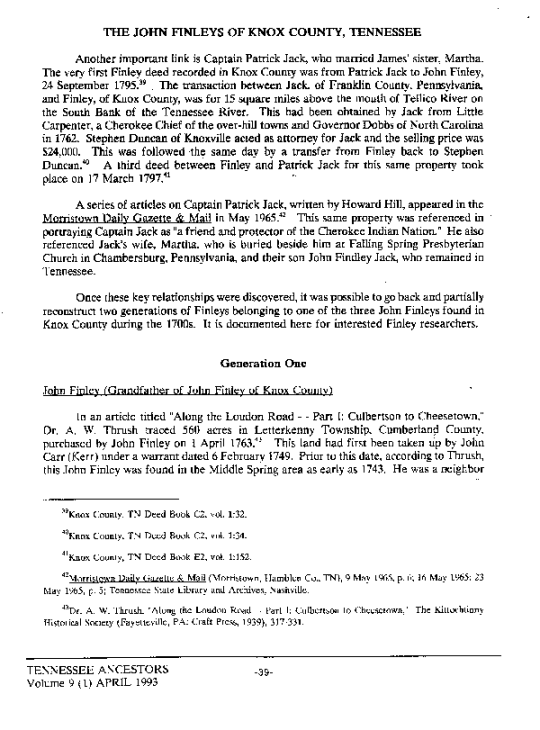
Another important link is Captain Patrick Jack, who married James’ sister, Martha. The very first Finley deed recorded in Knox County was from Patrick Jack to John Finley, 24 September 1795.39 The transaction between Jack, of Franklin County, Pennsylvania, and Finley, of Knox County, was for 15 square miles above the mouth of Tellico River on the South Bank of the Tennessee River. This had been obtained by Jack from Little Carpenter, a Cherokee Chief of the over-hill towns and Governor Dobbs of North Carolina in 1762. Stephen Duncan of Knoxville acted as attorney for Jack and the selling price was $24,000. This was followed the same day by a transfer from Finley back to Stephen Duncan.40 A third deed between Finley and Patrick Jack for this same property took place on 17 March 1797.41
A series of articles on Captain Patrick Jack, written by Howard Hill, appeared in the Morristown Daily Gazette & Mail in May 1965.42 This same property was referenced in portraying Captain Jack as a friend and protector of the Cherokee Indian Nation. He also referenced Jack’s wife, Martha, who is buried beside him at Falling Spring Presbyterian Church in Chambersburg, Pennsylvania, and their son John Findley Jack who remained in Tennessee.
Once these key relationships were discovered, it was possible to go back and partially reconstruct two generations of Finleys belonging to one of the three John Finleys found in Knox County during the 1790s. It is documented here for interested Finley researchers.
Generation One
John Finley (Grandfather of John Finley of Knox County)
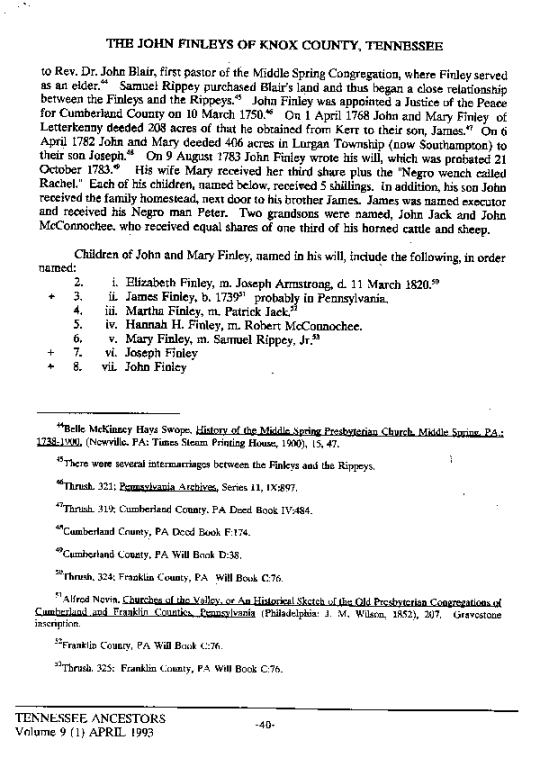
In an article titled “Along the Loudon Road -- Part I: Culbertson to Cheesetown,” Dr. A. W. Thrush stated 560 acres in Letterkenny Township, Cumberland County, purchased by John Finley on 1 April 1763.43 This land had first been taken up by John Carr (Kerr) under a warrant dated 6 February 1749. Prior to this date, according to Thrush, this John Finley was found in the Middle Spring area as early as 1743. He was a neighbor
39 Knox County, TN Deed Book C2, vol. 1:32.
40 Knox County, TN Deed Book C2, vol. 1:34.
41 Knox County, TN Deed Book E2, vol. 1:152.
42 Morristown Daily Gazette & Mail (Morristown, Hamblen Co., TN) 9 May 1965, p. 1; 15 May 1965, p. 5; Tennessee State Library and Archives, Nashville.
43 Dr. A. W. Thrush, “Along the Loudon Road -- Part I: Culbertson to Cheesetown,” The Kittochtinny Historical Society (Fayetteville, PA: Craft Press, 1939), 317-331.
TENNESSEE ANCESTORS
Volume 9 (1) APRIL 1993 —39—
THE JOHN FINLEYS OF KNOX COUNTY, TENNESSEE
Generation Two
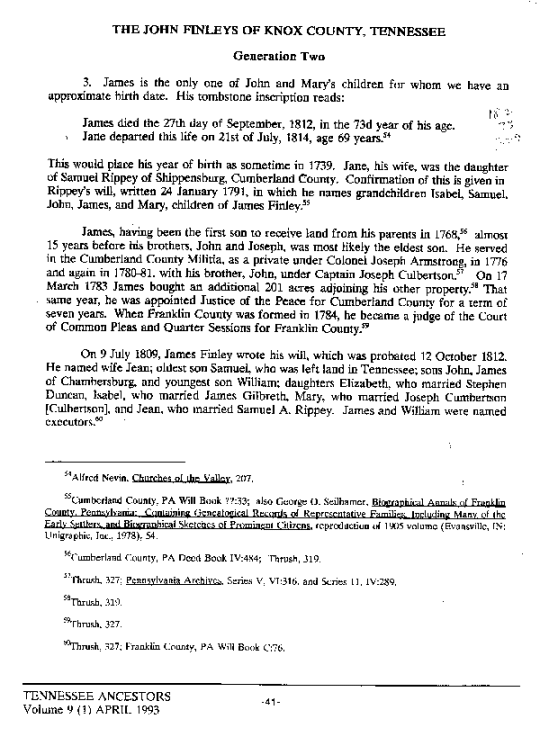
3. James is the only one of John and Mary’s children for whom we have an approximate birth date. His tombstone inscription reads:
James died the 27th day of September, 1812, in the 73d year of his age.
Jane departed this life on 21st of July, 1814, age 69 years.54
This would place his year of birth as sometime in 1739. Jane, his wife, was the daughter of Samuel Rippey of Shippensburg, Cumberland County. Confirmation of this is given in Rippey’s will, written 24 January 1791, in which he names grandchildren Isabel, Samuel, John, James, and Mary, children of James Finley.55
James, having been the first son to receive land from his parents in 1768,56 almost 15 years before his brothers, John and Joseph, was most likely the eldest son. He served in the Cumberland County Militia, as a private under Colonel Joseph Armstrong, in 1776 and again in 1780-81 with his brother, John, under Captain Joseph Culbertson.57 On 17 March 1783 James bought an additional 201 acres adjoining his other property.58 That same year, he was appointed Justice of the Peace for Cumberland County for a term of seven years. When Franklin County was formed in 1784, he became a judge of the Court of Common Pleas and Quarter Sessions for Franklin County.59
On 9 July 1809, James Finley wrote his will, which was probated 12 October 1812. He named wife Jean; oldest son Samuel, who was left land in Tennessee; sons John, James of Chambersburg, and youngest son William; daughters Elizabeth, who married Stephen Duncan, Isabel, who married James Gilbreth, Mary, who married Joseph Cumberson [Culbertson], and Jean, who married Samuel A. Rippey. James and William were named executors.60
54 Alfred Nevin, Churches of the Valley, 207.
55 Cumberland County, PA Will Book Y:33; also George O. Seilhamer, Biographical Annals of Franklin County, Pennsylvania: Containing Genealogical Records and Representative Families, Including Many of the Early Settlers, and Biographical Sketches of Prominent Citizens, reproduction of 1905 volume (Evansville, IN: Unigraphic, Inc., 1978), 54.
56 Cumberland County, PA Deed Book IV:484; Thrush, 319.
57 Thrush, 327; Pennsylvania Archives, Series V, VI:316, and Series II, IV:289.
58 Thrush, 319.
59 Thrush, 327.
60 Thrush, 327; Franklin County, PA Will Book C:76.
TENNESSEE ANCESTORS
Volume 9 (1) APRIL 1993 —41—
THE JOHN FINLEYS OF KNOX COUNTY, TENNESSEE
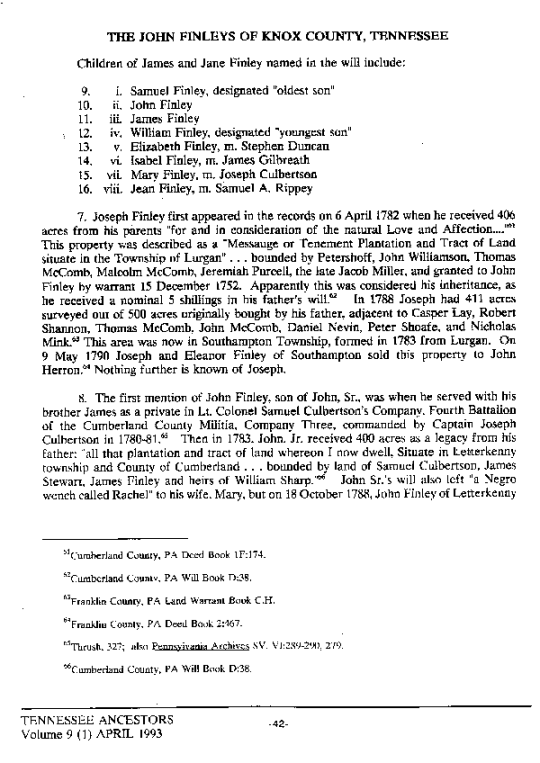
Children of James and Jane Finley named in the will include:
9. i. Samuel Finley, designated “oldest son”
10. ii. John Finley
11. iii. James Finley
12. iv. William Finley, designated “youngest son”
13. v. Elizabeth Finley, m. Stephen Duncan
14. vi. Isabel Finley, m. James Gilbreath
15. vii. Mary Finley, m. Joseph Culbertson
16. viii. Jean Finley, m. Samuel A. Rippey
7. Joseph Finley first appeared in the records on 6 April 1782 when he received 406 acres from his parents “for and in consideration of the natural Love and Affection....” This property was described as a “Messuage or Tenement Plantation and Tract of Land situate in the Township of Lurgan” . . . bounded by Petershoff, John Williamson, Thomas McComb, Malcolm McComb, Jeremiah Purcel, and the Jacob Miller, and granted to John Finley by warrant 15 December 1752. Apparently this was considered his inheritance, as he received a nominal 5 shillings in his father’s will.61 In 1788 Joseph had 411 acres surveyed out of 500 acres originally bought by his father, adjacent to Casper Lay, Robert Shannon, Thomas McComb, John McComb, Daniel Nevin, Peter Shoafe, and Nicholas Mink.62 This area was now in Southampton Township, formed in 1783 from Lurgan. On 9 May 1790 Joseph and Eleanor Finley of Southampton sold this property to John Herron.63 Nothing further is known of Joseph.
8. The first mention of John Finley, son of John, Sr., was when he served with his brother James as a private in Lt. Colonel Samuel Culbertson’s Company, Fourth Battalion of the Cumberland County Militia, Company Three, commanded by Captain Joseph Culbertson in 1780-81.64 Then in 1783, John, Jr. received 400 acres as a legacy from his father: “all that plantation and tract of land whereon I now dwell, situate in Letterkenny township and County of Cumberland . . . bounded by land of Samuel Culbertson, James Stewart, James Finley and heirs of William Sharp....” John Sr.’s will also left “a Negro wench called Rachel” to his wife, Mary, but on 18 October 1783, John Finley of Letterkenny
61 Cumberland County, PA Deed Book I:174.
62 Cumberland County, PA Will Book B:38.
63 Franklin County, PA Land Warrant Book C:H.
64 Franklin County, PA Deed Book 2:467.
65 Thrush, 327; also Pennsylvania Archives V, VI:239-240, 270.
66 Cumberland County, PA Will Book D:38.
TENNESSEE ANCESTORS
Volume 9 (1) APRIL 1993 —42—
THE JOHN FINLEYS OF KNOX COUNTY, TENNESSEE
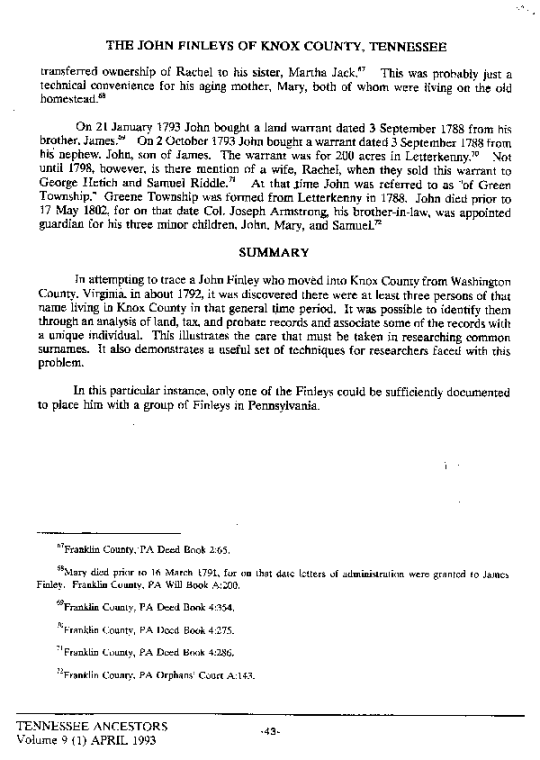
transferred ownership of Rachel to his sister, Martha Jack.67 This was probably just a technical convenience for his aging mother, Mary, both of whom were living on the old homestead.68
On 21 January 1793 John bought a land warrant dated 3 September 1788 from his brother, James.69 On 2 October 1793 John bought a warrant dated 3 September 1788 from his nephew, John, son of James. The warrant was for 200 acres in Letterkenny.70 Not until 1798, however, is there mention of a wife, Rachel, when they sold this warrant to George Lietch and Samuel Riddle.71 At that time John was referred to as “of Green Township.” Green Township was formed from Letterkenny in 1788. John died prior to 17 May 1802, for on that date Col. Joseph Armstrong, his brother-in-law, was appointed guardian for his three minor children, John, Mary, and Samuel.72
SUMMARY
In attempting to trace a John Finley who moved into Knox County from Washington County, Virginia, in about 1792, it was discovered there were at least three persons of that name living in Knox County in that general time period. It was possible to identify them through an analysis of land, tax, and probate records and associate some of the records with a unique individual. This illustrates the care that must be taken in researching common surnames. It also demonstrates a useful set of techniques for researchers faced with this problem.
In this particular instance, only one of the Finleys could be sufficiently documented to place him with a group of Finleys in Pennsylvania.
67 Franklin County, PA Deed Book 2:65.
68 Mary died prior to 14 March 1791, for on that date letters of administration were granted to James Finley. Franklin County, PA Will Book A:200.
69 Franklin County, PA Deed Book 4:354.
70 Franklin County, PA Deed Book 4:275.
71 Franklin County, PA Deed Book 4:286.
72 Franklin County, PA Orphans’ Court A:143.
TENNESSEE ANCESTORS
Volume 9 (1) APRIL 1993 —43—