

aaa-0029.html
Text Version
NATIONAL GENEALOGICAL SOCIETY QUARTERLY
Volume 77
September 1989
Number 3
Identifying the Revolutionary Soldier:
James Downing of Lincoln County, Virginia (Kentucky)
By Carmen J. Finley*
The ongoing efforts of patriotic lineage organizations have done much to clarify and correct American lineages. Still, errors exist and “approved” lines. Most often they are created by a too-casual attempt to establish origins, parentage, or service for a man with a relatively common name. Such confusion has occurred between two James Downings (also spelled “Downey” and “Downing”). One man of this name, born in 1750 (origins unstated), died 23 September 1822 in Stark County, Ohio; he is listed by the Ohio Society, Daughters of the American Revolution, as a captain of the Lincoln Militia in Clark’s Illinois Regiment.1 Yet within Lincoln County, Virginia (later Kentucky), there existed another James Downing, who died elsewhere in Kentucky on 17 October 1811.2 This second James is well documented in the Dix River area of Kentucky at the time that the Lincoln Militia accompanied General George Rogers Clark on his expedition against the Shawnee, 24 October to 24 November 1782.3 The identities of these two James Downings have been confused by prior researchers.
The purpose of this paper is to document the movements of these two men and thus identify the holder of the legitimate claim to Revolutionary service in Clark’s Shawnee campaign. It will be shown that: (1) the campaign centered in the area of Lincoln County, Kentucky, (despite Clark’s designation as head of an Illinois regiment) and that the Lincoln Militia, at the time of its 1782 action, was composed of men who actually lived in Lincoln County; (2) the James Downing who served as that unit’s captain was a well-known Lincoln citizen who had come there from Montgomery County (now Wythe), Virginia; and (3) the James Downing who died in Stark County, Ohio—presently credited with the Lincoln captaincy—lived at that time in Washington County, Pennsylvania, where he saw Revolutionary service in a company captained by his brother.
170
National Genealogical Society Quarterly
GEORGE ROGERS CLARK AND KENTUCKY IN 1782
The correct identification of a Revolutionary soldier must always consider the nature of the campaign and the composition of the unit which saw that service. Dale Van Every’s Company of Heroes: The American Frontier, 1775–1783 provides a useful discussion which places the 1782 Clark expedition in perspective. He states:
Kentucky’s sole organized defense in 1782, aside from emergency musters of local militia, depended upon Clark’s Fort Nelson garrison at Louisville, consisting of militia serving under term enlistments. There was increasingly bitter criticism of his failure to establish forts also at the mouths of the Kentucky, the Licking, and the Limestone to block the main Indian invasion routes.
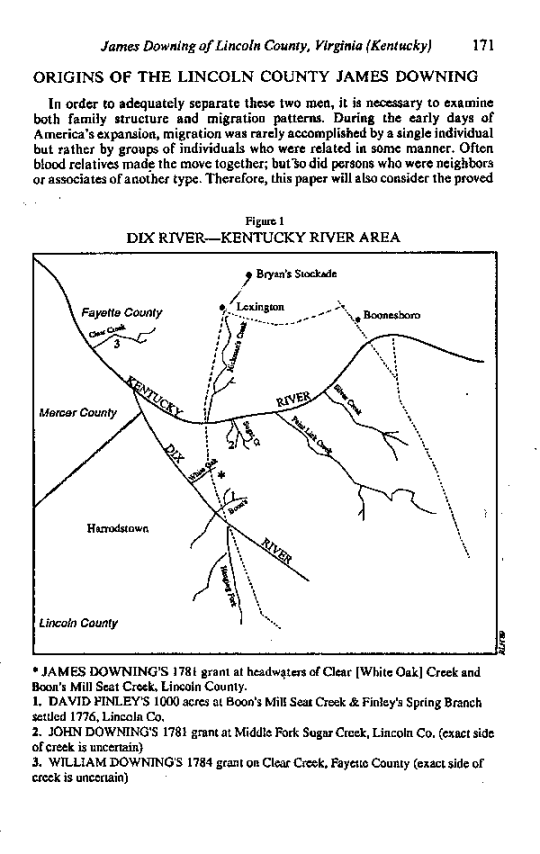
Local concern gained momentum after the British attack of Bryan’s stockade (see figure 1) in August 1782, led by William Caldwell. Caldwell’s troops consisted of 50 men selected from the Tory Rangers and 300 Indians. After a two-day siege, Caldwell withdrew up the buffalo trace across the Licking to Blue Licks, where he positioned himself for inevitable pursuit. Reinforcements of 182 men arrived at Bryan’s the next day, the pursuit was launched prematurely, and they were badly defeated at Blue Licks. Seventy-seven Kentuckians were killed—and buried three days later when reinforcements arrived on the scene. According to Van Every, “Kentucky was stunned.”5
Other Indian attacks continued throughout the summer, prompting Daniel Boone to write Governor Benjamin Harrison, “Our Number of Militia decreases Our Widows & Orphants are numerous Our Officers & worthiest Men fall a Sacrafise.”6 Finally, the settlers took their own action, as Van Every reports:
In November, Clark found his fellow Kentuckians so exercised by the Indian victories of the summer that virtually every man who owned a horse and a rifle volunteered for a surprise invasion of the Shawnee country. His advance, with 1050 mounted riflemen was too rapid to allow the Shawnee time to summon assistance from their allies. They, therefore, refused battle and lost only 7 killed and 7 captured, but their principal towns were destroyed, together with an important English supply center on the upper Miami and most of the Shawnee winter food supply.7
It is clear from the preceding accounts that the Lincoln militiamen whom Clark led against the Shawnee were residents of the Bryan’s Stockade-Blue Licks area of Kentucky—shown on the accompanying map of the Dix River–Kentucky River area (figure 1). Other documentary evidence exists to support that conclusion. A list of thirty-eight men who served in Captain James Downing’s company of Lincoln militia has been well documented by the Kentucky Historical Society.8 At least twenty-nine of those are proved owners of land within a small Lincoln County neighborhood in which there also resided a well-known landowner named James Downing.9 The question now exists: which James Downing was he—the previously credited James who died in Stark County, Ohio, in 1822 or the man of the same name who died in Kentucky in 1811?
James Downing of Lincoln County, Virginia (Kentucky)
171
ORIGINS OF THE LINCOLN COUNTY JAMES DOWNING
In order to adequately separate these two men, it is necessary to examine both family structure and migration patterns. During the early days of America’s expansion, migration was rarely accomplished by a single individual but rather by groups of individuals who were related in some manner. Often blood relatives made the move together, but so did persons who were neighbors or associates of another type. Therefore, this paper will also consider the proved
Figure 1
DIX RIVER—KENTUCKY RIVER AREA
* JAMES DOWNING’S 1781 grant at headwaters of Clear [White Oak] Creek and Boone’s Mill Seat Creek, Lincoln County.
1. DAVID PINLEY’S 1000 acres at Boone’s Mill Seat Creek & Finley’s Spring Branch settled 1776, Lincoln Co.
2. JOHN DOWNING’S 1781 grant at Middle Fork Sugar Creek, Lincoln Co. (exact side of creek is uncertain)
3. WILLIAM DOWNING’S 1784 grant on Clear Creek, Fayette County (exact side of creek is uncertain)
172
National Genealogical Society Quarterly
and alleged relatives and in-laws of both James Downings—particularly, for James Downing of Kentucky and Virginia: brothers William, John, Andrew, and Ezekiel Downing; and for James Downing of Ohio, Virginia, and Pennsylvania: Timothy, John, and Robert Downing, also brothers. Additionally, for the first James it is also important to consider his close associate David Finley, who came to Lincoln from Montgomery County, Virginia, and whose son married James’s daughter.10 As will be shown, the association of the Downing-Finley families in Virginia and Kentucky spanned some fifty years.
The Downings in Southwest Virginia
The identity of the Lincoln County James is best presented by beginning with the earliest document found for him to date, the will of John Downing, father of James, William, John, Andrew, and Ezekiel. Downing’s will was written 4 November 1777 and probated 22 December 1777 in Bedford County, Virginia.11 Most of the land which he bequeathed to his sons, however, was one hundred or so miles to the west in the newer county of Montgomery. William was to receive “one survey of land” on the south side of Stony Fork of Reed Creek in Montgomery. John and Andrew were jointly left a “tract of patented land” on the north side of Stony Fork, and James and Ezekiel were left “one survey of land” on “Reed Creek called Blue Spring.” Reed Creek is a tributary of New River and lies entirely within modern Wythe County, which was cut from Montgomery in 1790. Stony Fork and Sally Run (where the Finleys lived12) both empty into Reed Creek and run more or less parallel, thereby outlining a rural neighborhood only three to six miles wide.
James Downing’s residence in the Finley neighborhood obviously antedated his father’s will; most probably, all of Downing’s Montgomery County bequests (the one to William excluded) were a mere legalization of an already-existing occupation of the properties. Less than a month after the will was probated, James was recommended for the post of second lieutenant in Captain Stephens’s company of the Montgomery County militia; and in May of that same year he took the oath of first lieutenant.13 His contacts there were clearly well established by the time of his inheritance.
Migration to the Frontier
Over the next several years, the Downings and David Finley abandoned the Appalachian Valley for the more-promising opportunities offered by the frontier newly called Kentucky County, Virginia. Local histories place James Downing there as early as 1779, in the portion of Kentucky County that was renamed Lincoln the following year. According to one writer:
Downing’s Station [was] settled by James and John Downing, Matthias Mounts,14 Samuel Shelton, and John Mounce together with Alexander Collier, Sr. This Station was near or at the Fork Church in 1779. By this station, came the road from Harrodsburg to Boonesboro by way of Three Forks of Sugar Creek. . . . There was a trace here as early as 1775.15
James Downing of Lincoln County, Virginia (Kentucky)
173
Not coincidentally, 1779 records of Kentucky (Lincoln) County also document the residence of David Finley in that same neighborhood that same year.16 Figure 1 attests the proximity of their residences.
The appearance of James in Kentucky as early as 1779 is compatible with Montgomery County records, which seemingly contain nothing more on him after mid-1778. John Downing made his decision to move after August 1780, at which time he entered fifty acres on Montgomery County’s Reed Creek to the north of the land of their brother Ezekiel;17 by 1781, however, John had surfaced in Lincoln with the fourth brother, Andrew. While both John and Andrew were called “of Lincoln County” in that 1781 document, the latter was still conducting business in Montgomery as late as 1786.18 William Downing, the last of the brothers, apparently chose to remain for a while on the old homestead in Bedford; but in 1783 he and his wife Rachel sold their land along Bedford’s Meadows Creek and joined the rest of the family in Kentucky.19
Downing Settlements in Lincoln County
The earliest land grants issued to this family in Kentucky are dated 1781, but it is well to consider the sequence of events necessary to obtain a grant in that society. Prior to requesting a grant, a settler commonly chose a site and tested its suitability through one or more crop years.20 Once he had made his choice of land, he petitioned for a title. If his petition was favorably received, he was granted a warrant that certified his right to specific acreage and authorized a survey to be made. Once the surveyor filed his plat of the property—a drawing with a complete legal description expressed in metes and bounds—the final grant was issued.21 As a rule of thumb, therefore, a researcher may assume that the recipient of a normal-sized grant of land had been a resident of the area at least a year, and usually more, before the actual date of the grant, if he did not have relatives there to choose his site in advance.
This settlement pattern corresponds to existing documentation for the Downings. Not coincidentally, the earliest surveys for James and John Downing (Downey) are recorded together with that of David Finley, in adjacent entries, in the 1780 section of the Lincoln County Survey Book.22
James Downey Enters 250 Acres upon a treasury warrant on the East end of Asel Davis settlement & Preemption on the Head waters of Clear Creek [subsequently White Oak Creek] and the waters of Boons mill creek. [Granted 1781.]
David Finley enters 300 acres upon a treasury warrant Adjoining John Mounces preemption of 400 acres on Silver Creek on the North side thereof on the East side of the Creek. [Granted 1784.]
John Downey enters 300 acres upon a treasury warrant on the middle fork of Sugar Creek about 2 or 3 miles from the mouth on the West side of the Creek. [Granted 1781.]
The association of Finley and the Downings that is implied by the sequence of the foregoing land entries is strengthened by deed records subsequently created by Finley (as well as by the county road-order books to be discussed shortly).
174
National Genealogical Society Quarterly
When Finley eventually sold part of his original thousand-acre tract along Dix River (not the Silver Creek grant), he named his neighbors as Asel Davis23—the same man named as adjacent landowner to James’s tract above.
At this point, three facts merge to support the conclusion that Lincoln County’s James Downing came there from Montgomery County, Virginia: (1) Downing chose for his first land a tract just one farm away from David Finley; (2) Finley’s prior place of residence has been established as Montgomery County; and (3) Finley’s near neighbor in Montgomery County, James Downing, disappears from Montgomery’s records at the same time that James Downing emerges as Finley’s even-closer neighbor in Kentucky.
Downing Activities in Lincoln County
Lincoln’s order books, land transactions, and court minutes also clearly make several other important points. They detail the region’s landmarks, confirming the proximity of James and John Downing’s farms to that of David Finley. They reveal the landowning James Downing as a community-minded citizen of the caliber likely to be appointed captain of his neighborhood militia. And they remove any last shred of doubt that the landowning James was one and the same as that captain. At a court held for Lincoln on 20 May 1783, the following minutes were recorded:
The persons appointed to view the road from the Courthouse to the mouth of Hickman [Creek] returned their report in these words . . . (of: from the Courthouse . . . to the dividing ridge between the waters of Dick’s River and the Hanging Fork thence down said Ridge to the mouth of the Hanging Fork thence near the old trace to the crossing of Boone’s Mill Seat Creek thence on a line to the mouth of Davis’ Spring branch thence . . . to the head of White Oak Creek [James Downing’s site] thence down the same to the forks [Three Forks of Sugar Creek, John Downing’s site] thence [by] the ridge . . . to the mouth of Hickman’s Creek. . . . (signed) James Nevill, John Downing, James Hogan, Robert Scott.
. . . James Downing is appointed surveyor of the Road from the mouth of Hickman Creek to the mouth of the Hanging Fork.24
Viewers and surveyors of each section of a county’s roads were men who lived along the stretch to which they were assigned—a very practical measure, since a man who lived on a road had a personal stake in its condition. As shown on figure 1, James Downing’s residence lay along the road detailed above—between the headwaters of White Oak (old Clear Creek) and Boone’s Mill Seat. Below him stretched the thousand-acre Finley tract, straddling Finley’s spring branch;25 and across the road (and ridge) from James, on the east, lay the homestead of his brother John. The personal and physical closeness between this James Downing and the David Finley who hailed from Montgomery County also continued as they expanded their landholdings in other areas. In 1795, when James sold another tract of one hundred acres across the Dix in Mercer County, he named his neighbor as David Finley.26
Lincoln County’s road orders also provide a definitive link between the landowning James and the Lincoln County militia. At a court on 17 March
James Downing of Lincoln County, Virginia (Kentucky)
175
1784, it was
Ordered that James Downing, Benjamin Cooper, John Mounts and John Downing or any three of them being first sworn do view the most convenient way for a road from Captain Downing’s to the Horse Road on the Kentucky River, and likewise that kind of a road may be had on the other side of said River.27
James’s continued captaincy of the militia is attested by the following two entries dated August and November 1786, respectively:
The Court proceeded to recommend the following persons to his Excellency the Governor of Virginia as proper persons to be appointed Officers of the Militia in this county, to wit, James Downing, Benjamin Pettit, Harvey Nash, Nathan Farris, Baker Ewing, William Price, and Jeremiah Parker—Captains.
Baker Ewing, William Montgomery, Robert Barrett, James Downing, Nathan Farris, and Marvel Nash produced Commissions from his Excellency the Governor of Virginia appointing them Captains of the Militia in this County. Whereupon they severally had the Oaths prescribed by law administered to them.28
These same order books document a relationship, at least one of friendship and material support, between James and John Downing and their neighbor David Finley. Consider:
February Court, 1784
James Smith, Pltf., against James Downing and John Downing, Defts. . . . David Finley became Special Bail and Pledge for the Defendants in this suit, and the said Defendants defends the force and injury.29
Lincoln County’s extant records not only include James and John Downing but they also attest the fact that the brothers named for them back in Montgomery and Bedford counties—Andrew, Ezekiel, and William—were with them in Kentucky. On 7 May 1781, “John and Andrew Downing & Company” of Lincoln County deeded their 248 acres of Montgomery County land to one Nicholas Darter.30 Soon thereafter, apparently, Andrew returned to Montgomery County. He does not appear with his brothers, James and John, in the spring of 1783 when they (together with Finley) signed a petition of Lincoln County inhabitants requesting laws to secure better military protection, care of orphans, civil marriages, and stray stock;31 and, as previously noted, Andrew continues to appear in Montgomery as late as 1786. Their brother William, who did not leave the old homestead in Bedford County until 1783, acquired a 400-acre grant the following year on Clear Creek of Kentucky River, in Fayette County, just above the Lincoln County line; but in 1785 he bought 300 acres of David Finley’s original grant.32
By the end of this decade, the Downing brothers were again parting. A 1789 petition of inhabitants of the “District of Kentucky,” requesting a repeal of the Act of Separation, was signed by Andrew, Ezekiel, and John—as well as by David Finley—but not by William or James.33 William’s absence from the record might be explained by the 1792 power of attorney in which his apparent widow Rachel authorized his brother Andrew to attend a land transaction for her.34 Meanwhile, in 1791, James and his wife Nancy deeded 67.5 acres of their tract on Clear Creek of “Dicks” River, in Lincoln County, to the brother Ezekiel; and in 1794 they sold the remainder of that tract of land, said then to
176
National Genealogical Society Quarterly
be 221 acres, to Mathias Mounce; Ezekiel also witnessed that deed. By the following year, when James sold his Mercer County property adjacent to Finley, he was identified as a resident of Clark County, some thirty or forty miles to the northeast.35 At the time of his death, he was still in possession of 850 acres of the 1,700-acre grant along Paint Lick Creek that had been made to him in 1784, a tract lying between the Sugar Creek homestead of his brother John and the Silver Creek grant that David Finley had acquired for speculative purposes in 1781. Those remaining acres, which James left to his heirs, remained in litigation until 1844.36
The foregoing land transactions, court records, and petitions unequivocally establish two points. First, the James Downing who settled at the headwaters of Boone’s Mill Creek or Dix River about 1779, where he remained a close neighbor and associate of David Finley, was indisputably the James Downing of Finley’s old neighborhood in Montgomery County, Virginia, and the son and heir of the elder John Downing who had died 1777 in Bedford County. Second, James Downing of Lincoln’s Boone’s Mill Creek was the Captain James Downing of the Lincoln County militia who led his forces in General Clark’s campaign to rout the Shawnee from that area. It is inconceivable, in light of the facts presented, that another James Downing casually dropped in to take over Lincoln’s already-established militia for a one-month campaign.
Who, then, was the James Downing of Stark County, Ohio, to whom this service has been credited?
JAMES DOWNING OF OHIO
The Stark County Downings had connections to Virginia also, but their temporary residence in the state occurred some three hundred miles north of the Montgomery County family and they did not leave Virginia until a generation later. According to one early history of Stark and its county seat, Canton:
The first settlement in what is now Sandy township was made by Isaac Van Meter in the spring of 1805. He came from Brooke county, Virginia, with a wife and child, accompanied by his father-in-law, James Downing, Sr., who had previously entered the land upon which they intended making an opening. . . . On reaching the land, northeast quarter section 29, they made a temporary shelter . . . after which Downing returned to his family in Virginia. . . . In the spring of 1805 Downing returned with his family, consisting of a wife, three sons, James, Hugh and Adam, and a daughter Sarah, afterward married to Robert Thompson.37
Downing’s move, as described above, was one of just seventy or so miles westward across the state line—not one of some three hundred miles to the north from Lincoln County, Kentucky. Downing’s stated place of origin, Brooke County, Virginia (now West Virginia), formed the northern tip of the slender needle of land that separates Ohio from Pennsylvania. For both Stark and Brooke counties, there are a number of documents that support Downing’s account. For example, land-entry records in Ohio’s State Auditor’s Office
James Downing of Lincoln County, Virginia (Kentucky)
177
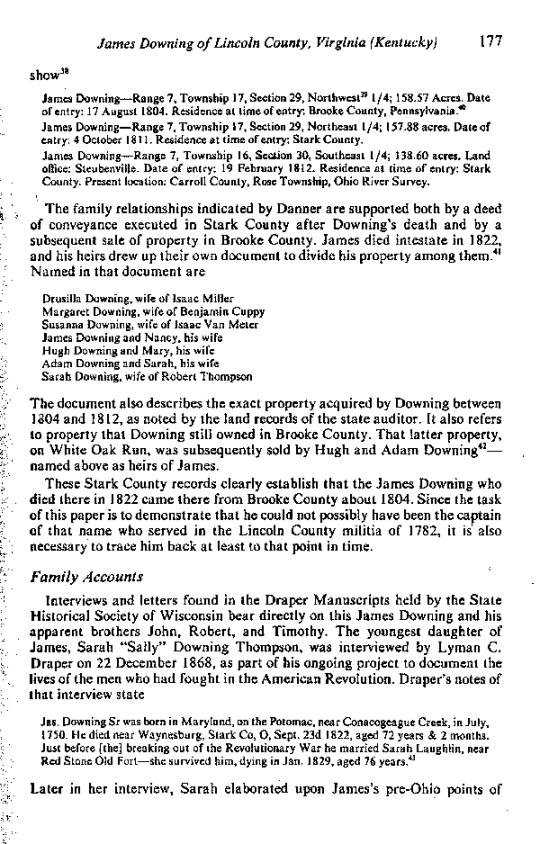
show:38
James Downing—Range 7, Township 17, Section 29, Northwest 1/4; 158.57 Acres. Date of entry: 17 August 1804. Residence at time of entry: Brooke County, Pennsylvania.
James Downing—Range 7, Township 17, Section 29, Northeast 1/4; 157.88 acres. Date of entry: 4 October 1811. Residence at time of entry: Stark County.
James Downing—Range 7, Township 16, Section 30, Southeast 1/4; 138.60 acres. Land office: Steubenville. Date of entry: 19 February 1812. Residence at time of entry: Stark County. Present location: Carroll County, Rose Township, Ohio River Survey.
The family relationships indicated by Danner are supported both by a deed of conveyance executed in Stark County after Downing’s death and by a subsequent sale of property in Brooke County. James died intestate in 1822, and his heirs drew up their own document to divide his property among them.41 Named in that document are
Drusilla Downing, wife of Isaac Miller
Margaret Downing, wife of Benjamin Cuppy
Susanna Downing, wife of Isaac Van Meter
James Downing and Nancy, his wife
Hugh Downing and Mary, his wife
Adam Downing and Sarah, his wife
Sarah Downing, wife of Robert Thompson
The document also describes the exact property acquired by Downing between 1804 and 1812, as noted by the land records of the state auditor. (It also refers to property that Downing still owned in Brooke County. That latter property, on White Oak Run, was subsequently sold by Hugh and Adam Downing42—named above as heirs of James.
These Stark County records clearly establish that the James Downing who died there in 1822 came there from Brooke County about 1804. Since the task of this paper is to demonstrate that he could not possibly have been the captain of that name who served in the Lincoln County militia of 1782, it is also necessary to trace him back at least to that point in time.
Family Accounts
Interviews and letters found in the Draper Manuscripts held by the State Historical Society of Wisconsin bear directly on this James Downing and his apparent brothers John, Robert, and Timothy. The youngest daughter of James, Sarah “Sally” Downing Thompson, was interviewed by Lyman C. Draper on 22 December 1868, as part of his ongoing project to document the lives of the men who had fought in the American Revolution. Draper’s notes of that interview state
Jas. Downing Sr was born in Maryland, on the Potomac, near Conococheague Creek, in July, 1750. He died near Waynesburg, Stark Co, O, Sept. 23d 1822, aged 72 years & 2 months. Just before [the] breaking out of the Revolutionary War he married Sarah Langhlin, near Red Stone Old Fort—she survived him, dying in Jan. 1829, aged 76 years.43
Later in her interview, Sarah elaborated upon James’s pre-Ohio points of
178
National Genealogical Society Quarterly
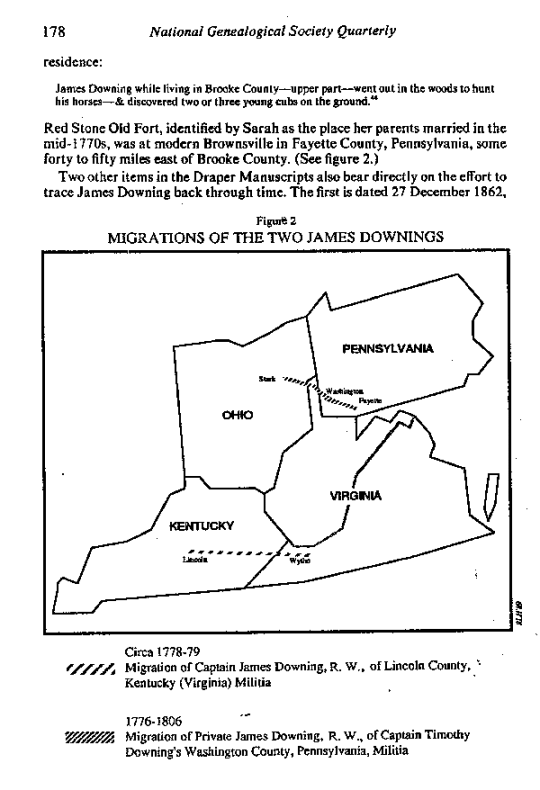
residence:
James Downing while living in Brooke County—upper part—went out in the woods to hunt his horse—& discovered two or three young cubs on the ground.44
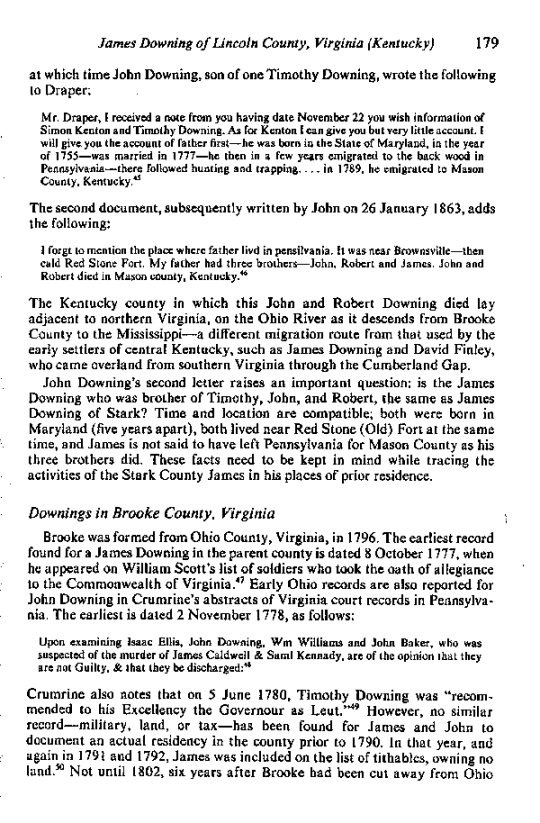
Red Stone Old Fort, identified by Sarah as the place her parents married in the mid-1770s, was at modern Brownsville in Fayette County, Pennsylvania, some forty to fifty miles east of Brooke County. (See figure 2.)
Two other items in the Draper Manuscripts also bear directly on the effort to trace James Downing back through time. The first is dated 27 December 1862,
Figure 2
MIGRATIONS OF THE TWO JAMES DOWNINGS
Circa 1778-79
Migration of Captain James Downing, R. W., of Lincoln County, Kentucky (Virginia) Militia
1776-1805
Migration of Private James Downing, R. W., of Captain Timothy Downing’s Washington County, Pennsylvania, Militia
James Downing of Lincoln County, Virginia (Kentucky)
179
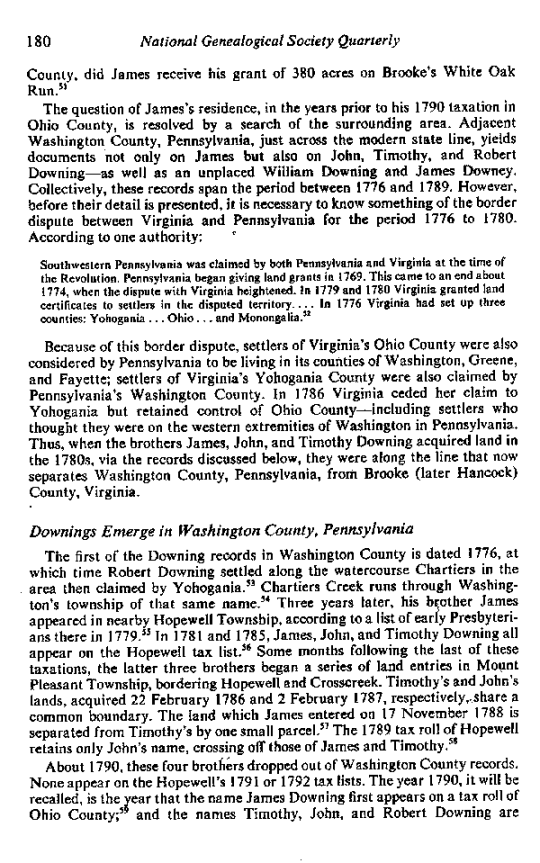
at which time John Downing, son of one Timothy Downing, wrote the following to Draper:
Mr. Draper, I received a note from you having date November 22 you wish information of Simon Kenton and Timothy Downing. As for Kenton I can give you but very little account. I will give you the account of father first,—he was born in the State of Maryland, in the year of 1755—was married in 1777—he then in a few years emigrated to the back wood in Pennsylvania—there followed hunting and trapping. . . . in 1789, he emigrated to Mason County, Kentucky.45
The second document, subsequently written by John on 26 January 1863, adds the following:
I forgot to mention the place where father lived in pensilvania. It was near Brownsville—then cald Red Stone Fort. My father had three brothers—John, Robert and James. John and Robert died in Mason county, Kentucky.46
The Kentucky county in which this John and Robert Downing died lay adjacent to northern Virginia, on the Ohio River as it descends from Brooke County to the Mississippi—a different migration route from that used by the early settlers of central Kentucky, such as James Downing and David Finley, who came overland from southern Virginia through the Cumberland Gap.
John Downing’s second letter raises an important question: is the James Downing who was brother of Timothy, John, and Robert, the same as James Downing of Stark? Time and location are compatible; both were born in Maryland (five years apart), both lived near Red Stone (Old) Fort at the same time, and James is not said to have left Pennsylvania for Mason County as his three brothers did. These facts need to be kept in mind while tracing the activities of the Stark County James in his places of prior residence.
Downings in Brooke County, Virginia
Brooke was formed from Ohio County, Virginia, in 1796. The earliest record found for a James Downing in the parent county is dated 8 October 1777, when he appeared on William Scott’s list of soldiers who took the oath of allegiance to the Commonwealth of Virginia.47 Early Ohio records are also reported for John Downing in Crumrine’s abstracts of Virginia court records in Pennsylvania. The earliest is dated 2 November 1778, as follows:
Upon examining Isaac Ellis, John Downing, Wm Williams and John Baker, who was suspected of the murder of James Caldwell & Saml Kennedy, are of the opinion that they are not Guilty, & that they be discharged.48
Crumrine also notes that on 5 June 1780, Timothy Downing was “recommended to his Excellency the Governour as Leut.”49 However, no similar record—military, land, or tax—has been found for James and John to document an actual residency in the county prior to 1790. In that year, and again in 1791 and 1792, James was included on the list of tithables, owning no land.50 Not until 1802, six years after Brooke had been cut away from Ohio
James Downing of Lincoln County, Virginia (Kentucky)
181
entered together, under date of 21 August 1790, on that year’s tax rolls of old Mason County, Kentucky.51 The names Robert, James, John, and Timothy—it will be remembered—are those previously found in Draper’s Manuscripts, wherein Timothy’s sons identified them as brothers and stated that all but James settled in Mason County.
Meanwhile, in Richill Township of Washington County, some thirty-five miles south of the above quartet, there simultaneously lived a William Downing and a James Downey who possibly present further clues for reconstructing this family. On 13 September 1784, they warranted adjacent parcels of 400 acres.61 On 15 February 1798, this William Downing and James Downey both sold their properties to one Thomas Leeper;62 they have not been found in the area thereafter. The names William and James Downing appear on the Ohio County, Virginia, census of 1810, after the James Downing of this study had removed to Stark County; if the census data is correct, however, the James of 1810 was too young to be the James Downey who had departed from Richill Township.63 Finally, on 18 September 1812, one William Downing wrote his will in Ohio County, naming sons James, John, and Robert, among others; there was no mention of a Timothy.64 The Timothy who left Washington for Mason County, Kentucky, died there in 1816.65
Revolutionary Service for
James Downing of Ohio and Pennsylvania
The most-important piece of information regarding the James Downing of Brooke County places him in the Washington County militia in the crucial year 1782. On 12 April of that year, “James Downing, 2nd class,” is listed as serving in the “Capt. Timothy Downing Compy. in the 3d batt. Washington County Militia ordered to rendezvous the 12th April, 1782.”66 He is also listed, under second class, on another roll of Captain Timothy Downing’s company that is undated but placed after a return dated 1 May 1783 in an arrangement that is chronological up to that point.67
CONCLUSION
Two James Downings have obviously been confused by researchers in their attempt to match Revolutionary War service with human lives—two men with different families, different migration patterns, and different military statuses.
The James Downing who died in Stark County, Ohio, was a younger man and one for whom no Kentucky residence can be found. He can be traced backward into Brooke County, (West) Virginia, and then into Washington and Fayette counties, Pennsylvania. His birth occurred in Maryland in 1750 near the Potomac River and Conococheague Creek. His parents are not known, but his brothers, beyond reasonable doubt, were Timothy, John, and Robert. This James Downing did have militia service in the Revolutionary War, as a private
182
National Genealogical Society Quarterly
in the company captained by his brother; he was not a captain, himself, at this time. This James Downing clearly was not the James Downing who led the Lincoln County militia against the Shawnee Indians in 1782.
The Captain James Downing who saw service under General George Rogers Clark was an actual resident and community leader of Lincoln County. He died in Kentucky in 1811, still in possession of land he had been granted while a resident of Lincoln. He settled on the Kentucky frontier about 1779, following the westward migration of his former neighbor in Montgomery County (now Wythe County), Virginia, David Finley. This James Downing had brothers William, Ezekiel, Andrew, and John—all sons of the elder John Downing who died 1777 in Bedford County, Virginia.
The “Captain James Downing of the Lincoln County militia,” as reconstructed in some lineage-society applications, is merely a straw man. On the surface, there are no breaches of logic in the construction. James Downing of Stark arrived there in 1804, reportedly from Brooke County, Virginia. A scan of Brooke County records shows nothing on him before 1796, and the records of Brooke’s parent county date his residence only to 1790—with an isolated appearance of the same name in 1777. Why could not he be the same James Downing who served, in the meanwhile, in the “Lincoln Militia” under that well-known Virginian George Rogers Clark?
Numerous reasons are obvious from the present paper—as is another point with broader implications for genealogy. The real lives of individuals cannot be pieced together if the search is less than exhaustive. It does not suffice to find a few records which seem to fit and assume that all of them apply to the same man. It is important that each individual be placed into the context of a larger pattern of migration. It is imperative that all known relatives and—major metropolitan areas excepted—all areas the same family name be studied and that the individual under search be placed into the pattern of the larger family to which he belonged. Finally, it is imperative, in any attempt to document military service prior to the twentieth century, that a study be made of the specific campaign; only by doing so can one understand the type of man who would have been called upon to perform that type of service.
NOTES AND REFERENCES
* 4820 Rockridge Lane; Santa Rosa, CA 95404. Dr. Finley is immediate past president of the Sonoma County Genealogical Society. Her related study, “David Finley (1754–1848): Correlating the Record,” appeared in the VGS Quarterly in June 1988 (vol. 76: 112–120). The author wishes to acknowledge the assistance of Daphene L. Blair of Morgantown, West Virginia; W. J. Downing, Tallahassee, Florida; and Robert Kitzmiller, Bellingham, Washington. Mr. Downing and Mr. Kitzmiller are Downing descendants also.
1. Mabel C. Smith and Hilda M. Johnson, comps., Official Roster III, Soldiers of the American Revolution Who Lived in the State of Ohio, 3 vols. (N.p.: Ohio Society, Daughters of the American Revolution, 1929–39), 31:10.
2. John S. Downing Bible, New Testament of Our Lord and Savior, Jesus Christ (Hartford, 1836), covering the years 1790–1856; copy in possession of present writer. John S. Downing is son of John, brother to James.
3. Margery Heberling Harding, compiler, George Rogers Clark and His Men: Military Records, (Frankfort: Kentucky Historical Society, n.d.), 189.
James Downing of Lincoln County, Virginia (Kentucky)
183
4. Dale Van Every, A Company of Heroes: The American Frontier, 1775–1783 (New York: William Morrow and Co., 1962), 296.
5. Ibid., 297–99.
6. Ibid., 301.
7. Ibid., 303.
8. Harding, George Rogers Clark and His Men: Military Records, 189.
9. Twenty-five of these are listed in William Rouse Jillson, The Kentucky Land Grants (Baltimore: Genealogical Publishing Co., 1971), Part I:15, 25, 41, 49, 52–53, 65, 69, 88, 91, 119–20, 122, 127, 130, 135, 138, 145. Another four (Jacob Marsh, William McClure, Elisha Allen, and Joseph Turner) were not found on Jillson’s list but do appear in published abstracts from the Kentucky Gazette; see Karen Mauer Green, The Kentucky Gazette, 1787–1800 (Baltimore: Gateway Press, 1983), 19, 55, 230, 245.
10. Finley Bible records, in possession of this writer.
11. Bedford County Will Book 1:266.
12. Finley, “David Finley,” 113–14.
13. Lewis Preston Summers, Annals of Southwest Virginia, 1769–1800 (Baltimore: Genealogical Publishing Co., 1970), Part I:685.
14. David Finley married Elizabeth Mounce, whose father and brother were both named Matthias; Garrard County, Kentucky, Circuit Court Files, Box 2, Suit 39, and Book 1:407.
15. Forrest Calico, History of Garrard County, Kentucky, and its Churches (New York: Hobson Book Press, 1947), 39.
16. Testimony of David Finley, in H. V. McChesney, ed., “Certificate Book,” Kentucky State Historical Society Register 21 (January 1923): 26. Finley, “David Finley,” 114.
17. Montgomery County Entry Book A:2.
18. Lyman Chalkley, Chronicles of the Scotch-Irish Settlement in Virginia (Extracted from the Original Court Records of Augusta County, 1745–1800), 3 vols. (1912; reprinted, Baltimore: Genealogical Publishing Co., 1980), 3:197.
19. Bedford County Deed Book 7:237.
20. For example, Finley appeared before officials in 1779, seeking title to a tract in Lincoln County. He stated that he had first built a “hut” and raised a crop of corn on the premises in 1776. See McChesney, “Certificate Book,” 20.
21. William Tartarica, “Land and Tax Records,” in Arlene Eakle and John Cerny, The Source: A Guidebook of American Genealogy (Salt Lake City: Ancestry Publishing, 1984), 215.
22. Lincoln County Survey Book 3:31; McChesney, “Certificate Book,” 44. The change of name from Clear Creek to White Oak Creek was apparently prompted by the fact that another Clear Creek existed just a few miles to the north, on the Kentucky River across the Lincoln-Fayette county line. While the survey notes identify the land on Clear Creek, the subsequent sales of the land by Downing cite its location on “Clear Creek, a branch of Dick’s River.” See Lincoln County Deed Books, A:49 and B:310.
23. Mercer County, Kentucky, Deed Book 2:465.
24. Martha Porter Miller, ed., “Lincoln County, Kentucky, Order Books, 1781–1791,” Kentucky Genealogist 7 (October–December 1965): 135–36.
25. Finley, “David Finley,” 114–15.
26. Mercer County Deed Book 2:465.
27. Miller, ed., “Lincoln County, Kentucky, Order Books, 1781–1791,” Kentucky Genealogist 13 (January–March 1971): 26.
28. Lincoln County Order Book 1:5, 19.
29. Miller, ed., “Lincoln County, Kentucky, Order Books, 1781–1791,” Kentucky Genealogist 12 (October–December 1970): 138.
30. Summers, Annals of Southwest Virginia, 913.
31. James and Robert Johnson, Petition of the Early Inhabitants of Kentucky to the General Assembly of Virginia, 1782–1792 (Louisville: John P. Morton & Co., 1914), 68.
32. Lincoln County Deed Book A:79–80.
33. Robertson, Petition of the Early Inhabitants of Kentucky, 121–22.
34. Mercer County Deed Book 1:416–17. Not only William Downing but also his brothers John and Ezekiel married women named Rachel. However, there is no evidence to indicate that John or Ezekiel was dead by this time or that their wives were otherwise empowered to act as femes sole.
35. Lincoln County Deed Books A:490, B:189; Mercer County Deed Book 2:465.
James Downing of Lincoln County, Virginia (Kentucky)
185
64. Ohio County Will Book 2:42.
65. Will Book D:121–23, Mason County, Kentucky.
66. “Muster Rolls Relating to the Associators & Militia of the County of Washington,” Thomas Lynch Montgomery, ed., Pennsylvania Archives, 6th ser., vol. 2 (Harrisburg: State Printer, 1906), 100.
67. Ibid., 117.
Additions and Corrections
Volume 76: Number 3 (September 1988)
Sandra K. Ogle, “Genealogical Research in California”
Stewart Rafert, “American-Indian Genealogical Research in the Midwest”
Editors’ Note: Both articles included a reference to the renowned facilities of the Huntington Library of San Marino, California, which holds both privately generated material and public records created by government officials in various states and colonies. Miss Mary L. Robertson, Curator of Manuscripts at the Huntington, has requested that the following additional remarks be addressed to the genealogical community:
Because of staff limitations and the need to preserve the rare and frequently fragile books and manuscripts in its collections, the Huntington regrets that it is not an appropriate library for general research inquiries and can only accommodate advanced researchers—priority being given to those affiliated with academic institutions.
As a private research library, the Huntington respectfully requests that individuals who have identified specific records among its holdings that are important to their study should first write the library, briefly describe their need and their experience or qualifications, and request access to the records.
Researchers whose interests or needs point toward materials at the Huntington will first wish to study Mary Robertson and Jean F. Preston’s Guide to American Historical Manuscripts in the Huntington Library (San Marino: Huntington Library, 1979).
Army Enlistment: Joseph Davis
31 May 1848
Lexington, Kentucky.
Joseph Davis. Born: Fairfield County, Ohio. Age: twenty one. Occupation: cabinet maker. Voluntarily enlisted: 23 May 1848. Attested: 31 May 1848 before B. F. Graves, J. P., Lexington. Signed: Joseph Davis (X his mark). Witness: Joseph Stewart.
Formal affidavit of examining surgeon: “I certify, on honor, that I have minutely inspected the Recruit Joseph Davis, previously to his enlistment, and that he was entirely sober when enlisted; that, to the best of my judgement and belief, he is of lawful age. . . . This Soldier has grey eyes, dark hair, dark complexion, is five feet five inches high.” Signed: R. A. Arnold, Capt. 2nd Drag.
Added note of recruiting officer: “I certify that the within named recruit Joseph Davis being suspected by me as a minor, has been carefully questioned by me relative to his history, parentage, and age and that he affirms that he is twenty-one years of age. I further certify that I have made diligent enquiry in the neighborhood and from his brother William Davis and that no accepting him (Joseph Davis) as a good Recruit invalidly enlists I have no reason to suppose that his statement is not true.” Signed: R. A. Arnold, Capt. 2nd Dragoons, Rect. Officer.
[File No. 2 (113), Joseph Davis, Medical Examination of Recruits, Record Group 94, Records of the Adjutant General. National Archives and Records Service, Washington, D.C.]