

aaa-0030.htm
Text Version
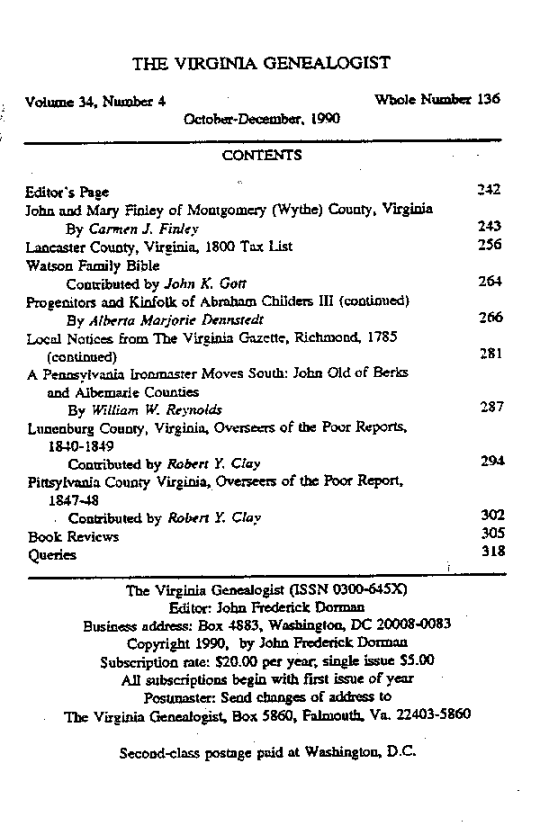
THE VIRGINIA GENEALOGIST
Volume 34, Number 4 Whole Number 136
October-December, 1990
CONTENTS
Editor’s Page 242
John and Mary Finley of Montgomery (Wythe) County, Virginia
By Carmen J. Finley 243
Lancaster County, Virginia, 1800 Tax List 256
Watson Family Bible
Contributed by John K. Gott 264
Progenitors and Kinfolk of Abraham Childers III (continued)
By Alberta Marjorie Dennstedt 266
Local Notices from The Virginia Gazette, Richmond, 1785 (continued) 281
A Pennsylvania Ironmaster Moves South: John Old of Berks and Albemarle Counties
By William W. Reynolds 287
Lunenburg County, Virginia, Overseers of the Poor Reports, 1840-1849
Contributed by Robert F. Clay 294
Pittsylvania County Virginia, Overseers of the Poor Report, 1847-48
Contributed by Robert F. Clay 302
Book Reviews 305
Queries 318
The Virginia Genealogist (ISSN 0300-645X)
Editor: John Frederick Dorman
Business address: Box 4833, Washington, DC 20008-0083
Copyright 1990, by John Frederick Dorman
Subscription rate: $20.00 per year; single issue $5.00
All subscriptions begin with first issue of year
Postmaster: Send changes of address to
The Virginia Genealogist, Box 5860, Falmouth, Va. 22403-5860
Second-class postage paid at Washington, D.C.
JOHN AND MARY FINLEY
OF MONTGOMERY (WYTHE) COUNTY, VIRGINIA
By Carmen J. Finley, C.G., Ph.D.
Santa Rosa, California
Most, if not all, early immigrants of the name Finley were Scotch-Irish who arrived in America either from Northern Ireland (Ulster) or Dublin between 1720 and the early 1770s. They were a part of Great Britain’s massive plantation of Scotsmen in Ulster during the reign of King James I in the early 1600s. They were primarily lowland Scots and primarily Presbyterian in faith.1 By the early 1700s, religious persecution and unfavorable economic conditions provided the impetus for increasing numbers of Scotch-Irish to turn to the American wilderness.
Their first stop in the New World was Pennsylvania. But to the early settlers of that area the Scotch-Irish were late comers and not particularly welcome. The Quakers, in particular, cared naught for the Scotch-Irish Presbyterians, and restrictive measures adopted by the government soon encouraged them to seek homes elsewhere.2 The natural migration path was up the Shenandoah Valley of Virginia. The Quakers and Germans had already begun to settle in the northernmost part of the Valley, so the Scotch-Irish went to the most extended frontier in order to insure freedom of their religion and their life.3 One historian refers to them as people “who constituted the skirmish line of civilization.”5
1 These were the Finleys traced by Maj. Albert Finley France and expanded by Admiral Herald F. Stout, pioneer Finley researchers, cited following.
2 Cecil Baskin Holsclaw, “Protestants in Ireland: Their Impact on Society and Family,” in World Conference on Records: Preserving Our Heritage, Aug. 12-15 1980, v. 6 of 12, British Family and Local History, pt. 2, #434.
3 Howard McKnight Wilson, The Tinkling Spring: Headwater of Freedom: A Study of the Church and Her People, 1732-1952 (Fishersville, Va., 1954), pp. 26-29.
4 Ibid., p. 30.
5 William Fletcher Boogher, comp., Gleanings of Virginia History: An Historical and Genealogical Collection, Largely from Original Sources (Baltimore, 1976), p. 113.
THE VIRGINIA GENEALOGIST
John Lewis lead the movement when he settled, in 1732, near the present city of Staunton in Augusta County. These early pioneers were deeply religious. During the French and Indian War, the Scotch-Irish stood as a bulwark against Indian incursions east of the Blue Ridge. During the Revolution the sons and grandsons of the original settlers were almost unanimously in favor of American independence and were found in battles from Saratoga to Yorktown.6
The Finleys presented here almost certainly come from the group of early settlers in Augusta County, but the exact order of ascendence has not been adequately proven to date. Pioneer research on the Finleys was done by Maj. Albert Finley France in the 1930s and 1940s.7 His work was expanded by Admiral Herald F. Stout in the 1950s through the 1970s.8 Robert M. Torrence has also published extensively on his branch of the Finleys, giving early history similar to that presented by France and Stout.9
The present paper begins with John and Mary Finley, in Montgomery (now Wythe) Co., Va., just prior to the start of the Revolution.
GENERATION ONE
In Nov. 1773 John Finley bought 327 acres in Montgomery Co., Va., on Salley Run, waters of Reed Creek, from John McFarland.10 Two previous papers demonstrate John and his wife, Mary, came from Prince Edward County where they resided from approximately 1765 to 1772-7311 and before that most likely from Augusta County.12 While there are other adult Finleys in their immediate vicinity, both in Prince Edward County and in Montgomery County, there is proof of only three sons.
6 Ibid., pp. 113-14.
7 Albert Finley France, “The Clan Finley” (manuscript, 73 pp., 1942, Historical Society of Indiana County, Pa., filmed by Genealogical Society of Utah (GSU) in 1966, film #0481791, item 3; also, Albert Finley France, untitled 54 pp. compilation (Annapolis, Md., 1940).
8 Herald F. Stout, The Clan Finley (2nd ed.; Dover, Ohio, 1956).
9 Robert M. Torrence, Torrence and Allied Families (Philadelphia, 1938), p. 142.
10 Montgomery Co., Va., Order Bk. 1, p. 142.
11 Carmen J. Finley, “David Finley (1754-1848): Correcting the Record,” National Genealogical Society Quarterly, v. 76 (1988), pp. 112-20.
12 Carmen J. Finley, “The Georges Finleys of Augusta County, Virginia,” The American Genealogist, v. 64, pp. 216-25.
JOHN AND MARY FINLEY
Montgomery County, there is proof of only three sons.
During their residence in Prince Edward County, John and his family lived on 400 acres on Vaughans Creek.13 This deed is dated 15 June 1765. Within two months of the time John bought this property, William Finley bought 430 acres on Vaughhans Creek.14 On 28 April 1769, George Finley bought 200 acres on Vaughans Creek from his father-in-law Thomas Fulton.15 All three of these Finleys moved on to Montgomery County, but no records have been found in either location that show their relationship.
In 1773 the New River tithables show “John Finley and sons David and Thomas.”16 Six years after John made the move to Montgomery County, he and his wife, Mary, deeded their 327 acres on Salley Run to David and Samuel Finley in exchange for life care.17 While these documents do not name David and Samuel as sons, subsequent documents regarding the sale of the property do refer to their deceased father.18 John died prior to 19 Aug. 1782,19 and on 13 Jan. 1783, 140 acres were surveyed for Thomas Finley adjacent to “John Finley’s decd patent land” on Sally Run.20
No evidence has been found as to what happened to John’s wife Mary. However, a persistent message that is found in the literature of Finley family researchers follows:
Eliz. Mounts’ Bible is still in existence and on fly leaf written by her dau., Jane Ann (Finley) Smith, is statement (apparently addressed to next generation): Your grandfather was David Finley and he married Elizabeth Mounts his father was John Finley who married Mary Caldwell, a cousin of Martha Caldwell who was the mother of the famous Statesman John C. Calhoun.” (unpublished data in D.A.R. Library, compiled & certified by Maj. Albert Finley France).21
13 Prince Edward Co., Va., Deed Bk. 3, p. 1.
14 Ibid., p. 21.
15 Ibid., p. 487.
16 Mary B. Kegley, New River Tithables (Wytheville, Va., 1941), p. 27.
17 Montgomery Co., Va., Deed Bk. A, pp. 283, 258.
18 Lincoln Co., Ky., Deed Bk. A, p. 338.
19 Montgomery Co., Va., Deed Bk. A, p. 284, states that heirs of John Finley gave legal notice on 19 Aug. 1782.
20 Montgomery Co., Va., Record of Plats B, p. 57.
21 Query, Genealogy and History (Washington, D.C.), 15 Dec. 1943, #8347. The unpublished data in the DAR Library cannot be located there.
THE VIRGINIA GENEALOGIST
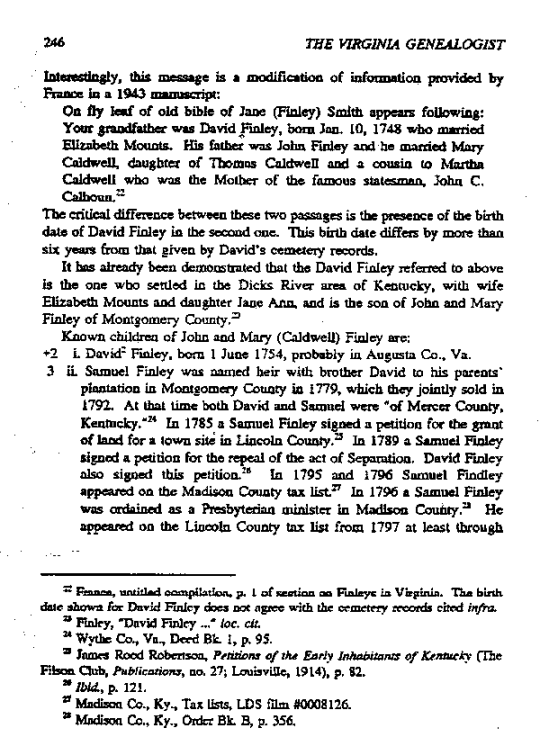
Interestingly, this message is a modification of information provided by France in a 1943 manuscript:
On fly leaf of old bible of Jane (Finley) Smith appears following: Your grandfather was David Finley, born Jan. 10, 1748 who married Elizabeth Mounts. His father was John Finley and he married Mary Caldwell, daughter of Thomas Caldwell and a cousin to Martha Caldwell who was the Mother of the famous statesman, John C. Calhoun.22
The critical difference between these two passages is the presence of the birth dates of David Finley in the second one. This birth date differs by more than six years from that given by David’s cemetery records.
It has already been demonstrated that the David Finley referred to above is the one who settled in the Dicks River area of Kentucky with wife Elizabeth Mounts and daughter Jane Ann, and is the son of John and Mary Finley of Montgomery County.23
Known children of John and Mary (Caldwell) Finley are:
+2 i. David2 Finley, born 1 June 1754, probably in Augusta Co., Va.
3 ii. Samuel Finley was named heir with brother David to his parents’ plantation in Montgomery County in 1779, which they jointly sold in 1792. At that time both David and Samuel were “of Mercer County, Kentucky.”24 In 1785 a Samuel Finley signed a petition for the grant of land for a town site in Lincoln County.25 In 1789 a Samuel Finley signed a petition for the repeal of the act of separation. David Finley also signed this petition.26 In 1795 and 1796 Samuel Finley appeared on the Madison County tax list.27 In 1796 a Samuel Finley was ordained as a Presbyterian minister in Madison County.28 He appeared on the Lincoln County tax list from 1797 to at least through 1811.
22 France, untitled compilation, p. 1 of section on Finleys in Virginia. The birth date shown for David Finley does not agree with the cemetery records cited infra.
23 Finley, “David Finley,” loc. cit.
24 Wythe Co., Va., Deed Bk. 1, p. 95.
25 James Rood Robertson, Petitions of the Early Inhabitants of Kentucky (The Filson Club, Publications, no. 27; Louisville, 1914), p. 82.
26 Ibid., p. 121.
27 Madison Co., Ky., Tax Lists, LDS film #0008126.
28 Madison Co., Ky., Order Bk. B, p. 356.
JOHN AND MARY FINLEY
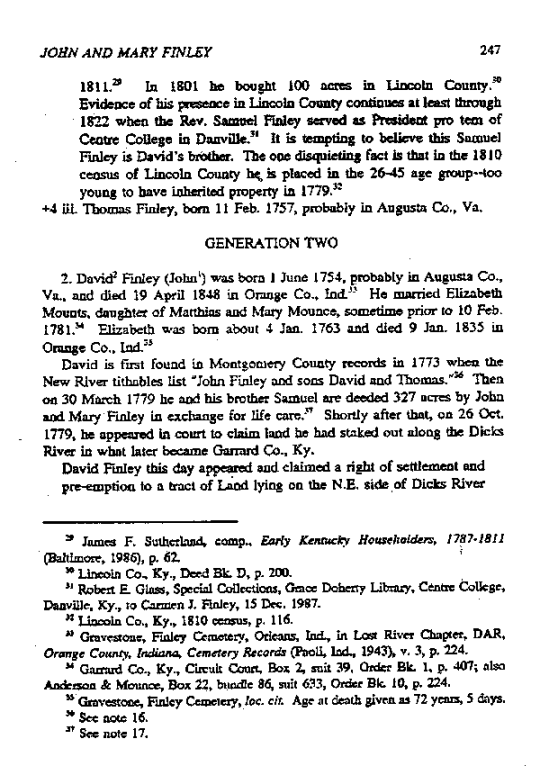
In 1801 he bought 100 acres in Lincoln County.30 Evidence of his presence in Lincoln County continues at least through 1822 when the Rev. Samuel Finley served as President pro tem of Centre College in Danville.31 It is tempting to believe this Samuel Finley is David’s brother. The one disquieting fact is that in the 1810 census of Lincoln County he is placed in the 26-45 age group—too young to have inherited property in 1779.32
+4 iii. Thomas Finley, born 11 Feb. 1757, probably in Augusta Co., Va.
GENERATION TWO
2. David2 Finley (John1) was born 1 June 1754, probably in Augusta Co., Va., and died 19 April 1848 in Orange Co., Ind.33 He married Elizabeth Mounts, daughter of Mathias and Mary Mounce, sometime prior to 10 Feb. 1781.34 Elizabeth was born about 4 Jan. 1763 and died 9 Jan. 1835 in Orange Co., Ind.35
David is first found in Montgomery County records in 1773 when the New River tithables list “John Finley and sons David and Thomas.”36 Then on 30 March 1779 he and his brother Samuel are deeded 327 acres by John and Mary Finley in exchange for life care.37 Shortly after that, on 26 Oct. 1779, he appeared in court to claim land he had staked out along the Dicks River in what later became Garrard Co., Ky.
David Finley this day appeared and claimed a right of settlement and pre-emption to a tract of Land lying on the N.E. side of Dicks River
30 James F. Sutherland, comp., Early Kentucky Householders, 1787-1811 (Baltimore, 1986), p. 62.
31 Lincoln Co., Ky., Deed Bk. D, p. 200.
32 Robert E. Glass, Special Collections, Grace Doherty Library, Centre College, Danville, Ky., to Carmen J. Finley, 15 Dec. 1987.
33 Lincoln Co., Ky., 1810 census, p. 116.
34 Gravestone, Finley Cemetery, Orleans, Ind., in Lost River Chapter, DAR, Orange County, Indiana, Cemetery Records (Paoli, Ind., 1943), v. 3, p. 224.
35 Garrard Co., Ky., Circuit Court, Box 2, suit 39, Order Bk. 1, p. 407; also Abstracts of Monroe, Box 22, bundle 66, suit 63, Order Bk. 10, p. 224.
36 Gravestone, Finley Cemetery, loc. cit. Age at death given as 72 years, 5 days.
37 See note 16.
38 See note 17.
JOHN AND MARY FINLEY
In 1801 he bought 100 acres in Lincoln County.30 Evidence of his presence in Lincoln County continues at least through 1822 when the Rev. Samuel Finley served as President pro tem of Centre College in Danville.31 It is tempting to believe this Samuel Finley is David’s brother. The one disquieting fact is that in the 1810 census of Lincoln County he is placed in the 26-45 age group—too young to have inherited property in 1779.32
+4 iii. Thomas Finley, born 11 Feb. 1757, probably in Augusta Co., Va.
GENERATION TWO
2. David2 Finley (John1) was born 1 June 1754, probably in Augusta Co., Va., and died 19 April 1848 in Orange Co., Ind.33 He married Elizabeth Mounts, daughter of Mathias and Mary Mounce, sometime prior to 10 Feb. 1781.34 Elizabeth was born about 4 Jan. 1763 and died 9 Jan. 1835 in Orange Co., Ind.35
David is first found in Montgomery County records in 1773 when the New River tithables list “John Finley and sons David and Thomas.”36 Then on 30 March 1779 he and his brother Samuel are deeded 327 acres by John and Mary Finley in exchange for life care.37 Shortly after that, on 26 Oct. 1779, he appeared in court to claim land he had staked out along the Dicks River in what later became Garrard Co., Ky.
David Finley this day appeared and claimed a right of settlement and pre-emption to a tract of Land lying on the N.E. side of Dicks River about 3 or 4 Miles below the mouth of Fishing Creek including two small Springs by building a Hut and raising a crop of Corn on the premises in the year 1776. Wm Frazer contested the claim by Joseph Frazer and alleged that the said Frazer has a prior improvement to the said land. Sundry Witnesses were sworn and examined in consideration of which the Court are of Opinion that the said Finley has a right only to a pre-emption of 1000 Acres of Land including said improvement and that a Certificate issue for same and that the said Finley recover of the said Frazer his Costs.38 The records for David show he obtained a warrant for his 1000 acres on 10 March 1780 while the survey date was 5 April 1781 and the grant date was 14 Jan. 1784.39
30 James F. Sutherland, comp., Early Kentucky Householders, 1787-1811 (Baltimore, 1986), p. 62.
31 Lincoln Co., Ky., Deed Bk. D, p. 200.
32 Robert E. Glass, Special Collections, Grace Doherty Library, Centre College, Danville, Ky., to Carmen J. Finley, 15 Dec. 1987.
33 Lincoln Co., Ky., 1810 census, p. 116.
34 Gravestone, Finley Cemetery, Orleans, Ind., in Lost River Chapter, DAR, Orange County, Indiana, Cemetery Records (Paoli, Ind., 1943), v. 3, p. 224.
35 Garrard Co., Ky., Circuit Court, Box 2, suit 39, Order Bk. 1, p. 407; also Abstracts of Monroe, Box 22, bundle 66, suit 63, Order Bk. 10, p. 224.
36 Gravestone, Finley Cemetery, loc. cit. Age at death given as 72 years, 5 days.
37 See note 16.
38 See note 17.
39 H. V. McChesney, ed., “Certificate Book,” Register of the Kentucky Historical Society, v. 21 (1923), p. 20; Virginia Land Grants v. 1, 1783-84, pp. 322-24.
THE VIRGINIA GENEALOGIST
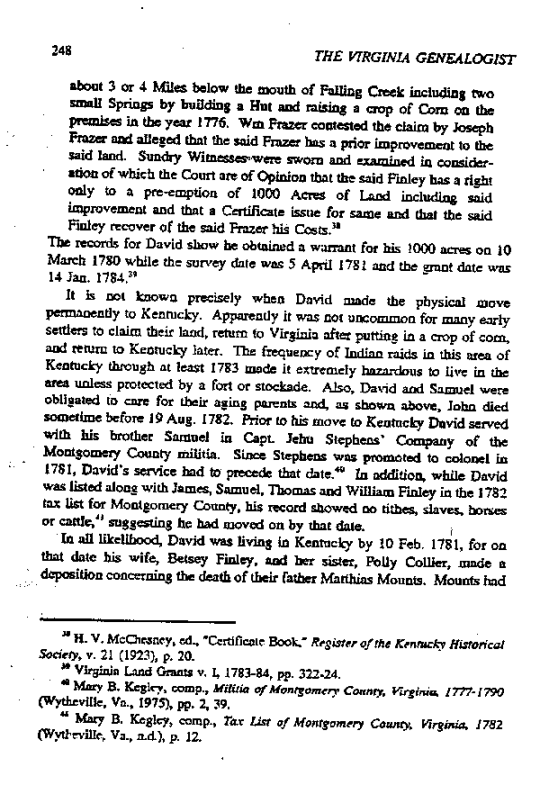
about 3 or 4 Miles below the mouth of Fishing Creek including two small Springs by building a Hut and raising a crop of Corn on the premises in the year 1776. Wm Frazer contested the claim by Joseph Frazer and alleged that the said Frazer has a prior improvement to the said land. Sundry Witnesses were sworn and examined in consideration of which the Court are of Opinion that the said Finley has a right only to a pre-emption of 1000 Acres of Land including said improvement and that a Certificate issue for same and that the said Finley recover of the said Frazer his Costs.38 The records for David show he obtained a warrant for his 1000 acres on 10 March 1780 while the survey date was 5 April 1781 and the grant date was 14 Jan. 1784.39
It is not known precisely when David made the physical move permanently to Kentucky. Apparently it was not uncommon for many early settlers to claim their land, return to Virginia after putting in a crop of corn, and return to Kentucky later. The frequency of Indian raids in this area of Kentucky through at least 1783 made it extremely hazardous to live in the area unless protected by a fort or stockade. Also, David and Samuel were obligated to care for their aging parents and, as shown above, John died sometime before 19 Aug. 1782. Prior to his move to Kentucky David served with his brother Samuel in Capt. John Stephens’ Company of the Montgomery County militia. Since Stephens was promoted to colonel in 1781, David’s service had to precede that date.40 In addition, while David was listed along with James, Samuel, Thomas and William Finley in the 1782 tax list for Montgomery County, his record showed no tithes, slaves, horses or cattle,41 suggesting he had moved on by that date.
In all likelihood, David was living in Kentucky by 10 Feb. 1781, for on that date his wife, Betsey Finley, and her sister, Polly Collier, made a deposition concerning the death of their father Mathias Mounts. Mounts had
38 H. V. McChesney, ed., “Certificate Book,” Register of the Kentucky Historical Society, v. 21 (1923), p. 20.
39 Virginia Land Grants v. 1, 1783-84, pp. 322-24.
40 Mary B. Kegley, comp., Militia of Montgomery County, Virginia 1777-1790 (Wytheville, Va., 1975), pp. 2, 39.
41 Mary B. Kegley, comp., Tax List of Montgomery County, Virginia, 1782 (Wytheville, Va., n.d.), p. 12.
JOHN AND MARY FINLEY
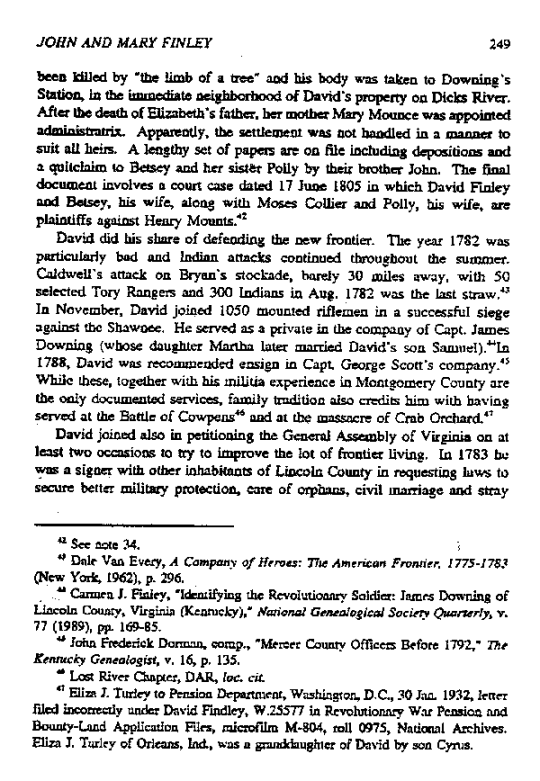
been killed by “the limb of a tree” and his body was taken to Downing’s Station, in the immediate neighborhood of David’s property on Dicks River. After the death of Elizabeth’s father, her mother Mary Mounce was appointed administratrix. Apparently, the settlement was not handled in a manner to suit all heirs. A lengthy set of papers are on file including depositions and a quotation to Betsey and her sister Polly by their brother John. The final document involves a court case dated 17 June 1805 in which David Finley and Betsey, his wife, along with Moses Collier and Polly, his wife, are plaintiffs against Henry Mounts.42
David did his share of defending the new frontier. The year 1782 was particularly bad and Indian attacks continued throughout the summer. Caldwell’s attack on Bryan’s stockade, barely 30 miles away, with 50 selected Tory Rangers and 300 Indians in Aug. 1782 was the last straw.43 In November, David joined 1050 mounted riflemen in a successful siege against the Shawnee. He served as a private in the company of Capt. James Downing (whose daughter Martha later married David’s son Samuel).44 In 1783, David was recommended ensign in Capt. George Scott’s company.45 While these, together with his militia experience in Montgomery County are the only documented services, family tradition also credits him with having served at the Battle of Cowpens46 and at the massacre of Crab Orchard.47
David joined also in petitioning the General Assembly of Virginia on at least two occasions to try to improve the lot of frontier living. In 1783 he was a signer with other inhabitants of Lincoln County in requesting laws to secure better military protection, care of orphans, civil marriage and stray stock.48
42 See note 34.
43 Dale Van Every, A Company of Heroes: The American Frontier, 1775-1783 (New York, 1962), p. 296.
44 Carmen J. Finley, “Identifying the Revolutionary Soldier: James Downing of Lincoln County, Virginia (Kentucky),” National Genealogical Society Quarterly, v. 77 (1989), pp. 169-85.
45 John Frederick Dorman, comp., “Mercer County Officers Before 1792,” The Kentucky Genealogist, v. 16, p. 135.
46 Lost River Chapter, DAR, loc. cit.
47 Eliza J. Turley to Pension Department, Washington, D.C., 30 Jan. 1912, letter filed incorrectly under David Findley, W.25577 in Revolutionary War Pension and Bounty-Land Application Files, microfilms M-804, roll 0975, National Archives. Eliza J. Turley of Orleans, Ind., was a granddaughter of David by son Cyrus.
48 John Frederick Dorman, comp., “Mercer County Officers Before 1792,” The Kentucky Genealogist, v. 16, p. 135.
THE VIRGINIA GENEALOGIST
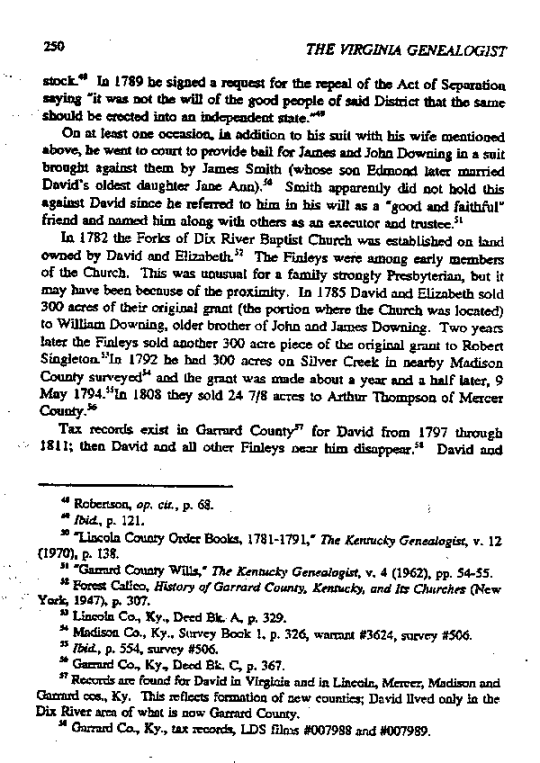
In 1789 he signed a request for the repeal of the Act of Separation saying “it was not the will of the good people of said District that the same should be erected into an independent state.”49
On at least one occasion, in addition to his suit with his wife mentioned above, he went to court to provide bail for James and John Downing in a suit brought against them by James Smith (whose son Edmund later married David’s oldest daughter Jane Ann).50 Smith apparently did not hold this against David since he referred to him in his will as a “good and faithful friend and much kind along with others as an executor and trustee.”51
In 1782 the Forks of Dix River Baptist Church was established on land owned by David and Elizabeth.52 The Finleys were among early members of the Church. This was unusual for a family strongly Presbyterian, but it may have been because of the proximity. In 1785 David and Elizabeth sold 300 acres of their original grant (the portion where the Church was located) to William Downing, older brother of John and James Downing. Two years later the Finleys sold another 300 acre piece of the original grant to Robert Singleton.53 In 1792 he had 300 acres on Silver Creek in nearby Madison County surveyed54 and the grant was made about a year and a half later, 9 May 1794.55 In 1808 they sold 24 7/8 acres to Arthur Thompson of Mercer County.56
Tax records exist in Garrard County57 for David from 1797 through 1811; then David and all other Finleys near him disappeared.58 David and Elizabeth had ten children while living in Kentucky, the youngest of whom was about 6 when they moved to Orange Co., Ind.
49 Robertson, op. cit., p. 68.
50 Ibid., p. 121.
51 Lincoln County Order Books, 1781-1791, The Kentucky Genealogist, v. 12 (1970), p. 138.
52 Garrard County Wills, The Kentucky Genealogist, v. 4 (1962), pp. 54-55.
53 Fosser Colvin, History of Garrard County, Kentucky, and Its Churches (New York, 1947), p. 307.
54 Lincoln Co., Ky., Deed Bk. A, p. 329.
55 Madison Co., Ky., Survey Book 1, p. 326, warrant #3624, survey #506.
56 Ibid., p. 554, survey #506.
57 Garrard Co., Ky., Deed Bk. C, p. 367.
58 Records are found for David in Virginia and in Lincoln, Mercer, Madison and Garrard cos., Ky. This reflects formation of new counties; David lived only in the Dix River area of what is now Garrard County.
JOHN AND MARY FINLEY
Elizabeth had ten children while living in Kentucky, the youngest of whom was about 6 when they moved to Orange Co., Ind.
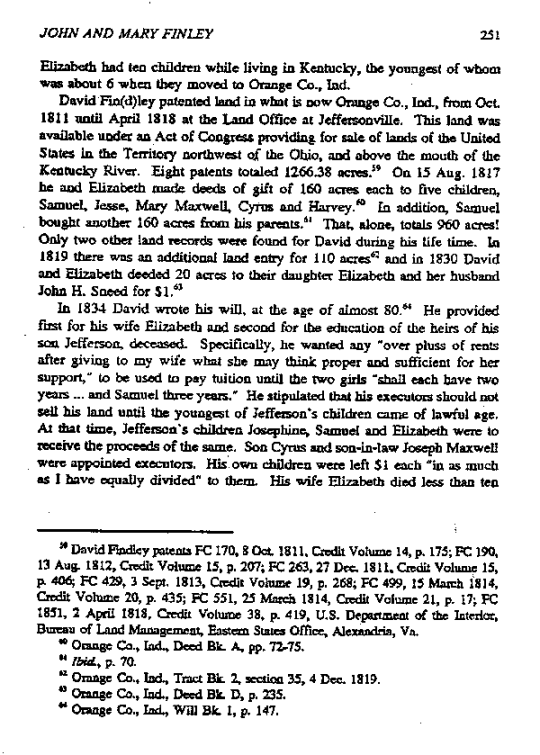
David Fin(ly) patented land in what is now Orange Co., Ind., from Oct. 1811 until April 1818 at the Land Office at Jeffersonville. This land was available under an Act of Congress providing for sale of lands of the United States in the Territory northwest of the Ohio, and above the mouth of the Kentucky River. Eight patents totaled 1266.38 acres.59 On 15 Aug. 1817 he and Elizabeth gave deeds of gift of 100 acres each to five children, Samuel, Jesse, Mary Maxwell, Cyrus and Harvey.60 In addition, Samuel bought another 160 acres from his parents.61 That alone, totals 960 acres! Only two other land records were found for David during his life time. In 1819 there was an additional land entry for 110 acres62 and in 1830 David and Elizabeth deeded 20 acres to their daughter Elizabeth and her husband John H. Sned for $1.63
In 1834 David wrote his will, at the age of almost 80.64 He provided first for his wife Elizabeth and second for the education of the heirs of his son Jefferson, deceased. Specifically, he wanted any “over plus of rents after giving to my wife what she may think proper and sufficient for her support,” to be used to pay tuition until the two girls “shall each have two years … and Samuel three years.” He stipulated that his executors should not sell his land until the youngest of Jefferson’s children came of lawful age. At that time, Jefferson’s children Josephine, Samuel and Elizabeth were to receive the proceeds of the same. Son Cyrus and son-in-law Joseph Maxwell were appointed executors. His own children were left $1 each “in as much as I have equally divided” to them. His wife Elizabeth died less than ten
59 David Finley patents FC 170, 8 Oct. 1811, Credit Volume 14, p. 173; FC 190, 13 Aug. 1812, Credit Volume 15, p. 207; FC 263, 27 Dec. 1811, Credit Volume 15, p. 406; FC 429, 3 Sept. 1813, Credit Volume 19, p. 268; FC 499, 15 March 1814, Credit Volume 20, p. 435; FC 551, 25 March 1814, Credit Volume 21, p. 17; FC 851, 2 April 1818, Credit Volume 38, p. 419, U.S. Department of the Interior, Bureau of Land Management, Eastern States Office, Alexandria, Va.
60 Orange Co., Ind., Deed Bk. A, pp. 72-75.
61 Ibid., p. 70.
62 Orange Co., Ind., Tract Bk. 2, section 35, 4 Dec. 1819.
63 Orange Co., Ind., Deed Bk. D, p. 235.
64 Orange Co., Ind., Will Bk. 1, p. 147.
THE VIRGINIA GENEALOGIST
months later, on 9 Jan. 1835.65
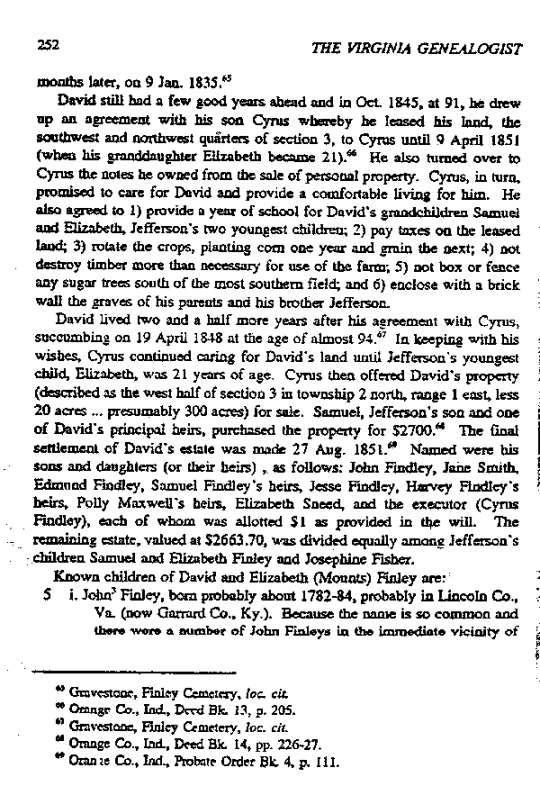
David still had a few good years ahead and in Oct. 1845, at 91, he drew up an agreement with his son Cyrus whereby he leased his land, the southwest and northwest quarters of section 3, to Cyrus until 9 April 1850 (when his granddaughter Elizabeth became 21).66 He also turned over to Cyrus the notes he owned from the sale of personal property. Cyrus, in turn, promised to care for David and provide a comfortable living for him. He also agreed to 1) provide a year of school for David’s grandchildren Samuel and Elizabeth, Jefferson’s two youngest children; 2) pay taxes on the leased land; 3) rotate the crops, planting corn one year and grain the next; 4) not destroy timber more than necessary for use of the farm; 5) not box or fence any sugar trees south of the most southern field; and 6) enclose with a brick wall the graves of his parents and his brother Jefferson.
David lived two and a half more years after his agreement with Cyrus, succumbing on 19 April 1848 at the age of almost 94.67 In keeping with his wishes, Cyrus continued caring for David’s land until Jefferson’s youngest child, Elizabeth, was 21 years of age. Cyrus then offered David’s property (described as the west half of section 3 in township 2 north, range 1 east, less 20 acres … presumably 300 acres) for sale. Samuel, Jefferson’s son and one of David’s principal heirs, purchased the property for $2700.68 The final settlement of David’s estate was made 27 Aug. 1851.69 Named were his sons and daughters (or their heirs), as follows: John Findley, Jane Smith, Edmund Finley, Samuel Finley’s heirs, Jesse Finley, Harvey Findley’s heirs, Polly Maxwell’s heirs, Elizabeth Sned, and the executor (Cyrus Findley), each of whom was allotted $1 as provided in the will. The remaining estate, valued at $2663.70, was divided equally among Jefferson’s children Samuel and Elizabeth Finley and Josephine Fisher.
Known children of David and Elizabeth (Mounts) Finley are:
5 i. John3 Finley, born probably about 1782-84, probably in Lincoln Co., Va. (now Garrard Co., Ky.). Because the name is so common and there were a number of John Finleys in the immediate vicinity of David on the Garrard County tax lists beginning in 1797,70 probably a nephew.
65 Gravestone, Finley Cemetery, loc. cit.
66 Orange Co., Ind., Deed Bk. 13, p. 205.
67 Gravestone, Finley Cemetery, loc. cit.
68 Orange Co., Ind., Deed Bk. 14, pp. 226-27.
69 Orange Co., Ind., Probate Order Bk. 4, p. 111.
70 Garrard Co., Ky., Tax records, LDS films #007988 and #007989.
JOHN AND MARY FINLEY
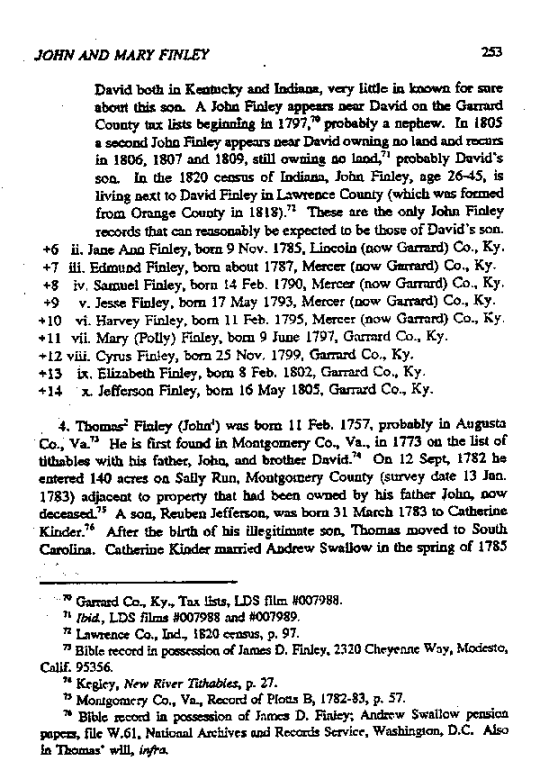
David both in Kentucky and Indiana, very little is known for sure about this son. A John Finley appears near David on the Garrard County tax lists beginning in 1797,70 probably a nephew. In 1805 a second John Finley appears near David owning no land and reappears in 1806, 1807 and 1809, still owning no land,71 probably David’s son. In the 1820 census of Indiana, John Finley, age 26-45, is living next to David Finley in Lawrence County (which was formed from Orange County in 1818).72 These are the only John Finley records that can reasonably be expected to be those of David’s son.
+6 ii. Jane Ann Finley, born 9 Nov. 1785, Lincoln (now Garrard) Co., Ky.
+7 iii. Edmund Finley, born about 1787, Mercer (now Garrard) Co., Ky.
+8 iv. Samuel Finley, born 14 Feb. 1790, Mercer (now Garrard) Co., Ky.
+9 v. Jesse Finley, born 17 May 1793, Mercer (now Garrard) Co., Ky.
+10 vi. Harvey Finley, born 11 Feb. 1795, Mercer (now Garrard) Co., Ky.
+11 vii. Mary (Polly) Finley, born 9 June 1797, Garrard Co., Ky.
+12 viii. Cyrus Finley, born 25 Nov. 1799, Garrard Co., Ky.
+13 ix. Elizabeth Finley, born 8 Feb. 1802, Garrard Co., Ky.
+14 x. Jefferson Finley, born 16 May 1805, Garrard Co., Ky.
4. Thomas2 Finley (John1) was born 11 Feb. 1757, probably in Augusta Co., Va.73 He is first found in Montgomery Co., Va., in 1773 on the list of tithables with his father, John, and brother David.74 On 12 Sept, 1782 he entered 140 acres on Salley Run, Montgomery County (survey date 13 Jan. 1783) adjacent to property that had been owned by his father John, now deceased.75 A son, Reuben Jefferson, was born 31 March 1783 to Catherine Kinder.76 After the birth of his illegitimate son, Thomas moved to South Carolina. Catherine Kinder married Andrew Swallow in the spring of 1785 and Reuben was reared by his mother and Swallow.77
70 Garrard Co., Ky., Tax lists, LDS film #007988.
71 Ibid., LDS films #007988 and #007989.
72 Lawrence Co., Ind., 1820 census, p. 97.
73 Bible record in possession of James D. Finley, 2320 Cheyenne Way, Modesto, Calif. 95356.
74 Kegley, New River Tithables, p. 27.
75 Montgomery Co., Va., Record of Plats B, 1782-83, p. 57.
76 Bible record in possession of James D. Finley; Andrew Swallow pension papers, file W-61, National Archives and Records Service, Washington, D.C. Also in Thomas’ will, infra.
77 Andrew Swallow pension papers, loc. cit.
THE VIRGINIA GENEALOGIST
and Reuben was reared by his mother and Swallow.77
About 1792 Thomas married Jeanne Gibert, daughter of Jean Louis Gibert, probably in Abbeville, S.C.78 On 7 Nov. 1795 John Lewis, his only other known son, was born. Sometime before 1797 Thomas married Sarah (McLane) Stedman Pettigrew.79 He married, for a third time, Jane Clark on 20 Dec. 1808.80
His will, written in 1823 in Abbeville, S.C., and probated 2 Jan. 1832, showed he had become a wealthy land owner and possessed many slaves.81 His appraisement listed 23 slaves and was valued at $8935.40.82 His will was unique in a number of ways. Basically, he left the bulk of his estate to his wife, Jane, and provided specifically she should have his Negroes named Finda, Tom, Jude, William, Caroline, Willey and Rose, along with “all my other negroes.” After her death, all property was to go to his son “Reuben Finley of the State of Tennessee, Wrecewitch, whose mother’s maiden name was Catherine Kinder … on the following conditions … that he emancipate all the female children of my two negro women Hanny and Lincy or cause them to be sent to the State of Indiana or Ohio where by laws of the State will liberate them. The said female children are to be set free as they respectively arrive at the age of twenty five years and all their children with them should they have any, as it is my wish and desire to put a stop to the slavery of the race of negroes belonging to me in future.” He requested Reuben to erect marble headstones for him and Jane and gave their respective birth dates, 11 Feb. 1757 and 8 Nov. 1765. He also directed Reuben to enclose his grave and his wife’s “with a stone wall of five feet high with a shutter to the door of some durable materials, and that spot of ground to be reserved and never conveyed away with the tract of land.” He further bequeathed to his niece, Ann Finley, his “negro boy, Franklin … and negro girl Peggy.” Peggy was to be set free at age 25 and Franklin was not to be
77 Andrew Swallow pension papers, loc. cit.
78 Larry E. Presley, comp., 7500 Marriages from Ninety-Six & Abbeville Districts, S.C., 1774-1850 (Easley, S.C., 1980), p. 65.
79 Ibid.
80 Hester and Makres Service of South Carolina, A Register of Marriages Celebrated & Solemnized by Moses Waddel in South Carolina and Georgia, 1795-1836 (n.p., 1943), p. 6; Presley, loc. cit.
81 Abbeville, S.C., Will Bk. 2, p. 301.
82 Abbeville, S.C., Probate Box 34, pack 732.
JOHN AND MARY FINLEY
bartered or sold out of the family “where I trust he will be well treated.” Thomas Finley Mitchell, son of Francis Mitchel, was to receive his “negro boy Robert.” The death of Reuben Finley prior to that of Thomas’ wife Jane created some problems as will be seen in the following account of Reuben.
The child of Thomas Finley and Catherine Kinder was:
+15 i. Reuben Jefferson Finley, born 31 March 1783, Montgomery (now Wythe) Co., Va.
The only known child of Thomas Finley by his first wife, Jeanne Gibert, was:
16 i. John Lewis3 Finley, born 7 Nov. 1795, Abbeville, S.C.83 He died in Columbia on 7 Sept. 1814, at the age of 18, while in his junior year at South Carolina College (now University of South Carolina).84
(To be continued)
83 Bible record in possession of James D. Finley.
84 Hollace H. Stock, Manuscripts Division, University of South Carolina, to James D. Finley, 17 Feb. 1977.