

aaa-0041.html
Text Version
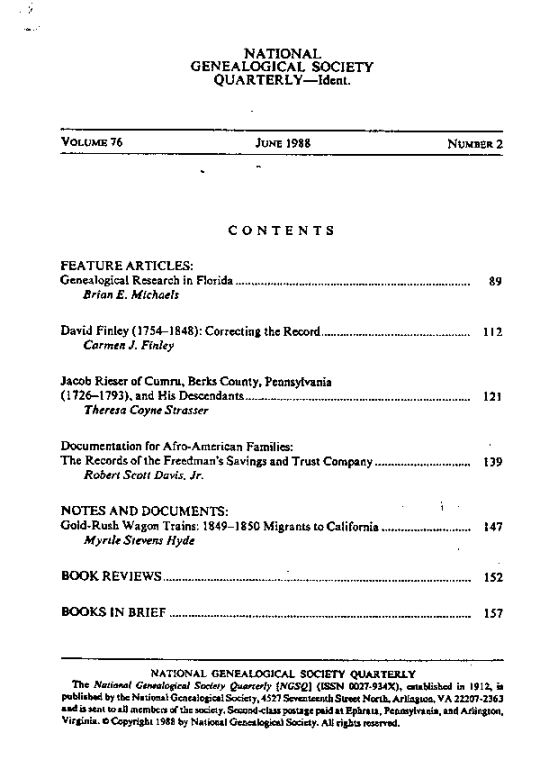
NATIONAL GENEALOGICAL SOCIETY QUARTERLY—Ident.
Volume 76 June 1988 Number 2
CONTENTS
FEATURE ARTICLES:
Genealogical Research in Florida .............................................. 89
Brian E. Michaels
David Finley (1754–1848): Correcting the Record ............................ 112
Carmen J. Finley
Jacob Rieser of Cumru, Berks County, Pennsylvania (1726–1793), and His Descendants ........................................ 121
Theresa Coyne Strasser
Documentation for Afro-American Families:
The Records of the Freedman’s Savings and Trust Company .............. 139
Robert Scott Davis, Jr.
NOTES AND DOCUMENTS:
Gold-Rush Wagon Trains: 1849–1850 Migrants to California .............. 147
Myrtle Stevens Hyde
BOOK REVIEWS ........................................................................ 152
BOOKS IN BRIEF ...................................................................... 157
NATIONAL GENEALOGICAL SOCIETY QUARTERLY
The National Genealogical Society Quarterly (NGSQ) (ISSN 0027-934X), established in 1912, is published by the National Genealogical Society, 4527 Seventeenth Street North, Arlington, VA 22207-2363 and is sent to all members of the society. Second-class postage paid at Emporia, Pennsylvania, and Arlington, Virginia. © Copyright 1988 by National Genealogical Society. All rights reserved.
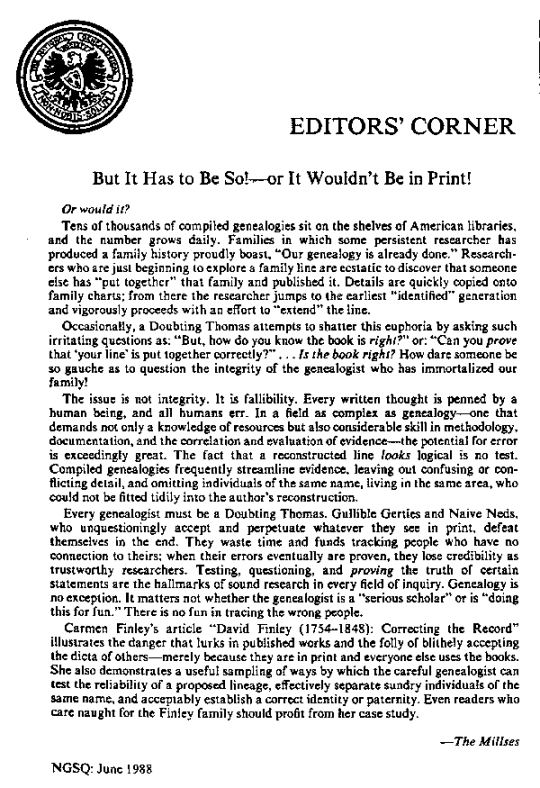
EDITORS’ CORNER
But It Has to Be So!—or It Wouldn’t Be in Print!
Or would it?
Tens of thousands of compiled genealogies sit on the shelves of American libraries, and the number grows daily. Families in which some persistent researcher has produced a family history proudly boast, “Our genealogy is already done.” Researchers who are just beginning to explore a family line are ecstatic to discover that someone else has “put together” that family and published it. Details are quickly copied onto family charts; from there the researcher jumps to the earliest “identified” generation and vigorously proceeds with an effort to “extend” the line.
Occasionally, a Doubting Thomas attempts to shatter this euphoria by asking such irritating questions as: “But, how do you know the book is right?” or: “Can you prove that your line is put together correctly?” . . . Is the book right? How dare someone be so gauche as to question the integrity of the genealogist who has immortalized our family!
The issue is not integrity, it is fallibility. Every written thought is penned by a human being, and all humans err. In a field as complex as genealogy—one that demands not only a knowledge of resources but also considerable skill in methodology, documentation, and the correlation and evaluation of evidence—the potential for error is exceedingly great. The fact that a reconstructed line looks logical is no test. Compiled genealogies frequently streamline evidence, leaving out confusing or conflicting detail, and omitting individuals of the same name, living in the same area, who could not be fitted tidily into the author’s reconstruction.
Every genealogist must be a Doubting Thomas. Gullible Gerics and Naive Neds, who unquestioningly accept and perpetuate whatever they see in print, defeat themselves in the end. They waste time and funds tracking people who have no connection to theirs; when their errors eventually are proven, they lose credibility as trustworthy researchers. Testing, questioning, and proving the truth of certain statements are the hallmarks of sound research in every field of inquiry. Genealogy is no exception. It matters not whether the genealogist is a “serious scholar” or is “doing this for fun.” There is no fun in tracing the wrong people.
Carmen Finley’s article “David Finley (1754–1848): Correcting the Record” illustrates the danger that lurks in published works and the folly of blithely accepting the dicta of others—merely because they are in print and everyone else uses the books. She also demonstrates a useful sampling of ways by which the careful genealogist can test the reliability of a proposed lineage, effectively separate sundry individuals of the same name, and acceptably establish a correct identity or paternity. Even readers who care naught for the Finley family should profit from her case study.
—The Millers
NGSQ: June 1988
David Finley (1754–1848): Correcting the Record
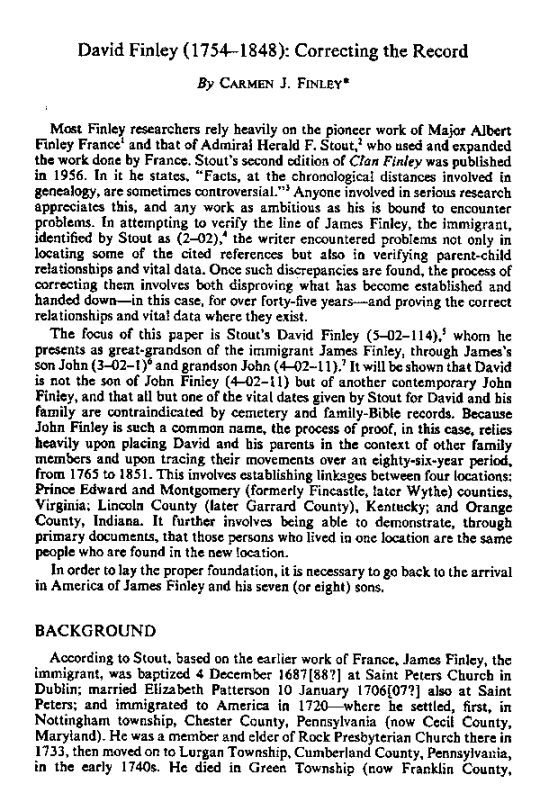
By Carmen J. Finley*
Most Finley researchers rely heavily on the pioneer work of Major Albert Finley France and that of Admiral Herald F. Stout,1 who used and expanded the work done by France. Stout’s second edition of Clan Finley was published in 1956. In it he states, “Facts, at the chronological distances involved in genealogy, are sometimes controversial.”2 Anyone involved in serious research appreciates this, and any work as ambitious as his is bound to encounter problems. In attempting to verify the line of James Finley, the immigrant, identified by Stout as (2–02),4 the writer encountered problems not only in locating some of the cited references but also in verifying parent-child relationships and vital data. Once such discrepancies are found, the process of correcting them involves both disproving what has become established and handed down—in this case, for over forty-five years—and proving the correct relationships and vital data where they exist.
The focus of this paper is Stout’s David Finley (5–02–114),5 whom he presents as great-grandson of the immigrant James Finley, through James’s son John (3–02–1)6 and grandson John (4–02–11).7 It will be shown that David is not the son of John Finley (4–02–11) but of another contemporary John Finley, and that all but one of the vital dates given by Stout for David and his family are contraindicated by cemetery and family-Bible records. Because John Finley is such a common name, the process of proof, in this case, relies heavily upon placing David and his parents in the context of other family members and upon tracing their movements over an eighty-six-year period, from 1765 to 1851. This involves establishing linkages between four locations: Prince Edward and Montgomery (formerly Fincastle, later Wythe) counties, Virginia; Lincoln County (later Garrard County), Kentucky; and Orange County, Indiana. It further involves being able to demonstrate, through primary documents, that those persons who lived in one location are the same people who are found in the new location.
In order to lay the proper foundation, it is necessary to go back to the arrival in America of James Finley and his seven (or eight) sons.
BACKGROUND
According to Stout, based on the earlier work of France, James Finley, the immigrant, was baptized 4 December 1687 [88?] at Saint Peters Church in Dublin; married Elizabeth Patterson 10 January 1706[07?], also at Saint Peters; and emigrated to America in 1720—where he settled, first, in Nottingham township, Chester County, Pennsylvania (now Cecil County, Maryland). He was a member and elder of Rock Presbyterian Church there in 1733, then moved on to Lurgan Township, Cumberland County, Pennsylvania, in the early 1740s. He died in Green Township (now Franklin County,
David Finley
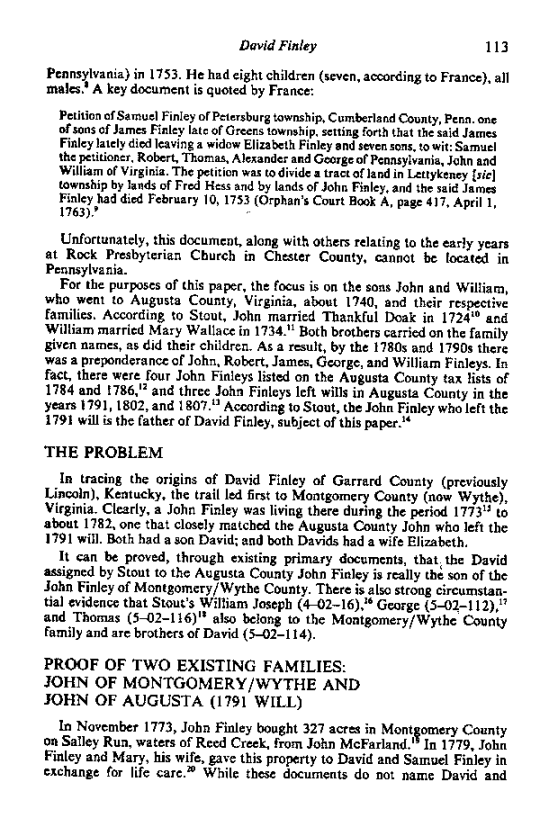
Pennsylvania) in 1753. He had eight children (seven, according to France), all males.8 A key document is quoted by France:
Petition of Samuel Finley of Petersbury township, Cumberland County, Penn. one of sons of James Finley late of Greens township, setting forth that the said James Finley lately died leaving a widow Elizabeth Finley and seven sons, to wit: Samuel the petitioner, Robert, Thomas, Alexander and George of Pennsylvania, John and William of Virginia. The petition was to divide a tract of land in Letterkenny [sic] township by lands of Fred Hess and by lands of John Finley, and the said James Finley had died February 10, 1753 (Orphan’s Court Book A, page 417, April 1, 1763).9
Unfortunately, this document, along with others relating to the early years at Rock Presbyterian Church in Chester County, cannot be located in Pennsylvania.
For the purposes of this paper, the focus is on the sons John and William, who went to Augusta County, Virginia, about 1740, and their respective families. According to Stout, John married Thankful Doak in 172410 and William married Mary Wallace in 1734.11 Both brothers carried on the family given names, as did their children. As a result, by the 1780s and 1790s there was a preponderance of John, Robert, James, George, and William Finleys. In fact, there were four John Finleys listed on the Augusta County tax lists of 1784 and 1786,12 and three John Finleys left wills in Augusta County in the years 1791, 1802, and 1807.13 According to Stout, the John Finley who left the 1791 will is the father of David Finley, subject of this paper.14
THE PROBLEM
In tracing the origins of David Finley of Garrard County (previously Lincoln), Kentucky, the trail led first to Montgomery County (now Wythe), Virginia. Clearly, a John Finley was living there during the period 177315 to about 1782, one that closely matched the Augusta County John who left the 1791 will. Both had a son David; and both Davids had a wife Elizabeth.
It can be proved, through existing primary documents, that the David assigned by Stout to the Augusta County John Finley is really the son of the John Finley of Montgomery/Wythe County. There is also strong circumstantial evidence that Stout’s William Joseph (4–02–16),16 George (5–02–112),17 and Thomas (5–02–116)18 also belong to the Montgomery/Wythe County family and are brothers of David (5–02–114).
PROOF OF TWO EXISTING FAMILIES: JOHN OF MONTGOMERY/WYTHE AND JOHN OF AUGUSTA (1791 WILL)
In November 1773, John Finley bought 327 acres in Montgomery County on Saley Run, waters of Reed Creek, from John McFarland.19 In 1779, John Finley and Mary, his wife, gave this property to David and Samuel Finley in exchange for life care.20 While these documents do not name David and
National Genealogical Society Quarterly
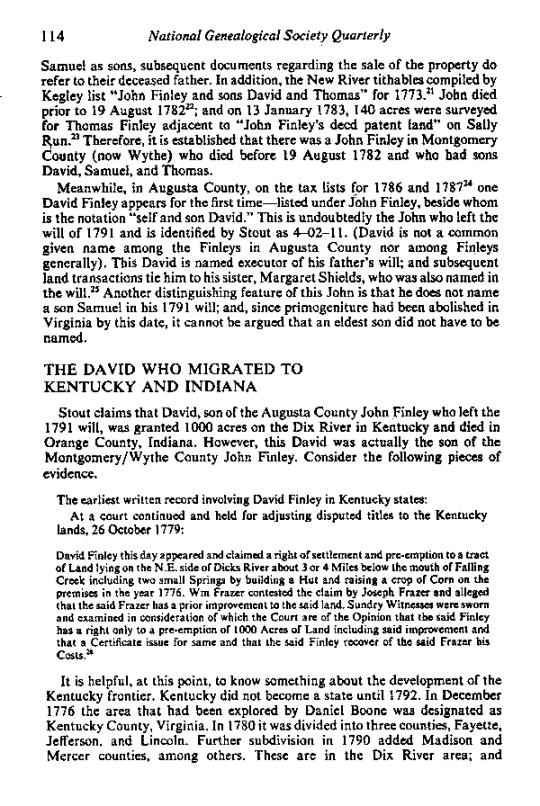
Samuel as sons, subsequent documents regarding the sale of the property do refer to their deceased father. In addition, the New River tithables compiled by Kegley list “John Finley and sons David and Thomas” for 1773.21 John died prior to 19 August 1782,22 and on 13 January 1783, 140 acres were surveyed for Thomas Finley adjacent to “John Finley’s decd patent land” on Sally Run.23 Therefore, it is established that there was a John Finley in Montgomery County (now Wythe) who died before 19 August 1782 and who had sons David, Samuel, and Thomas.
Meanwhile, in Augusta County, on the tax lists for 1786 and 178724 one David Finley appears for the first time—listed under John Finley, beside whom is the notation “self and son David.” This is undoubtedly the John who left the will of 1791 and is identified by Stout as 4–02–11. (David is not a common given name among the Finleys in Augusta County nor among Finleys generally.) This David is named executor of his father’s will; and subsequent land transactions tie him to his sister, Margaret Shields, who was also named in the will.25 Another distinguishing feature of this John is that he does not name a son Samuel in his 1791 will; and, since primogeniture had been abolished in Virginia by this date, it cannot be argued that an eldest son did not have to be named.
THE DAVID WHO MIGRATED TO KENTUCKY AND INDIANA
Stout claims that David, son of the Augusta County John Finley who left the 1791 will, was granted 1000 acres on the Dix River in Kentucky and died in Orange County, Indiana. However, this David was actually the son of the Montgomery/Wythe County John Finley. Consider the following pieces of evidence.
The earliest written record involving David Finley in Kentucky states:
At a court continued and held for adjusting disputed titles to the Kentucky lands, 26 October 1779;
David Finley this day appeared and claimed a right of settlement and pre-emption to a tract of Land lying on the N.E. side of Dixs River about 3 or 4 Miles below the mouth of Falling Creek including two small Springs by building a Hut and raising a crop of Corn on the premises in the year 1776. Wm Frazer contested the claim by Joseph Frazer and alleged that he said Frazer has a prior improvement to the said land. Sundry Witnesses were sworn and examined in consideration of which the Court are of the Opinion that the said Finley has a right only to a pre-emption of 1000 Acres of Land including said improvement and that a Certificate issue for same and that the said Finley recover of the said Frazer his Costs.26
It is helpful, at this point, to know something about the development of the Kentucky frontier. Kentucky did not become a state until 1792. In December 1776 the area that had been explored by Daniel Boone was designated as Kentucky County, Virginia. In 1780 it was divided into three counties, Fayette, Jefferson, and Lincoln. Further subdivision in 1790 added Madison and Mercer counties, among others. These are in the Dix River area; and
David Finley
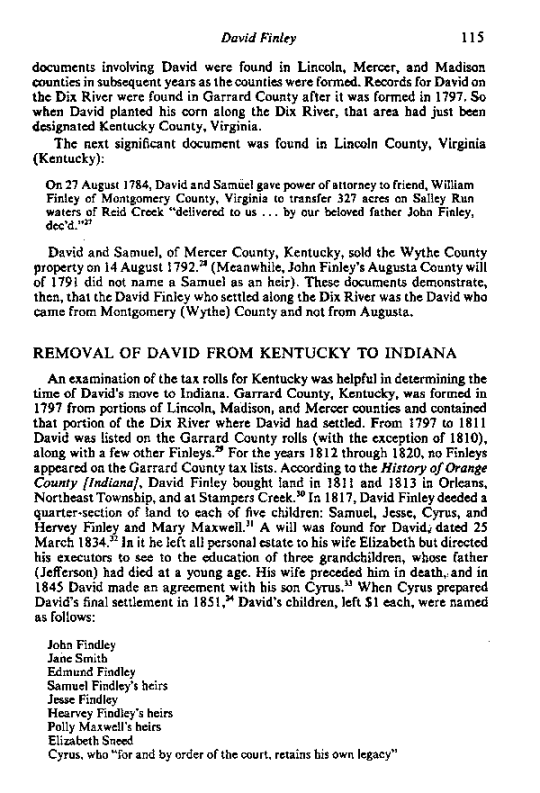
documents involving David were found in Lincoln, Mercer, and Madison counties in subsequent years as the counties were formed. Records for David on the Dix River were found in Garrard County after it was formed in 1797. So when David planted his corn along the Dix River, that area had just been designated Kentucky County, Virginia.
The next significant document was found in Lincoln County, Virginia (Kentucky):
On 27 August 1784, David and Samuel gave power of attorney to friend, William Finley of Montgomery County, Virginia to transfer 327 acres on Saley Run waters of Reid Creek “delivered to us . . . by our beloved father John Finley, decd.”27
David and Samuel, of Mercer County, Kentucky, sold the Wythe County property on 14 August 1792.28 (Meanwhile, John Finley’s Augusta County will of 1791 did not name a Samuel as an heir). These documents demonstrate, then, that the David Finley who settled along the Dix River was the David who came from Montgomery (Wythe) County and not from Augusta.
REMOVAL OF DAVID FROM KENTUCKY TO INDIANA
An examination of the tax rolls for Kentucky was helpful in determining the time of David’s move to Indiana. Garrard County, Kentucky, was formed in 1797 from portions of Lincoln, Madison, and Mercer counties and contained that portion of the Dix River where David had settled. From 1797 to 1811 David was listed on the Garrard County rolls (with the exception of 1810), along with a few other Finleys.29 For the years 1812 through 1820, no Finleys appeared on the Garrard County tax lists. According to the History of Orange County Indiana, David Finley bought land in 1811 and 1813 in Orleans, Northeast Township, and at Stampers Creek.30 In 1817, David Finley deeded a quarter-section of land to each of five children: Samuel, Jesse, Cyrus, and Hervey Finley and Mary Maxwell.31 A will was found for David, dated 25 March 1834.32 In it he left all personal estate to his wife Elizabeth but directed his executors to see to the education of three grandchildren, whose father (Jefferson) had died at a young age. His wife predeceased him in death, and in 1848 David made an agreement with his son Cyrus.33 When Cyrus prepared David’s final settlement in 1851,34 David’s children, left $1 each, were named as follows:
John Findley
Jane Smith
Edmund Findley
Samuel Findley’s heirs
Jesse Findley
Hervey Findley’s heirs
Polly Maxwell’s heirs
Elizabeth Sneed
Cyrus, who “for and by order of the court, retains his own legacy”
David Finley
PRE-MONTGOMERY RESIDENCE OF JOHN FINLEY
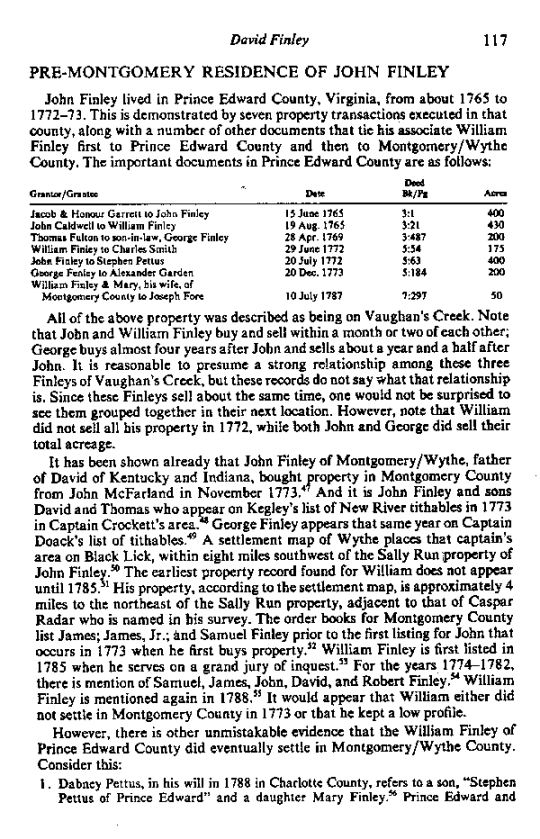
John Finley lived in Prince Edward County, Virginia, from about 1765 to 1772–73. This is demonstrated by seven property transactions executed in that county, along with a number of other documents that tie his associate William Finley first to Prince Edward County and then to Montgomery/Wythe County. The important documents in Prince Edward County are as follows:
| Grantor/Grantee | Date | Deed Bk./Pg. | Acres |
|---|---|---|---|
| Jacob & Honour Garrett to John Finley | 15 June 1765 | 3:1 | 400 |
| John Caldwell to William Finley | 19 Aug. 1765 | 3:21 | 430 |
| Thomas Fulton to son-in-law, George Finley | 28 Apr. 1769 | 5:487 | 200 |
| William Finley to Charles Smith | 29 June 1772 | 5:54 | 175 |
| John Finley to Stephen Pettus | 20 July 1772 | 5:63 | 400 |
| George Finley to Alexander Garden | 20 Dec. 1773 | 5:184 | 200 |
| William Finley & Mary, his wife, of Montgomery County to Joseph Fore | 10 July 1787 | 7:297 | 50 |
All of the above property was described as being on Vaughan’s Creek. Note that John and William Finley buy and sell within a month or two of each other; George buys almost four years after John and sells about a year and a half after John. It is reasonable to presume a strong relationship among these three Finleys of Vaughan’s Creek, but these records do not say what that relationship is. Since these Finleys sell about the same time, one would not be surprised to see them grouped together in their next location. However, note that William did not sell all his property in 1772, while both John and George did sell their total acreage.
It has been shown already that John Finley of Montgomery/Wythe, father of David of Kentucky and Indiana, bought property in Montgomery County from John McFarland in November 1773,35 and it is John Finley and sons David and Thomas who appear on Kegley’s list of New River tithables in 1773 in Captain Crockett’s area.36 George Finley appears that same year on Captain Doack’s list of tithables.37 A settlement map of Wythe places that captain’s area on Black Lick, within eight miles southwest of the Sally Run property of John Finley.38 The earliest property record found for William does not appear until 1785.39 His property, according to the settlement map, is approximately 4 miles to the northeast of the Sally Run property, adjacent to that of Casper Radar who is named in his survey. The order books for Montgomery County list James, James, Jr., and Samuel Finley prior to the first listing for John that occurs in 1773 when he first buys property.40 William Finley is first listed in 1785 when he serves on a grand jury of inquest.41 For the years 1774–1782, there is mention of Samuel, James, John, David, and Robert Finley.42 William Finley is mentioned again in 1788.43 It would appear that William either did not settle in Montgomery County in 1773 or that he kept a low profile.
However, there is other unmistakable evidence that the William Finley of Prince Edward County did eventually settle in Montgomery/Wythe County. Consider this:
1. Dabney Pettus, in his will in 1788 in Charlotte County, refers to a son, “Stephen Pettus of Prince Edward” and a daughter Mary Finley.44 Prince Edward and
National Genealogical Society Quarterly
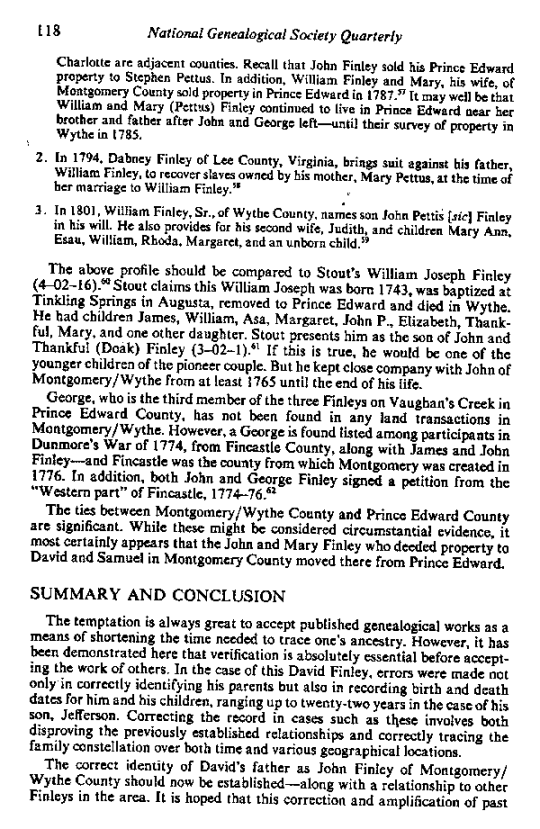
Charlotte are adjacent counties. Recall that John Finley sold his Prince Edward property to Stephen Pettus. In addition, William Finley and Mary, his wife, of Montgomery County sold property in Prince Edward in 1787.45 It may well be that William and Mary (Pettus) Finley continued to live in Prince Edward near her brother and father after John and George left—until their survey of property in Wythe in 1785.
2. In 1794, Dabney Finley of Lee County, Virginia, brings suit against his father, William Finley, to recover slaves owned by his mother, Mary Pettus, at the time of her marriage to William Finley.46
3. In 1801, William Finley, Sr., of Wythe County, names son John Pettis [sic] Finley in his will. He also provides for his second wife, Judith, and children Mary Ann, Esau, William, Rhoda, Margaret, and an unborn child.47
The above profile should be compared to Stout’s William Joseph Finley (4–02–16).48 Stout claims this William Joseph was born 1743, was baptized at Tinkling Springs in Augusta, removed to Prince Edward and died in Wythe. He had children James, William, Asa, Margaret, John P., Elizabeth, Thankful, Mary, and one other daughter. Stout presents him as the son of John and Thankful (Doak) Finley (3–02–1).49 If this is true, he would be one of the younger children of the pioneer couple. But he kept close company with John of Montgomery/Wythe from at least 1765 until the end of his life.
George, who is the third member of the three Finleys on Vaughan’s Creek in Prince Edward County, has not been found in any land transactions in Montgomery/Wythe. However, a George is found listed among participants in Dunmore’s War of 1774, from Fincastle County, along with James and John Finley—and Fincastle was the county from which Montgomery was created in 1776. In addition, both John and George Finley signed a petition from the “Western part” of Fincastle, 1774–76.50
The ties between Montgomery/Wythe County and Prince Edward County are significant. While these might be considered circumstantial evidence, it most certainly appears that the John and Mary Finley who deeded property to David and Samuel in Montgomery County moved there from Prince Edward.
SUMMARY AND CONCLUSION
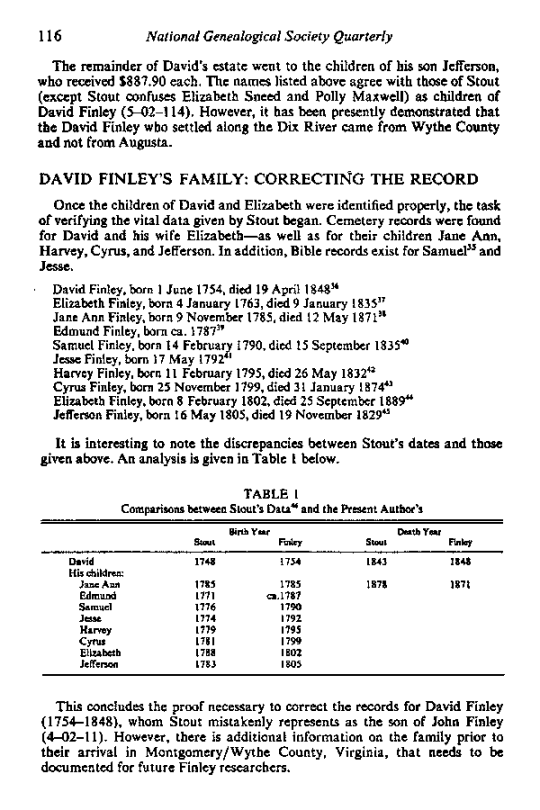
The temptation is always great to accept published genealogical works as a means of shortening the time needed to trace one’s ancestry. However, it has been demonstrated here that verification is absolutely essential before accepting the work of others. In the case of this David Finley, errors were made not only in correctly identifying his parents but also in recording birth and death dates for him and his children, ranging up to twenty-two years in the case of his son, Jefferson. Correcting the record in cases such as these involves both disproving the previously established relationships and correctly tracing the family constellation over both time and various geographical locations.
The correct identity of David’s father as John Finley of Montgomery/Wythe County should now be established—along with a relationship to other Finleys in the area. It is hoped that this correction and amplification of past
David Finley
information will provide a base for further research that might more conclusively document the parentage of David’s father, John. Perhaps the trail may yet lead back to Augusta County.
NOTES AND REFERENCES
1. Carmen J. Finley, 4520 Rockridge Lane, Santa Rosa, CA 95409. Dr. Finley acknowledges the assistance of Sharon B. Hammer, C.G.R.S., of Charlottesville, Virginia, and Pearl Wilson of Paoli, Indiana, in helping documentary materials for this study.
2. Albert Finley France, “The Clan Finley” (manuscript, 73 pp., 1942, Historical Society of Indiana County, Penn.), filmed by Genealogical Society of Utah (GSU) in 1966, film no. 0481791, item 3.
3. Herald F. Stout, The Clan Finley, 2nd ed. (Dover, Ohio: Engle Press, 1956).
4. Ibid., 12.
5. Ibid., 105. This David is the third-great-grandfather of the writer.
6. Ibid., 37.
7. Ibid., 61.
8. Ibid., 22.
9. Albert Finley France, untitled 54-page compilation (Annapolis, Md., 1940).
10. Stout, Clan Finley, 37.
11. Ibid.
12. Augusta County Tax Lists, 1784, 1786; manuscript returns located in Virginia State Archives, Richmond.
13. Augusta County Will Books, 7:404, 9:242, 10:172.
14. Stout, Clan Finley, 105.
15. This area was officially Fincastle County until 1776. However, Montgomery County’s order books begin 5 January 1773, and it is there the original Finley land transactions are recorded.
16. Ibid., 62.
17. Ibid., 104.
18. Ibid., 105.
19. Montgomery County Order Book, 1:142.
20. Montgomery County Deed Book A:283, A:298.
21. Mary B. Kegley, New River Tithables (Wytheville, Va.: privately printed, 1941), 27.
22. Montgomery County Deed Book, A:284 states that heirs of John Finley were legal notice on 19 August 1782.
23. Montgomery County Record of Plats, reel 33, B:57.
24. Augusta County Personal Property Tax Records, 1786.
25. Augusta County Will Book, 7:404.
26. H. V. McChesney, ed., “Certificate Book,” Kentucky State Historical Society Register 21 (January 1923): 20.
27. Lincoln County Deed Book, A:338.
28. Wythe County Deed Book, 1:84.
29. Kentucky Tax Records, GSU films no. 007968 and no. 007989.
30. History of Orange County (Paoli, Ind.: Stout’s Print Shop, 1865), reprinted from History of Lawrence, Orange, and Washington Counties (published 1884; no author, editor, or publisher indicated on reprint), 383, 405, 408.
31. Orange County Deed Book, A:70–75.
32. Orange County Will Book, A:147.
33. Orange County Deed Book, 13:205.
34. Orange County Probate Book, 4:111.
35. Samuel is the great-great-grandfather of the writer.
36. Orange County, Indiana, Cemetery Records (Paoli, Ind.: Lost River Chapter, Daughters of the American Revolution [DAR], 1943), 224 (Finley Cemetery at Orleans).
National Genealogical Society Quarterly
37. Ibid.
38. Kentucky Cemetery Records 1 (Frankfort: Kentucky Society, DAR, 1960), 171 (Burris Tavern Cemetery at Bryantsville, Garrard County).
39. Estimated from age given on 1850 federal census, population schedule, Hopkins County, Texas, p. 22; residence of Lewis Finley.
40. Bible record in possession of author. Samuel died in Decatur, Macon County, Illinois, and is probably buried there.
41. Bible record in possession of Jeanne Harmon, 1310 Aldridge Street, Commerce, TX 75428; copy verified by author.
42. Orange County Cemetery Records, 5 (Trimble Cemetery).
43. Green Hill Cemetery at Orleans, Orange County, Indiana; data read from tombstone marker described as “tall, substantial stone . . . letters very clear,” November 1987. The published DAR reading of this marker is in error.
44. Information provided by Robert Morton, 2307 West 229th Place, Torrance, CA 90501, who has picture of tombstone marker, verified by author.
45. Orange County Cemetery Records, 224 (Orleans, Finley Cemetery).
46. Stout, Clan Finley, 105.
47. Montgomery County Order Book, 1:142.
48. Kegley, New River Tithables, 27.
49. Ibid., 29.
50. F. B. Kegley and Mary B. Kegley, “A Settlement Map of Wythe County, Virginia” (Wytheville: Roanoke Valley Historical Society, 1974).
51. Montgomery County Survey Book, 220.
52. Montgomery County Order Books, 1:2, 3, 69, 78, 94, 97, 115.
53. Ibid., 256.
54. Ibid., 2:41, 43, 139, 177, 181, 192, 197, 261, 264, 266, 269–70, 283, 285, 298–99, 308–310, 316, 320–21, 338.
55. Ibid., 4:17.
56. J. G. Herndon, “Some of the Descendants of the Rev. John Thomson (1694–1753),” Virginia Magazine of History and Biography 51 (October 1943): 394–404; reprinted in Genealogies of Virginia Families, vol. (Baltimore: Genealogical Publishing Company, 1981), 8:546–64.
57. Prince Edward County Deed Book, 7:297.
58. Wythe County Deed Book, 2:477.
59. Wythe County Will Book, 1:202.
60. Stout, Clan Finley, 62.
61. Ibid., 37.
62. Richard B. Harwell, ed., Proceedings of the County Committees, 1774–1776, the Committees of Westmoreland & Fincastle (Richmond: Virginia State Library Publications no. 1, 1956), 103–04.
MOHAWK VALLEY ANCESTRY?
Send surname(s) & SASE for details on “Report” of 18th & early 19th century primary source data: marriages, births/baptisms, deaths, probate, land, census, & military.
MARLYL B. PENROSE, C.G.
P.O. BOX 59
FRANKLIN PARK, NEW JERSEY 08823
MICROGEN
SINCE 1977
P.O. BOX 11956
SALT LAKE CITY, UTAH 84147-0956
(801) 533-8472
Genealogical Research
and Publications
DISCOVER YOUR HERITAGE