

aaa-0043.html
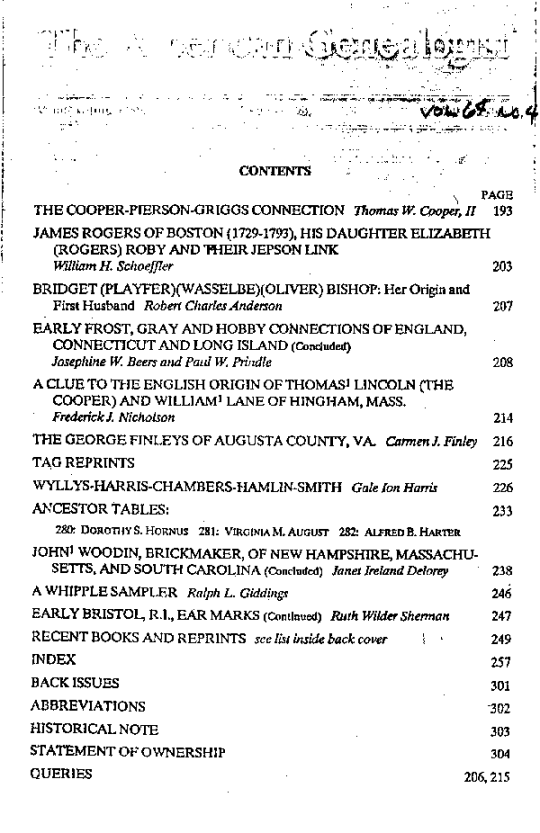
Contents
- The Cooper-Pierson-Griggs Connection. Thomas W. Cooper, II. Page 193
- James Rogers of Boston (1729–1793), His Daughter Elizabeth (Rogers) Roby and Their Jepson Link. William H. Schoeffler. Page 203
- Bridget (Playfer)(Wasselbe)(Oliver) Bishop: Her Origin and First Husband. Robert Charles Anderson. Page 207
- Early Frost, Gray and Hobby Connections of England, Connecticut and Long Island (Concluded). Josephine W. Beers and Paul W. Prindle. Page 208
- A Clue to the English Origin of Thomas1 Lincoln (the Cooper) and William1 Lane of Hingham, Mass. Frederick J. Nicholson. Page 214
- The George Finleys of Augusta County, VA. Carmen J. Finley. Page 216
- TAG Reprints. Page 225
- Wyllys-Harris-Chambers-Hamlin-Smith. Gale Ion Harris. Page 226
- Ancestor Tables. Page 233
- 280: Dorothy S. Hornus
- 281: Virginia M. August
- 282: Alfred B. Harter
- John Woodin, Brickmaker, of New Hampshire, Massachusetts, and South Carolina (Concluded). Janet Ireland Delorey. Page 238
- A Whipple Sampler. Ralph L. Giddings. Page 246
- Early Bristol, R.I., Ear Marks (Continued). Ruth Wilder Sherman. Page 247
- Recent Books and Reprints (see list inside back cover). Page 249
- Index. Page 257
- Back Issues. Page 301
- Abbreviations. Page 302
- Historical Note. Page 303
- Statement of Ownership. Page 304
- Queries. Pages 206 and 215
Page 216
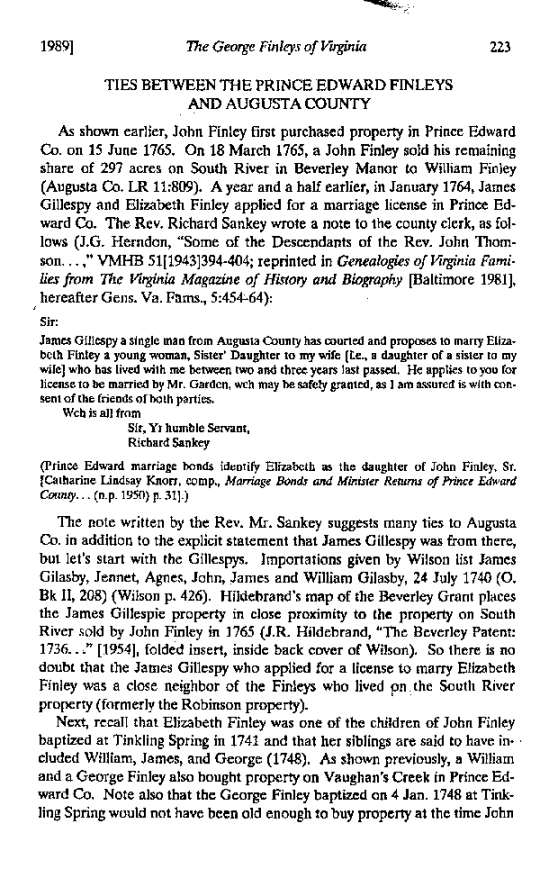
The George Finleys of Augusta County, Va.
By Carmen J. Finley, Ph.D.
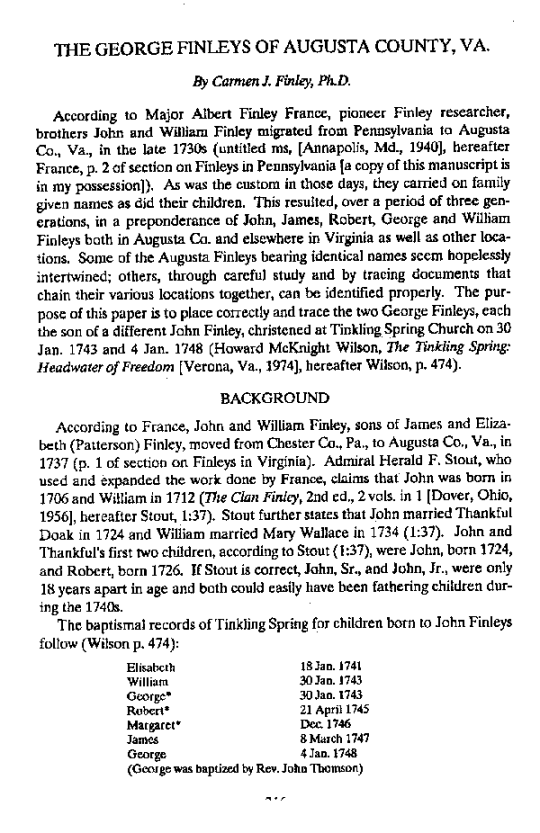
According to Major Albert Finley France, pioneer Finley researcher, brothers John and William Finley migrated from Pennsylvania to Augusta Co., Va., in the late 1730s (untitled ms. [Annapolis, Md., 1940], hereafter France, p. 2 of section on Finleys in Pennsylvania [copy of this manuscript is in my possession]). As was the custom in those days, they carried on family given names as did their children. This resulted, over a period of three generations, in a preponderance of John, James, Robert, George and William Finleys both in Augusta Co. and elsewhere in Virginia as well as other locations. Some of the Augusta Finleys bearing identical names seem hopelessly intertwined; others, through careful study and by tracing documents that chain their various locations together, can be identified properly. The purpose of this paper is to place correctly and trace the two George Finleys, each the son of a different John Finley, christened at Tinkling Spring Church on 30 Jan. 1743 and 4 Jan. 1748 (Howard McKnight Wilson, The Tinkling Spring: Headwater of Freedom [Verona, Va., 1974], hereafter Wilson, p. 474).
Background
According to France, John and William Finley, sons of James and Elizabeth (Patterson) Finley, moved from Chester Co., Pa., to Augusta Co., Va., in 1737 (p. 1 of section on Finleys in Virginia). Admiral Herald F. Stout, who used and expanded the work done by France, claims that John was born in 1706 and William in 1712 (The Clan Finley, 2nd ed., 2 vols. n. p. [Dover, Ohio, 1956], hereafter Stout, I:37). Stout further states that John married Thankful Doak in 1724 and William married Mary Wallace in 1734 (I:37). John and Thankful’s first two children, according to Stout (I:37), were John, born 1724, and Robert, born 1726. If Stout is correct, John, Sr., and John, Jr., were only 18 years apart in age and both could easily have been fathering children during the 1740s.
The baptismal records of Tinkling Spring for children born to John Finleys follow (Wilson p. 474):
- Elisabeth — 18 Jan. 1741
- William — 30 Jan. 1743
- George — 30 Jan. 1743
- Robert — 21 April 1745
- Margaret — Dec. 1746
- James — 8 March 1747
- George — 4 Jan. 1748
(George was baptized by Rev. John Thomson)
Page 217
1989] The George Finleys of Virginia 217
These records are apparently of the children of two fathers named John Finley; the asterisks in the printed version indicate that Wilson believed that the children so marked belonged to one family.
GEORGE FINLEY I
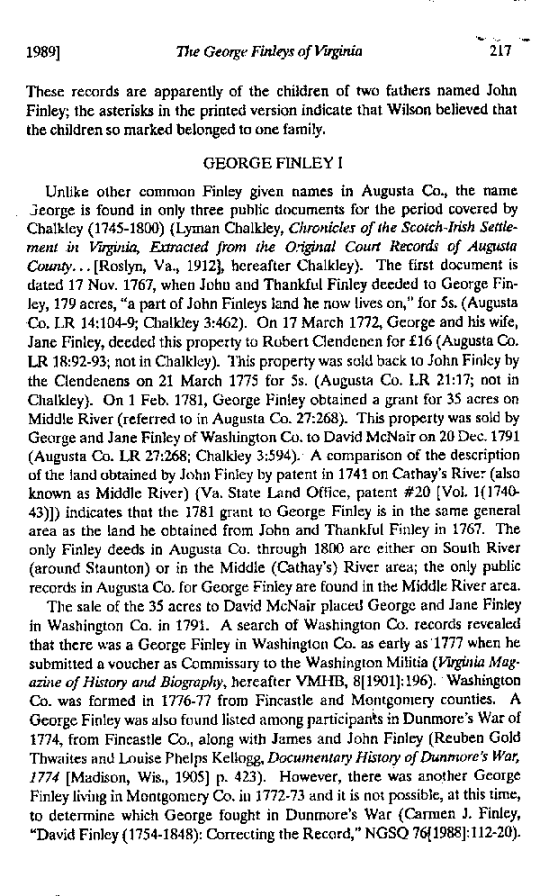
Unlike other common Finley given names in Augusta Co., the name George is found in only three public documents for the period covered by Chalkley (1745-1800) (Lyman Chalkley, Chronicles of the Scotch-Irish Settle-ment in Virginia, Extracted from the Original Court Records of Augusta County... [Roslyn, Va., 1912], hereafter Chalkley). The first document is dated 17 Nov. 1767, when John and Thankful Finley deeded to George Finley, 179 acres, “a part of John Finleys land he now lives on,” for 5s. (Augusta Co. LR 14:104-9; Chalkley 3:462). On 17 March 1772, George and his wife, Jane Finley, deeded this property to Robert Clendencen for £16 (Augusta Co. LR 18:92-93; not in Chalkley). This property was sold back to John Finley by the Clendencens on 21 March 1775 for 5s. (Augusta Co. LR 21:17; not in Chalkley). On 1 Feb. 1781, George Finley obtained a grant for 35 acres on Middle River (referred to in Augusta Co. 27:268). This property was sold by George and Jane Finley of Washington Co. to David McNair on 20 Dec. 1791 (Augusta Co. LR 27:268; Chalkley 3:594). A comparison of the description of the land obtained by John Finley by patent in 1741 on Cathey’s River (also known as Middle River) (Va. State Land Office, patent #20 [Vol. 1,1740-43]) indicates that the 1781 grant to George Finley is in the same general area as the land he obtained from John and Thankful Finley in 1767. The only Finley deeds in Augusta Co. through 1800 are either on South River (around Staunton) or in the Middle (Cathey’s) River area; the only public records in Augusta Co. for George Finley are found in the Middle River area.
The sale of the 35 acres to David McNair placed George and Jane Finley in Washington Co. in 1791. A search of Washington Co. records revealed that there was a George Finley in Washington Co. as early as 1777 when he submitted a voucher as Commissary to the Washington Militia (Virginia Mag-azine of History and Biography, hereafter VMHB, 8[1901]:196). Washington Co. was formed in 1776-77 from Fincastle and Montgomery counties. A George Finley was also found listed among participants in Dunmore’s War of 1774, from Fincastle Co., along with James and John Finley (Reuben Gold Thwaites and Louise Phelps Kellogg, Documentary History of Dunmore’s War, 1774 [Madison, Wis., 1905] p. 423). However, there was another George Finley living in Montgomery Co. in 1772-73 and it is not possible, at this time, to determine which George fought in Dunmore’s War (Carmen J. Finley, “David Finley (1754-1848): Correcting the Record,” NGSQ 76[1988]:112-20).
Page 218
218* The American Genealogist [October
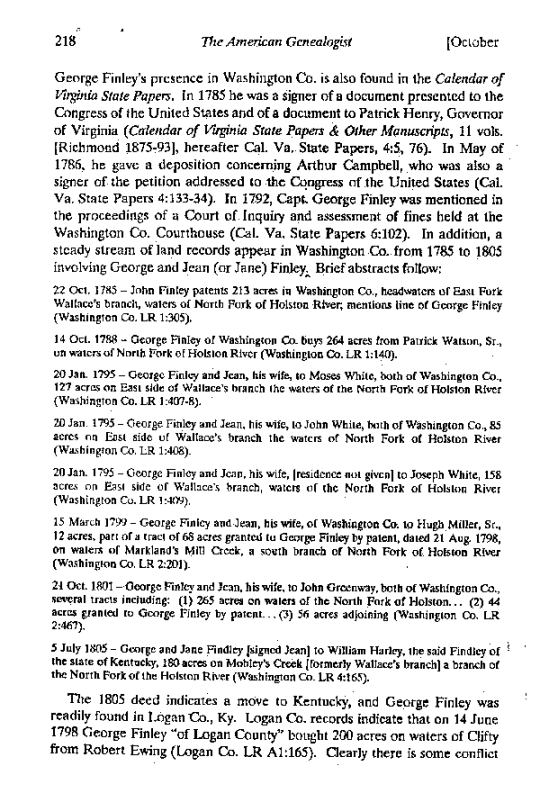
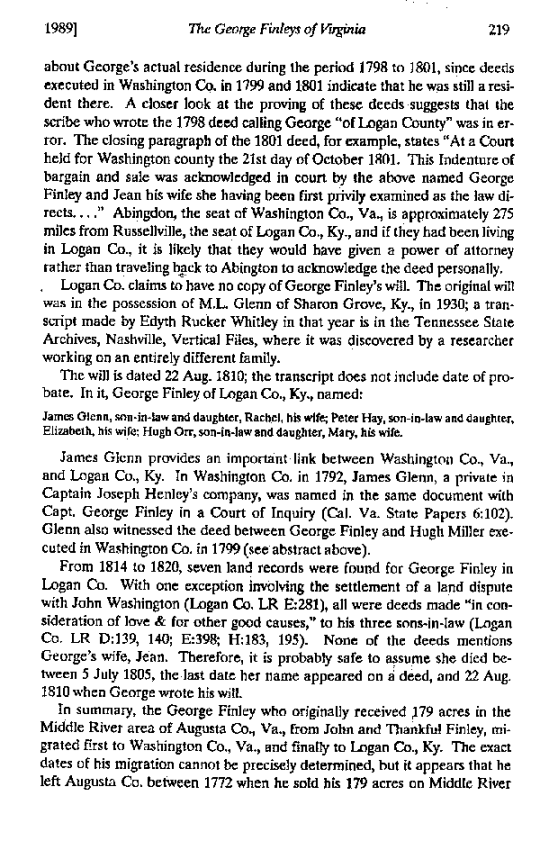
George Finley’s presence in Washington Co. is also found in the Calendar of Virginia State Papers. In 1785 he was a signer of a document presented to the Congress of the United States and of a document to Patrick Henry, Governor of Virginia (Calendar of Virginia State Papers & Other Manuscripts, 11 vols. [Richmond 1875-93], hereafter Cal. Va. State Papers, 4:5, 76). In May of 1786, he gave a deposition concerning Arthur Campbell, who was also a signer of the petition addressed to the Congress of the United States (Cal. Va. State Papers 4:133-34). In 1792, Capt. George Finley was mentioned in the proceedings of a Court of Inquiry and assessment of fines held at the Washington Co. Courthouse (Cal. Va. State Papers 6:102). In addition, a steady stream of land records appear in Washington Co. from 1785 to 1805 involving George and Jean (or Jane) Finley. Brief abstracts follow:
- 22 Oct. 1785 — John Finley patents 213 acres in Washington Co., headwaters of East Fork Wallace’s branch, waters of North Fork of Holston River; mentions line of George Finley (Washington Co. LR 1:305).
- 14 Oct. 1788 — George Finley of Washington Co. buys 264 acres from Patrick Watson, Sr., on waters of North Fork of Holston River (Washington Co. LR 1:140).
- 20 Jan. 1795 — George Finley and Jean, his wife, to Moses White, both of Washington Co., 127 acres on East side of Wallace’s branch the waters of the North Fork of Holston River (Washington Co. LR 1:407-8).
- 20 Jan. 1795 — George Finley and Jean, his wife, to John White, both of Washington Co., 85 acres, on East side of Wallace’s branch the waters of North Fork of Holston River (Washington Co. LR 1:408).
- 20 Jan. 1795 — George Finley and Jean, his wife, [residence not given] to Joseph White, 158 acres on East side of Wallace’s branch, waters of the North Fork of Holston River (Washington Co. LR 1:409).
- 15 March 1799 — George Finley and Jean, his wife, of Washington Co. to Hugh Miller, Sr., 12 acres, part of a tract of 68 acres granted to George Finley by patent, dated 21 Aug. 1798, on waters of Markland’s Mill Creek, a south branch of North Fork of Holston River (Washington Co. LR 2:231).
- 21 Oct. 1801 — George Finley and Jean, his wife, to John Greenway, both of Washington Co., several tracts including: (1) 265 acres on waters of the North Fork of Holston... (2) 44 acres granted to George Finley by patent... (3) 56 acres adjoining (Washington Co. LR 2:467).
- 5 July 1805 — George and Jane Findley [signed Jean] to William Hartley, the said Findley of the state of Kentucky, 180 acres on Mockey’s Creek [formerly Wallace’s branch] a branch of the North Fork of the Holston River (Washington Co. LR 4:165).
The 1805 deed indicates a move to Kentucky, and George Finley was readily found in Logan Co., Ky. Logan Co. records indicate that on 14 June 1798 George Finley “of Logan County” bought 200 acres on waters of Clifty from Robert Ewing (Logan Co. LR A1:165). Clearly there is some conflict
Page 219
1989] The George Finleys of Virginia 219
about George’s actual residence during the period 1798 to 1801, since deeds executed in Washington Co. in 1799 and 1801 indicate that he was still a resident there. A closer look at the proving of these deeds suggests that the scribe who wrote the 1798 deed calling George “of Logan County” was in error. The closing paragraph of the 1801 deed, for example, states “At a Court held for Washington county the 21st day of October 1801. This Indenture of bargain and sale was acknowledged in court by the above named George Finley and Jean his wife the having been first privily examined as the law directs. . .” Abingdon, the seat of Washington Co., Va., is approximately 275 miles from Russellville, the seat of Logan Co., Ky., and if they had been living in Logan Co., it is likely that they would have given a power of attorney rather than traveling back to Abington to acknowledge the deed personally.
Logan Co. claims to have no copy of George Finley’s will. The original will was in the possession of M.L. Glenn of Sharon Grove, Ky., in 1930; a transcript made by Edyth Rucker Whitley in that year is in the Tennessee State Archives, Nashville, Vertical Files, where it was discovered by a researcher working on an entirely different family.
The will is dated 22 Aug. 1810; the transcript does not include date of probate. In it, George Finley of Logan Co., Ky., named: James Glenn, son-in-law and daughter, Rachel, his wife; Peter Hay, son-in-law and daughter, Elizabeth, his wife; Hugh Orr, son-in-law and daughter, Mary, his wife.
James Glenn provides an important link between Washington Co., Va., and Logan Co., Ky. In Washington Co. in 1792, James Glenn, a private in Captain Joseph Henley’s company, was named in the same document with Capt. George Finley in a Court of Inquiry (Cal. Va. State Papers 6:102). Glenn also witnessed the deed between George Finley and Hugh Miller executed in Washington Co. in 1799 (see abstract above).
From 1814 to 1820, seven land records were found for George Finley in Logan Co. With one exception involving the settlement of a land dispute with John Washington (Logan Co. LR E:281), all were deeds made “in consideration of love & for other good causes,” to his three sons-in-law (Logan Co. LR D:139, 140; E:398; H:183, 195). None of the deeds mentions George’s wife, Jean. Therefore, it is probably safe to assume she died between 5 July 1805, the last date her name appeared on a deed, and 22 Aug. 1810 when George wrote his will.
In summary, the George Finley who originally received 179 acres in the Middle River area of Augusta Co., Va., from John and Thankful Finley, migrated first to Washington Co., Va., and finally to Logan Co., Ky. The exact dates of his migration cannot be precisely determined, but it appears that he left Augusta Co. between 1772 when he sold his 179 acres on Middle River
Page 220
220 The American Genealogist [October
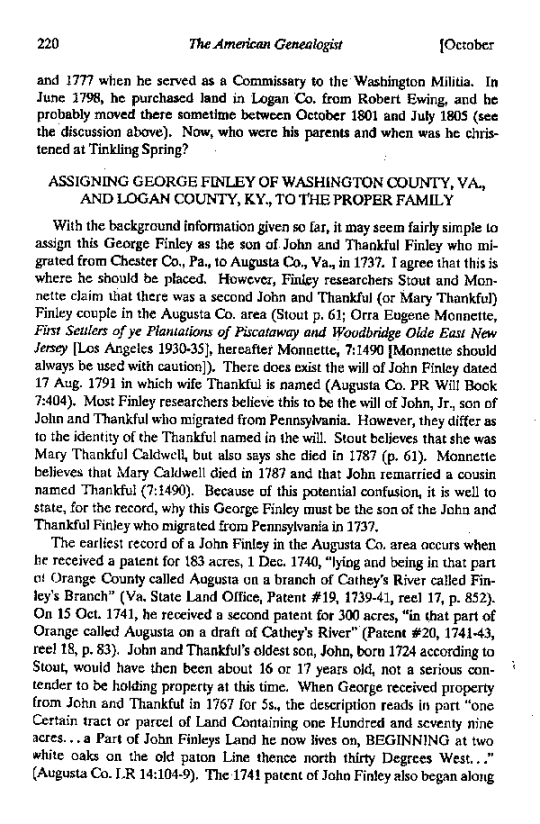
and 1777 when he served as a Commissary to the Washington Militia. In June 1798, he purchased land in Logan Co. from Robert Ewing, and he probably moved there sometime between October 1801 and July 1805 (see the discussion above). Now, who were his parents and when was he christened at Tinkling Spring?
ASSIGNING GEORGE FINLEY OF WASHINGTON COUNTY, VA.,
AND LOGAN COUNTY, KY., TO THE PROPER FAMILY
With the background information given so far, it may seem fairly simple to assign this George Finley as the son of John and Thankful Finley who migrated from Chester Co., Pa., to Augusta Co., Va., in 1737. I agree that this is where he should be placed. However, Finley researchers Stout and Monnette claim that there was a second John and Thankful (or Mary Thankful) Finley couple in the Augusta Co. area (Stout p. 61; Orr, Eugene Monnette, First Settlers of ye Plantation of Piscataway and Woodbridge Olde East New Jersey [Los Angeles 1930-35], hereafter Monnette, 7:1490 [Monnette should always be used with caution]). There does exist the will of John Finley dated 17 Aug. 1791 in which wife Thankful is named (Augusta Co. PR Will Book 7:404). Most Finley researchers believe it to be the will of John, Jr., son of John and Thankful who migrated from Pennsylvania. However, they differ as to the identity of the Thankful named in the will. Stout believes that she was Mary Thankful Caldwell, but also says he died in 1787 (p. 61). Monnette believes that Mary Caldwell died in 1787 and that John remarried a cousin named Thankful (7:1490). Because of this potential confusion, it is well to state, for the record, why this George Finley must be the son of the John and Thankful Finley who migrated from Pennsylvania in 1737.
The earliest record of a John Finley in the Augusta Co. area occurs when he received a patent for 183 acres, 1 Dec. 1740, “lying and being in that part of Orange County called Augusta on a branch of Cathey's River called Finley's Branch” (Va. State Land Office: Patent #19, 1739-41, reel 17, p. 852). On 15 Oct. 1741, he received a second patent for 300 acres, “in that part of Orange called Augusta on a draft of Cathey's River” (Patent #20, 1741-43, reel 18, p. 83). John and Thankful's oldest son, John, born 1724 according to Stout, would have been about 16 or 17 years old, not a serious contender to be holding property at this time. When George received property from John and Thankful in 1767 for 5s., the description reads in part “one Certain tract or parcel of Land Containing one Hundred and seventy nine acres... a Part of John Finleys Land he now lives on, BEGINNING at two white oaks on the old patant Line thence north thirty Degrees West...” (Augusta Co. LR 14:104-9). The 1741 patent of John Finley also began along
Page 221
1989] The George Finleys of Virginia 221
a line “North thirty Degrees West,” matching the beginning line direction of the property received by George. Hence, there can be no doubt the George Finley who migrated through Washington Co., Va., and Logan Co., Ky., is the son of John and Thankful Finley who came from Chester Co., Pa.
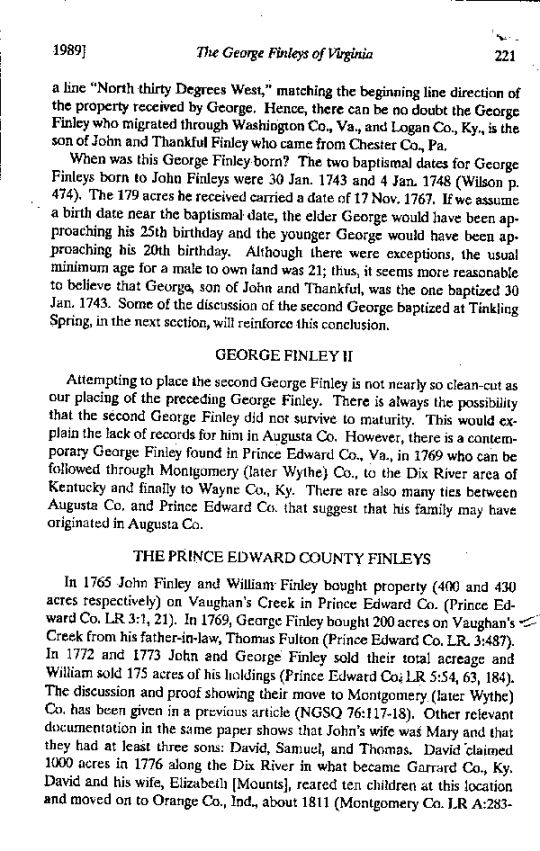
When was this George Finley born? The two baptismal dates for George Finleys born to John Finleys were 30 Jan. 1743 and 4 Jan. 1748 (Wilson p. 474). The 179 acres he received carried a date of 17 Nov. 1767. If we assume a birth date near the baptismal date, the elder George would have been approaching his 25th birthday and the younger George would have been approaching his 20th birthday. Although there were exceptions, the usual minimum age for a male to own land was 21; thus, it seems more reasonable to believe that George, son of John and Thankful, was the one baptized 30 Jan. 1743. Some of the discussion of the second George baptized at Tinkling Spring, in the next section, will reinforce this conclusion.
GEORGE FINLEY II
Attempting to place the second George Finley is not nearly so clean-cut as our placing of the preceding George Finley. There is always the possibility that the second George Finley did not survive to maturity. This would explain the lack of records for him in Augusta Co. However, there is a contemporary George Finley found in Prince Edward Co., Va., in 1769 who can be followed through Montgomery (later Wythe) Co., Va., to the Dix River area of Kentucky and finally to Wayne Co., Ky. There are also many ties between Augusta Co. and Prince Edward Co. that suggest that his family may have originated in Augusta Co.
THE PRINCE EDWARD COUNTY FINLEYS
In 1765 John Finley and William Finley bought property (400 and 430 acres respectively) on Vaughan’s Creek in Prince Edward Co. (Prince Edward Co. LR 3:1, 21). In 1769, George Finley bought 200 acres on Vaughan’s Creek from his father-in-law, Thomas Fulton (Prince Edward Co. LR 3:487). In 1772 and 1773 John and George Finley sold their total acreage and William sold 175 acres of his holdings (Prince Edward Co. LR 5:54, 63, 184). The discussion and proof showing their move to Montgomery (later Wythe) Co. has been given in a previous article (NGSQ 76:117-18). Other relevant documentation in the same paper shows that John’s wife was Mary and that they had at least three sons: David, Samuel, and Thomas. David claimed 1000 acres in 1776 along the Dix River in what became Garrard Co., Ky. David and his wife, Elizabeth [Mounts], reared ten children at this location and moved on to Orange Co., Ind., about 1811 (Montgomery Co. LR A:283-
Page 222
222 The American Genealogist [October
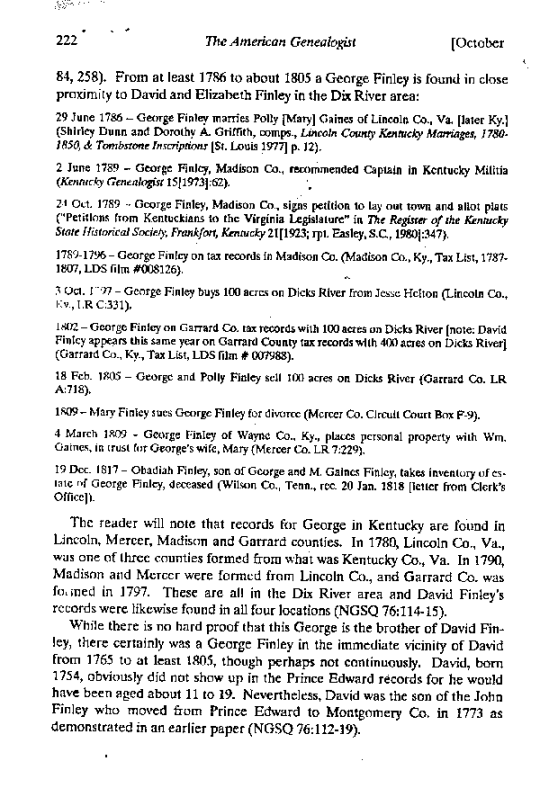
84, 258). From at least 1786 to about 1805 a George Finley is found in close proximity to David and Elizabeth Finley in the Dix River area:
- 29 Jun. 1786 — George Finley marries Polly [Mary] Gaines of Lincoln Co., Va. [later Ky.] (Shirley Dunlap and Dorothy A. Griffith, comps., Lincoln County Kentucky Marriages, 1780-1850, & Tombstone Inscriptions [St. Louis 1977], p. 12).
- 2 June 1789 — George Finley, Madison Co., recommended Captain in Kentucky Militia (Kentucky Genealogist 15[1973]:62).
- 21 Oct. 1789 — George Finley, Madison Co., signs petition to lay out town and allot plats (“Petitions from Kentuckians to the Virginia Legislature,” in The Register of the Kentucky State Historical Society, Frankfort, Kentucky 21[1923]:5, p. Easley, S.C., 1980:347).
- 1789-1795 — George Finley on tax records in Madison Co. (Madison Co., Ky., Tax List, 1787-1807, LDS film #008126).
- 3 Oct. 1797 — George Finley buys 100 acres on Dicks River from Jesse Hecton (Lincoln Co., Ky., LR C:331).
- 1802 — George Finley on Garrard Co. tax records with 100 acres on Dicks River [note: David Finley appears this same year on Garrard County tax records with 400 acres on Dicks River] (Garrard Co., Ky., Tax List, LDS film #007988).
- 18 Feb. 1805 — George and Polly Finley sell 100 acres on Dicks River (Garrard Co. LR A:718).
- 1809 — Mary Finley sues George Finley for divorce (Mercer Co. Circuit Court Box F-9).
- 4 March 1809 — George Finley of Wayne Co., Ky., places personal property with Wm. Gaines, in trust for George’s wife, Mary (Mercer Co. LR 7:229).
- 19 Dec. 1817 — Obadiah Finley, son of George and M. Gaines Finley, takes inventory of estate of George Finley, deceased (Wilson Co., Tenn., rec. 20 Jan. 1818 [letter from Clerk’s Office]).
The reader will note that records for George in Kentucky are found in Lincoln, Mercer, Madison and Garrard counties. In 1780, Lincoln Co., Va., was one of three counties formed from what was Kentucky Co., Va. In 1790, Madison and Mercer were formed from Lincoln Co., and Garrard Co. was formed in 1797. These are all in the Dix River area and David Finley’s records were likewise found in all four locations (NGSQ 76:114-15).
While there is no hard proof that this George is the brother of David Finley, there certainly was a George Finley in the immediate vicinity of David from 1765 to at least 1805, though perhaps not continuously. David, born 1754, obviously did not show up in the Prince Edward records for he would have been aged about 11 to 19. Nevertheless, David was the son of the John Finley who moved from Prince Edward to Montgomery Co. in 1773 as demonstrated in an earlier paper (NGSQ 76:112-39).
Page 223
1989] The George Finleys of Virginia 223
TIES BETWEEN THE PRINCE EDWARD FINLEYS
AND AUGUSTA COUNTY
As shown earlier, John Finley first purchased property in Prince Edward Co. on 15 June 1765. On 18 March 1765, a John Finley sold his remaining share of 297 acres on South River in Beverley Manor to William Finley (Augusta Co. LR 11:809). A year and a half earlier, in January 1764, James Gillespy and Elizabeth Finley applied for a marriage license in Prince Edward Co. The Rev. Richard Sankey wrote a note to the county clerk, as follows (J.G. Hendron, “Some of the Descendants of the Rev. John Thomson. . . .” VMHB 51[1943]:394-404; reprinted in Genealogies of Virginia Families from The Virginia Magazine of History and Biography [Baltimore 1981], hereafter Gens. Va. Fams., 5:454-64):
Sir:
James Gillespy a single man from Augusta County has courted and proposes to marry Elizabeth Finley a young woman, Sister’s Daughter to my wife (i.e., a daughter of a sister to my wife) who has lived with me between two and three years last passed. He applies to you for license to be married by Mr. Garden, wch may be safely granted, as I am assured is with consent of the friends of both parties.
Whch is all from
Sr. Yr humble Servant,
Richard Sankey
(Prince Edward marriage bonds identify Elizabeth as the daughter of John Finley, Sr. [Catharine Lindsay Knorr, comp., Marriage Bonds and Minister Returns of Prince Edward County. . . (n.p. 1959) p. 31].)
The note written by the Rev. Mr. Sankey suggests many ties to Augusta Co. in addition to the explicit statement that James Gillespy was from there, but let’s start with the Gillespys. Importations given by Wilson list James Gillesby, Jennet, Agnes, John, James and William Gillesby, 24 July 1740 (O. Bk II, 208) (Wilson p. 426). Hildebrand’s map of the Beverley Grant places the James Gillespy property in close proximity to the property on South River sold by John Finley in 1765 (J.R. Hildebrand, “The Beverley Patent: 1736. . .” [1954], folded insert, inside back cover of Wilson). So there is no doubt that the James Gillespy who applied for a license to marry Elizabeth Finley was a close neighbor of the Finleys who lived on the South River property (formerly the Robinson property).
Next, recall that Elizabeth Finley was one of the children of John Finley baptized at Tinkling Spring in 1741 and that her siblings are said to have included William, James, and George (1748). As shown previously, a William and a George Finley also bought property on Vaughan’s Creek in Prince Edward Co. Note also that the George Finley baptized on 4 Jan. 1748 at Tinkling Spring would not have been old enough to buy property at the time John
Page 224
224 The American Genealogist [October
and William made their original purchase (1765), but by 1769 when he did buy, he would have been about 21. Note also that this George Finley was baptized by the Rev. John Thomson.
Richard Sankey is also worthy of discussion. Hendron gives a good summary of the Rev. John Thomson and his descendants, in which Richard Sankey is presented as Thomson’s son-in-law, having married Thomson’s daughter, Sarah (Gens. Va. Fams. 5:459-60). Hendron also states that a daughter, name unknown, married John Finley (Gens. Va. Fams. 5:461). Speculation on which John Finley she married will be reserved for a later time. However, it is well to note that the paths of Richard Sankey and John Finley, an Elder at Tinkling Spring, crossed in the business of the presbytery (Wilson pp. 158-59); this is the John Finley who migrated from Chester Co., Penn.
Finally, the reference to Mr. Garden in Richard Sankey’s message may also have some meaning. The George Finley who bought 200 acres on Vaughan’s Creek in 1769 sold it to Alexander Garden in 1773 (Prince Edward Co. LR 5:184). Back in Augusta Co., John Finley on Middle River sold his original patent of 183 acres on Cathey’s Creek to Alexander “Garden” in 1749 (Augusta Co. LR 2:365).
The evidence supports the conclusion that the Finleys who moved into Prince Edward Co. could easily have come from Augusta Co.
SUMMARY
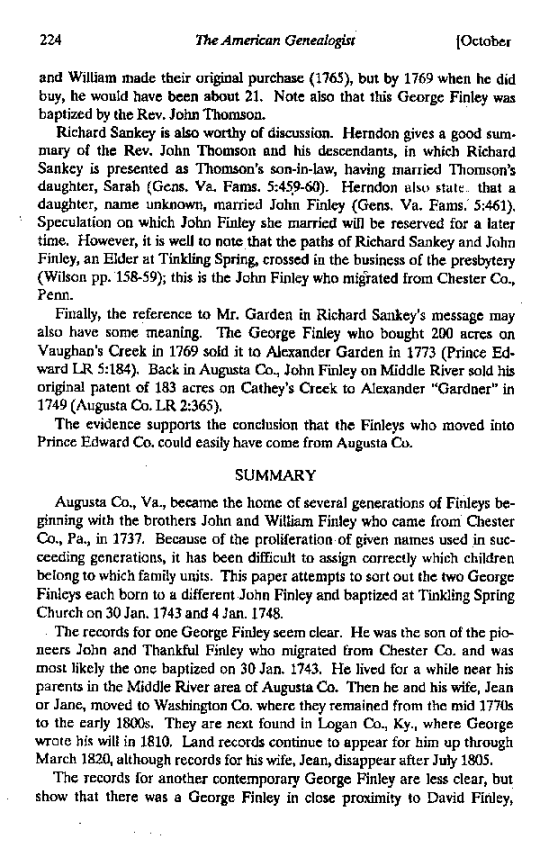
Augusta Co., Va., became the home of several generations of Finleys beginning with the brothers John and William Finley who came from Chester Co., Pa., in 1737. Because of the proliferation of given names used in succeeding generations, it has been difficult to assign correctly which children belong to which family units. This paper attempts to sort out the two George Finleys each born to a different John Finley and baptized at Tinkling Spring Church on 30 Jan. 1743 and 4 Jan. 1748.
The records for one George Finley seem clear. He was the son of the pioneers John and Thankful Finley who migrated from Chester Co. and was most likely the one baptized on 30 Jan. 1743. He lived for a while near his parents in the Middle River area of Augusta Co. Then he and his wife, Jean or Jane, moved to Washington Co. where they remained from the mid 1770s to the early 1800s. They are next found in Logan Co., Ky., where George wrote his will in 1810. Land records continue to appear for him up through March 1820, although records for his wife, Jean, disappear after July 1805.
The records for another contemporary George Finley are less clear, but show that there was a George Finley in close proximity to David Finley,
Page 225
1989] The George Finleys of Virginia 225
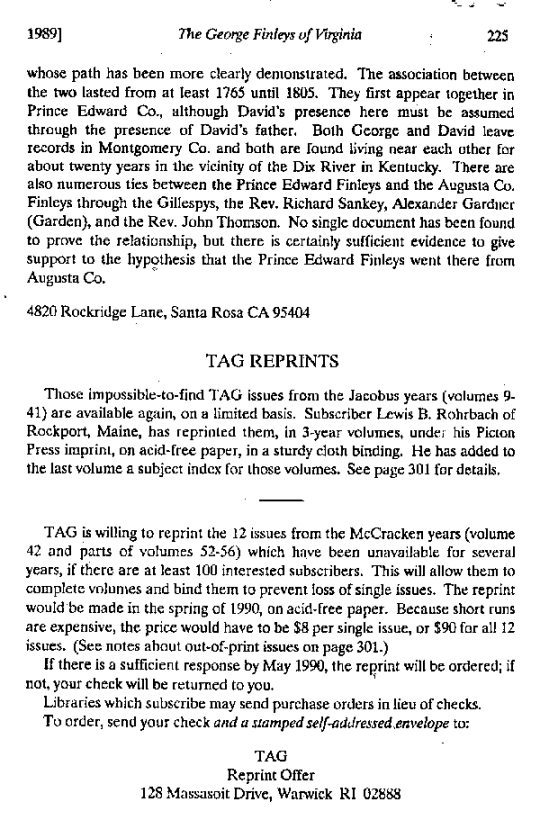
whose path has been more clearly demonstrated. The association between the two lasted from at least 1765 until 1805. They first appear together in Prince Edward Co., although David’s presence there must be assumed through the presence of David’s father. Both George and David leave records in Montgomery Co. and both are found living near each other for about twenty years in the vicinity of the Dix River in Kentucky. There are also numerous ties between the Prince Edward Finleys and the Augusta Co. Finleys through the Gillespys, the Rev. Richard Sankey, Alexander Gardiner (Garden), and the Rev. John Thomson. No single document has been found to prove the relationship, but there is certainly sufficient evidence to give support to the hypothesis that the Prince Edward Finleys went there from Augusta Co.
4820 Rockridge Lane, Santa Rosa CA 95404
TAG REPRINTS
Those impossible-to-find TAG issues from the Jacobus years (volumes 9-41) are available again, on a limited basis. Subscriber Lewis B. Rohrbach of Rockport, Maine, has reprinted them, in 3-year volumes, under his Pictou Press imprint, on acid-free paper, in a sturdy cloth binding. He has added to the last volume a subject index for those volumes. See page 301 for details,
TAG is willing to reprint the 12 issues from the McCracken years (volume 42 and parts of volumes 52-56) which have been unavailable for several years, if there are at least 100 interested subscribers. This will allow them to complete volumes and bind them to prevent loss of single issues. The reprint would be made in the spring of 1990, on acid-free paper. Because short runs are expensive, the price would have to be $8 per single issue, or $90 for all 12 issues. (See notes about out-of-print issues on page 301.)
If there is a sufficient response by May 1990, the reprint will be ordered; if not, your check will be returned to you. Libraries which subscribe may send purchase orders in lieu of checks. To order, send your check and a stamped self-addressed envelope to:
TAG
Reprint Offer
128 Massasoit Drive, Warwick RI 02888