

b14425282.html
Text Version
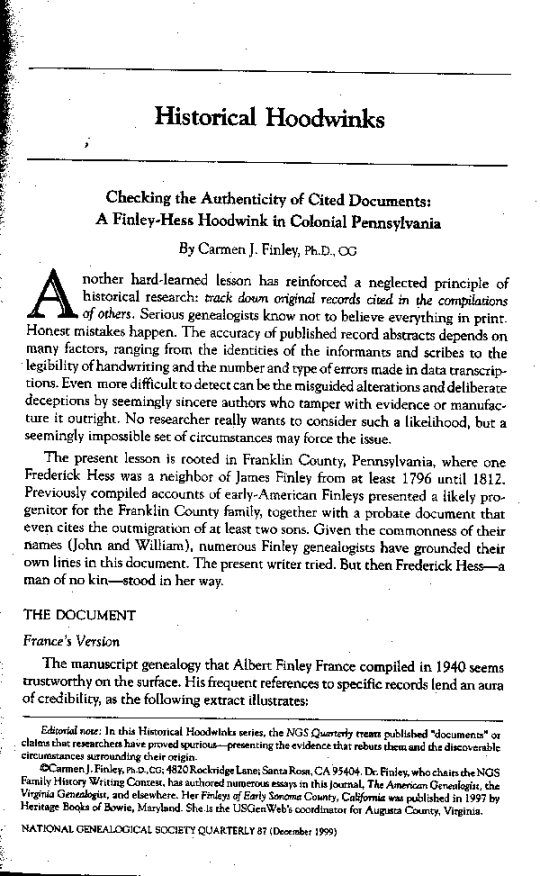
Historical Hoodwinks
Checking the Authenticity of Cited Documents: A Finley-Hess Hoodwink in Colonial Pennsylvania
By Carmen J. Finley, Ph.D., CG
Another hard-learned lesson has reinforced a neglected principle of historical research: track down original records cited in the compilations of others. Serious genealogists know not to believe everything in print. Honest mistakes happen. The accuracy of published record abstracts depends on many factors, ranging from the identities of the informants and scribes to the legibility of handwriting and the number and type of errors made in data transcriptions. Even more difficult to detect can be the misguided alterations and deliberate deceptions by seemingly sincere authors who tamper with evidence or manufacture it outright. No researcher really wants to consider such a likelihood, but a seemingly impossible set of circumstances may force the issue.
The present lesson is rooted in Franklin County, Pennsylvania, where one Frederick Hess was a neighbor of James Finley from at least 1796 until 1812. Previously compiled accounts of early-American Finleys presented a likely progenitor for the Franklin County family, together with a probate document that even cites the outmigration of at least two sons. Given the commonness of their names (John and William), numerous Finley genealogists have grounded their own lines in this document. The present writer tried. But then Frederick Hess—a man of no kin—stood in her way.
THE DOCUMENT
France’s Version
The manuscript genealogy that Albert Finley France compiled in 1940 seems trustworthy on the surface. His frequent references to specific records lend an aura of credibility, as the following extract illustrates:
Editorial note: In this Historical Hoodwinks series, the NGS Quarterly reprints published “documents” or claims that researchers have proved spurious—presenting the evidence that rebuts them and the discoverable circumstances surrounding their origin.
Carmen J. Finley, Ph.D., CG; 4820 Rockridge Lane; Santa Rosa, CA 95404. Dr. Finley, who chairs the NGS Family History Writing Contest, has authored numerous essays in this journal, The American Genealogist, The Virginia Genealogist, and elsewhere. Her Finleys of Early Sonoma County, California was published in 1997 by Heritage Books of Bowie, Maryland. She is the USGenWeb’s coordinator for Augusta County, Virginia.
NATIONAL GENEALOGICAL SOCIETY QUARTERLY 87 (December 1999)
National Genealogical Society Quarterly
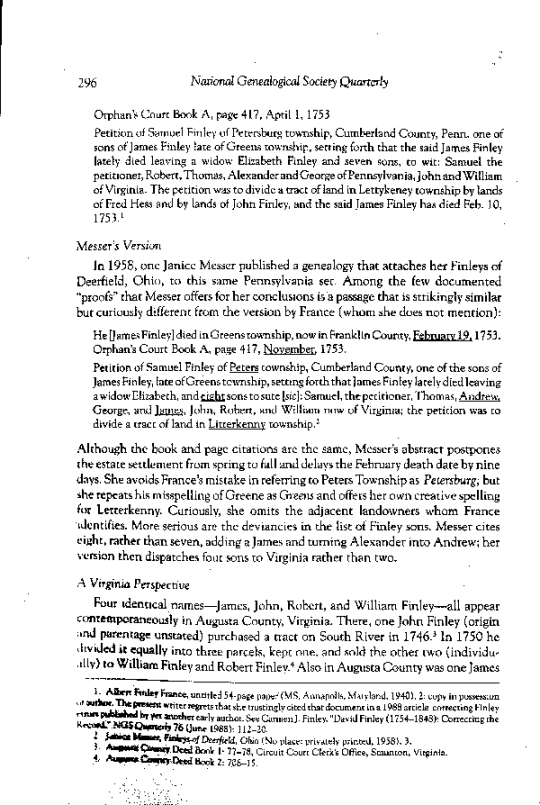
Orphan’s Court Book A, page 417, April 1, 1753
Petition of Samuel Finley of Petersburg township, Cumberland County, Penn. one of sons of James Finley late of Greens township, setting forth that the said James Finley lately died leaving a widow Elizabeth Finley and seven sons, to wit: Samuel the petitioner, Robert, Thomas, Alexander and George of Pennsylvania, John and William of Virginia. The petition was to divide a tract of land in Letterkenny township by lands of Fred Hess and by lands of John Finley and that said James Finley had died Feb. 10, 1753.1
Messer’s Version
In 1958, one Janice Messer published a genealogy that attaches her Finleys of Deerfield, Ohio, to this same Pennsylvania set. Among the few documented “proofs” that Messer offers for her conclusions is a passage that is strikingly similar but curiously different from the version by France (whom she does not mention):
He [James Finley] died in Greenstown, now in Franklin County, February 19, 1753. Orphan’s Court Book A, page 417, November, 1753.
Petition of Samuel Finley of Peters township, Cumberland County, one of the sons of James Finley, late of Greens township, setting forth that James Finley lately died leaving a widow Elizabeth, and eight sons to wit [sic]: Samuel, the petitioner, Thomas, Andrew, George, and James; John, Robert, and William now of Virginia; the petition was to divide a tract of land in Letterkenny township.
Although the book and page citations are the same, Messer’s abstract postpones the estate settlement from spring to fall and delays the February death date by nine days. She avoids France’s mistake in referring to Peters Township as Petersburg; but she repeats his misspelling of Greens as Greens and offers her own creative spelling for Letterkenny. Curiously, she omits the adjacent landowners whom France identifies. More serious are the deviations in the list of Finley sons. Messer cites eight, rather than seven, adding a James and turning Alexander into Andrew; her version then dispatches four sons to Virginia rather than two.
A Virginia Perspective
Four identical names—James, John, Robert, and William Finley—all appear contemporaneously in Augusta County, Virginia. There, one John Finley (origin and parentage unstated) purchased a tract on South River in 1746.2 In 1750 he divided it equally into three parcels, kept one, and sold the other two (individually) to William Finley and Robert Finley.3 Also in Augusta County was one James
A Finley-Hess Hoodwink in Colonial Pennsylvania
Finley (variously Findla) who was said to have “removed from the Colony” in 1746.5 The given names of these men are common. Verifying that they were (or were not) the father and/or sons of the 1753 document would obviously require a thorough study of the Pennsylvania family as well the Virginia one.6 The conflict between France’s version and Messer’s version should, just as obviously, require the location and examination of the original document.
THE VERIFICATION PROCESS
Internal Tests
Within itself and in both versions, the alleged document contains two warning flags discoverable by any researcher who performs a basic logistical review of the time and place.
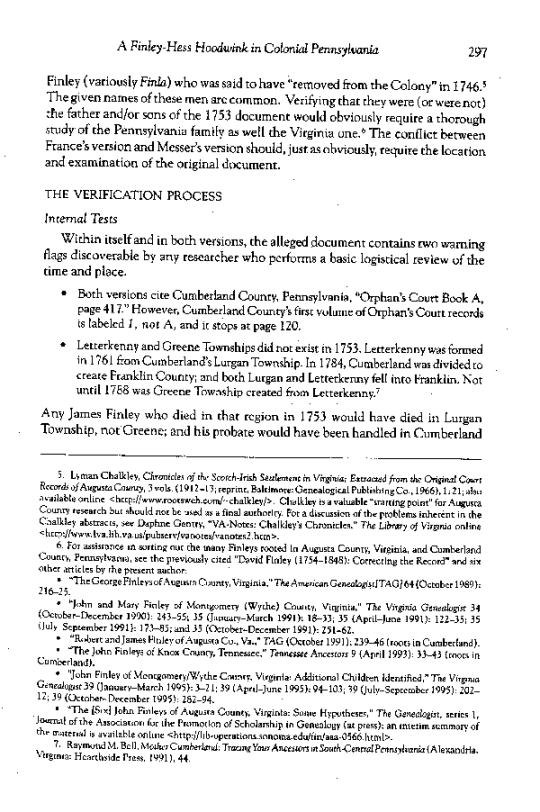
- Both versions cite Cumberland County, Pennsylvania, “Orphan’s Court Book A, page 417.” However, Cumberland County’s first volume of Orphan’s Court records is labeled I, not A, and it stops at page 120.
- Letterkenny and Greene Townships did not exist in 1753. Letterkenny was formed in 1761 from Cumberland’s Lurgan Township. In 1784, Cumberland was divided to create Franklin County; and both Lurgan and Letterkenny fell into Franklin. Not until 1788 was Greene Township created from Letterkenny.7
Any James Finley who died in that region in 1753 would have died in Lurgan Township, not Greene; and his probate would have been handled in Cumberland
- Lyman Chalkley, Chronicles of the Scotch-Irish Settlement in Virginia. Extracted from the Original Court Records of Augusta County, 1745–1800, 3 vols. (1912–13; reprint, Baltimore: Genealogical Publishing Co., 1965), 1:214; also available online <http://www.rootsweb.com/~chalkley/>. Chalkley is a valuable “starting point” for Augusta County research but should not be used as a final authority. For a discussion of the problems inherent in the Chalkley abstracts, see Daphne Gemmell, “VA Notes: Chalkley’s Chronicles,” The Library of Virginia online <http://www.lva.lib.va.us/public/va_notes/va_notes2.htm>.
- For assistance in sorting out the many Finleys noted in Augusta County, Virginia, and Cumberland County, Pennsylvania, see the previously cited “David Finley (1754–1848): Correcting the Record” and six other articles by the present author.
- “The George Finleys of Augusta County, Virginia,” The American Genealogist 74 (October 1998): 216–25.
- “John and Mary Finley of Montgomery (Wythe) County, Virginia,” The Virginia Genealogist 33 (October–December 1989): 243–55; 35 (January–March 1991): 18–33; 35 (April–June 1991): 122–35; 35 (July–September 1991): 173–85; and 35 (October–December 1991): 251–60.
- “Robert and James Finley of Augusta Co., Va.,” TAG (October 1991): 239–46 (roots in Cumberland).
- “John Finley of Montgomery (Wythe) County, Virginia: Additional Children Identified,” The Virginia Genealogist 39 (January–March 1995): 3–21; 39 (April–June 1995): 94–103; 39 (July–September 1995): 202–12; 39 (October–December 1995): 282–94.
- The [Six] John Finleys of Augusta County, Virginia: Some Hypotheses,” The Genealogist, series 1, journal of the Association for the Promotion of Scholarship in Genealogy (at press); an interim summary of the material is available online <http://lib.operas.com/aud/va/asa-0566.html>.
- Raymond M. Bell, McKee: Cumberland Tract (New Ancestors in South-Central Pennsylvania) (Alexandria, Virginia: Hearthside Press, 1991), 44.
National Genealogical Society Quarterly
County, not Franklin. Assuming that a probate document exists but was somehow mislabeled by book, page, and location, still other questions need answers:
- How could France have made “transcription errors” that altered the locations so drastically? Did he intentionally change the original place references, using more modern jurisdictional names—as amateurs are sometimes wont to do in a misguided attempt to be “helpful”?
- Could France and Messer have independently decided to make the same alterations, or did Messer copy her data from France? Do the differences between her version and his represent corrections on her part—made from a reexamination of the original—or did she further mangle the confusion France had created?
Family Tests
Finleys of the cited names can be followed in Cumberland and Franklin Counties from 1751. The Lurgan Township tax list of that year offers a James Finley as well as three Johns and an Andrew.8 The next extant roll, that of 1753, cites only one John and no James, implying that the James of 1751 had died, had left the county, or was no longer taxable. That 1753 list also includes an Eliza (Heh)—a name that corresponds to the wife given for James by France and Messer—and two other widows, unnamed. Letterkenny tax rolls of 1768, 1769, and 1770 include both a John and a James.9
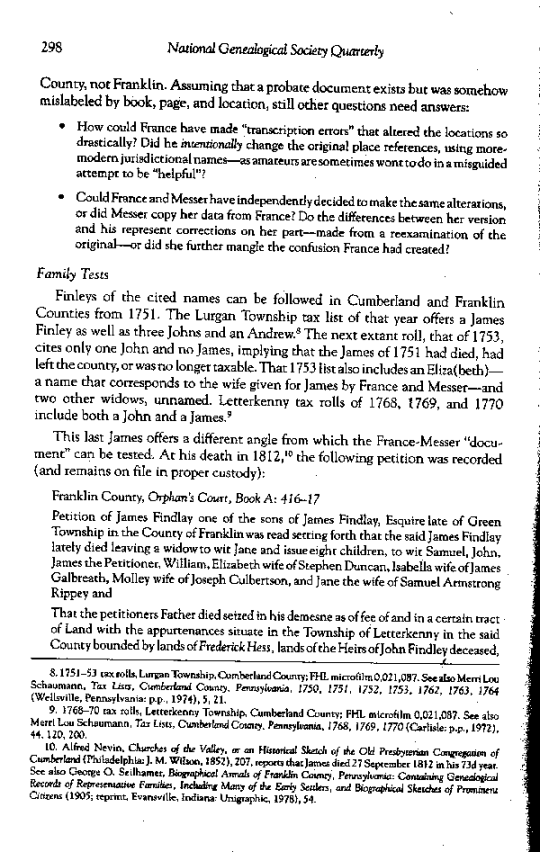
This last James offers a different angle from which the France-Messer “document” can be tested. At his death in 1812,10 the following petition was recorded (and remains on file in proper custody):
Franklin County, Orphan’s Court, Book A: 416–17
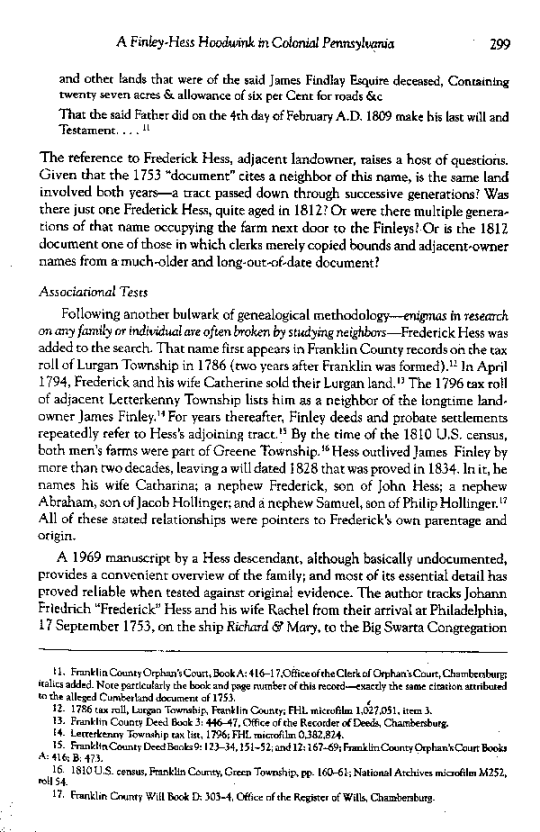
Petition of James Findlay one of the sons of James Findlay, Esquire late of Green Township in the County of Franklin was read setting forth that the said James Findlay lately died leaving a widow to wit Jane and issue eight children, to wit Samuel, John, James the Petitioner, William, Elizabeth wife of Stephen Duncan, Isabella wife of James Galbreath, Molley wife of Joseph Culbertson, and Jane the wife of Samuel Armstrong Rippey and
That the petitioners Father died seized in his demesne as of fee of and in a certain tract of Land with the appurtenances situate in the Township of Letterkenny in the said County bounded by lands of Frederick Hess, lands of the Heirs of John Findley deceased,
- 1751–53 tax rolls, Lurgan Township, Cumberland County, FHL microfilm 021,097. See also Mimi Lou Schaumann, Tax Lists, Cumberland County, Pennsylvania, 1750, 1751, 1752, 1753, 1762, 1763, 1764 (Wellsville, Pennsylvania: privately printed, 1974), 5, 21.
- 1768–70 tax rolls, Letterkenny Township, Cumberland County; FHL microfilm 0,021,087. See also Merri Lou Schaumann, Tax Lists, Cumberland County, Pennsylvania, 1768, 1769, 1770 (Carlisle: n.p., 1972), 44, 120, 200.
- Alfred Nevin, Churches of the Valley, or an Historical Sketch of the Old Presbyterian Congregation of Cumberland (Philadelphia: J. M. Wilson, 1852), 207, reports that James died 27 September 1812 in his 73d year. See also George O. Seilhamer, Biographical Annals of Franklin County, Pennsylvania: Containing Genealogical Records of Representative Families, Including Many of the Early Settlers, and Biographical Sketches of Prominent Citizens (1905; reprint, Evansville, Indiana: Unigraphic, 1978), 54.
A Finley-Hess Hoodwink in Colonial Pennsylvania
and other lands that were of the said James Findlay Esquire deceased, Containing twenty seven acres & allowance of six per Cent for roads &c
That the said Father did on the 4th day of February A.D. 1809 make his last will and Testament . . . .11
The reference to Frederick Hess, adjacent landowner, raises a host of questions. Given that the 1753 “document” cites a neighbor of this name, is the same land involved both years—a tract passed down through successive generations? Was there just one Frederick Hess, quite aged in 1812? Or were there multiple generations of that name occupying the farm next door to the Finleys? Or is the 1812 document one of those in which clerks merely copied bounds and adjacent-owner names from a much-older and long-out-of-date document?
Associational Tests
Following another bulwark of genealogical methodology—origins in research on any family or individual are often broken by studying neighbors—Frederick Hess was added to the search. That name first appears in Franklin County records on the tax roll of Lurgan Township in 1786 (two years after Franklin was formed).12 In April 1794, Frederick and his wife Catherine sold their Lurgan land.13 The 1796 tax roll of adjacent Letterkenny Township lists him as a neighbor of the longtime landowner James Finley.14 For years thereafter, Finley deeds and probate settlements repeatedly refer to Hess’s adjoining tract.15 By the time of the 1810 U.S. census, both men’s farms were part of Greene Township.16 Hess outlived James Finley by more than two decades, leaving a will dated 1828 that was proved in 1834. In it, he names his wife Catharine; a nephew Frederick, son of John Hess; a nephew Abraham, son of Jacob Hollinger; and a nephew Samuel, son of Philip Hollinger.17 All of these stated relationships were pointers to Frederick’s own parentage and origin.
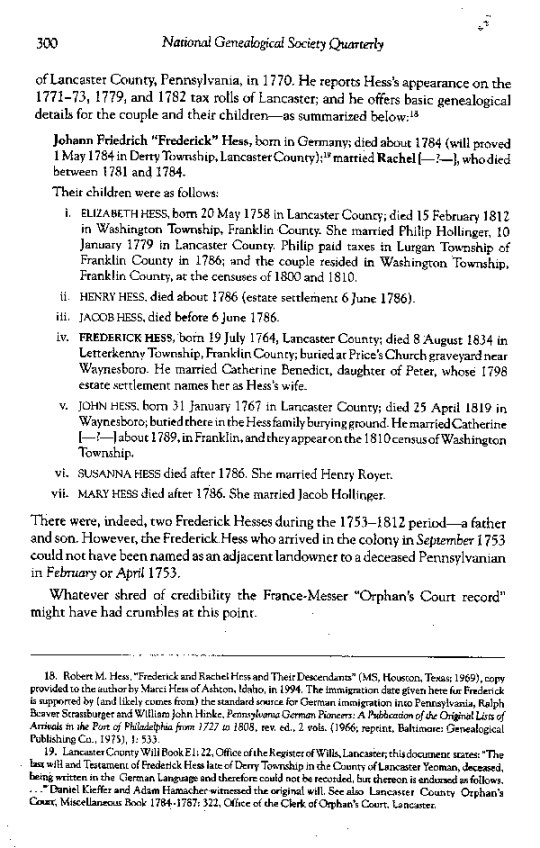
A 1969 manuscript by a Hess descendant, although basically undocumented, provides a convenient overview of the family, and most of its essential detail has proved reliable when tested against original evidence. The author tracks Johann Friedrich “Frederick” Hess and his wife Rachel from their arrival at Philadelphia, 17 September 1753, on the ship Richard & Mary, to the Big Swarta Congregation
- Franklin County Orphan’s Court, Book A: 416–17, Office of the Clerk of Orphan’s Court, Chambersburg; italics added. Note particularly the book and page number of this record—exactly the same citation attributed to the alleged Cumberland document of 1753.
- 1786 tax roll, Lurgan Township, Franklin County; FHL microfilm 1,021,051, item 3.
- Franklin County Deed Book 3: 446–47, Office of the Recorder of Deeds, Chambersburg.
- Letterkenny Township tax lists, 1796; FHL microfilm 0,382,824.
- Franklin County Deed Books 9: 123–34, 151–52; and 12: 167–69; Franklin County Orphan’s Court Books A: 416; B: 473.
- 1810 U.S. census, Franklin County, Green Township, pp. 160–61; National Archives microfilm M252, roll 54.
- Franklin County Will Book D: 303–4, Office of the Register of Wills, Chambersburg.
National Genealogical Society Quarterly
of Lancaster County, Pennsylvania, in 1770. He reports Hess’s appearance on the 1771–73, 1779, and 1782 tax rolls of Lancaster; and he offers basic genealogical details for the couple and their children—as summarized below:18
Johan Friedrich “Frederick” Hess, born in Germany; died about 1784 (will proved 1 May 1784 in Derry Township, Lancaster County);19 married Rachel [—?—], who died between 1781 and 1794.
Their children were as follows:
i. ELIZABETH HESS, born 20 May 1758 in Lancaster County; died 15 February 1812 in Washington Township, Franklin County. She married Philip Hollinger, 10 January 1779 in Lancaster County. Philip paid taxes in Lurgan Township of Franklin County in 1786, and the couple resided in Washington Township, Franklin County, at the censuses of 1800 and 1810.
ii. HENRY HESS, died about 1786 (estate settlement 6 June 1786).
iii. JACOB HESS, died before 6 June 1786.
iv. FREDERICK HESS, born 19 July 1764, Lancaster County; died 8 August 1834 in Letterkenny Township, Franklin County; buried at Price’s Church graveyard near Waynesboro. He married Catherine Benedict, daughter of Peter, whose 1798 estate settlement names her as Hess’s wife.
v. JOHN HESS, born 31 January 1767 in Lancaster County; died 25 April 1819 in Waynesboro; buried there in the Hess family burying ground. He married Catherine [—?—] about 1789, in Franklin, and they appear on the 1810 census of Washington Township.
vi. SUSANNA HESS died after 1786. She married Henry Royer.
vii. MARY HESS died after 1786. She married Jacob Hollinger.
There were, indeed, two Frederick Hesses during the 1753–1812 period—a father and son. However, the Frederick Hess who arrived in the colony in September 1753 could not have been named as an adjacent landowner to a deceased Pennsylvanian in February or April 1753.
Whatever shred of credibility the France-Messer “Orphan’s Court record” might have had crumbles at this point.
- Robert M. Hess, “Frederick and Rachel Hess and Their Descendants” (MS, Houston, Texas; 1969), copy provided to the author by Marci Hess of Ashton, Idaho in 1994. The immigration date given here for Frederick is supported by (and likely comes from) the standard source for German immigration into Pennsylvania, Ralph Beaver Strassburger and William John Hinke, Pennsylvania German Pioneers: A Publication of the Original Lists of Arrivals in the Port of Philadelphia from 1727 to 1808, rev. ed., 2 vols. (1966; reprint, Baltimore: Genealogical Publishing Co., 1975), 1:533.
- Lancaster County Will Book E1: 22, Office of the Register of Wills, Lancaster; this document states: “The last will and Testament of Frederick Hess late of Derry Township in the County of Lancaster Yeoman, deceased, being written in the German Language and therefore could not be recorded, but therefore is endorsed as follows, ‘Daniel Lefever and Adam Hamacher witnessed the original will. See also Lancaster County Orphan’s Court, Miscellaneous Book 1784–1767, 322, Office of the Clerk of Orphan’s Court, Lancaster.
A Finley-Hess Hoodwink in Colonial Pennsylvania
THE REAL PROBATE EVIDENCE
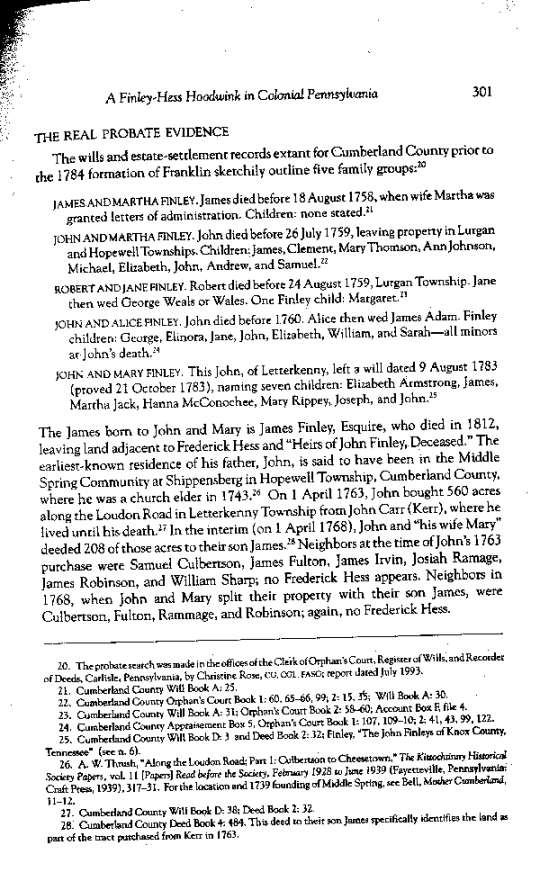
The wills and estate-settlement records extant for Cumberland County prior to the 1784 formation of Franklin sketchily outline five family groups:20
JAMES AND MARTHA FINLEY. James died before 18 August 1758, when wife Martha was granted letters of administration. Children: none stated.21
JOHN AND MARTHA FINLEY. John died before 26 July 1779, leaving property in Lurgan and Hopewell Townships. Children: James, Clement, Mary Thomson, Ann Johnson, Michael, Elizabeth, John, Andrew, and Samuel.22
ROBERT AND JANE FINLEY. Robert died before 24 August 1759, Lurgan Township. Jane then wed George Wells or Wales. One Finley child: Margaret.23
JOHN AND ALICE FINLEY. John died before 1760. Alice then wed James Adam. Finley children: George, Elinora, Jane, John, Elizabeth, William, and Sarah—all minors at John’s death.24
JOHN AND MARY FINLEY. This John, of Letterkenny, left a will dated 9 August 1783 (proved 21 October 1783), naming seven children: Elizabeth Armstrong, James, Martha Jack, Hanna McConachey, Mary Rippey, Joseph, and John.25
The James born to John and Mary is James Finley, Esquire, who died in 1812, leaving land adjacent to Frederick Hess and “Heirs of John Finley, Deceased.” The earliest-known residence of his father, John, is said to have been in the Middle Spring Community at Shippensburg in Hopewell Township, Cumberland County, where he was a church elder in 1743.26 On 1 April 1763, John bought 560 acres along the Loudon Road in Letterkenny Township from John Carr (Kerr), where he lived until his death.27 In the interim (on 1 April 1768), John and “his wife Mary” deeded 208 of those acres to their son James.28 Neighbors at the time of John’s 1763 purchase were Samuel Culbertson, James Fulton, James Irvin, Josiah Ramage, James Robinson, and William Sharp; no Frederick Hess appears. Neighbors in 1768, when John and Mary split their property with their son James, were Culbertson, Fulton, Ramage, and Robinson; again, no Frederick Hess.
- The probate search was made in the offices of the Clerk of Orphan’s Court, Register of Wills, and Recorder of Deeds, Carlisle, Pennsylvania, by Christine Rose, CG, CGL, FASG; report dated July 1993.
- Cumberland County Will Book A: 25.
- Cumberland County Orphan’s Court Book I: 60, 65–66, 99; 2: 15, 35; Will Book A: 30.
- Cumberland County Will Book A: 31; Orphan’s Court Book 2: 58–60; Account Book F, file 4.
- Cumberland County Appraisement Box 5, Orphan’s Court Book I: 101, 109–10; 2: 41, 43, 99, 122.
- Cumberland County Will Book D: 3 and Deed Book 2: 32; Finley, The John Finleys of Knox County, Tennessee (see n. 6).
- A. W. Thrush, Along the Loudon Road; Part I: Culbertson to Chambersburg, The Kittochtinny Historical Society Papers, vol. 11 (reprinted by the Society, February 1978; reprint 1990), 1–3. For the location and 1739 founding of Middle Spring, see Bell, Mother Cumberland, 11–12.
- Cumberland County Will Book D: 38; Deed Book 2: 32.
- Cumberland County Deed Book 4: 484. This deed to their son James specifically identifies the land as part of the tract purchased from Kerr in 1763.
National Genealogical Society Quarterly
CONCLUSION
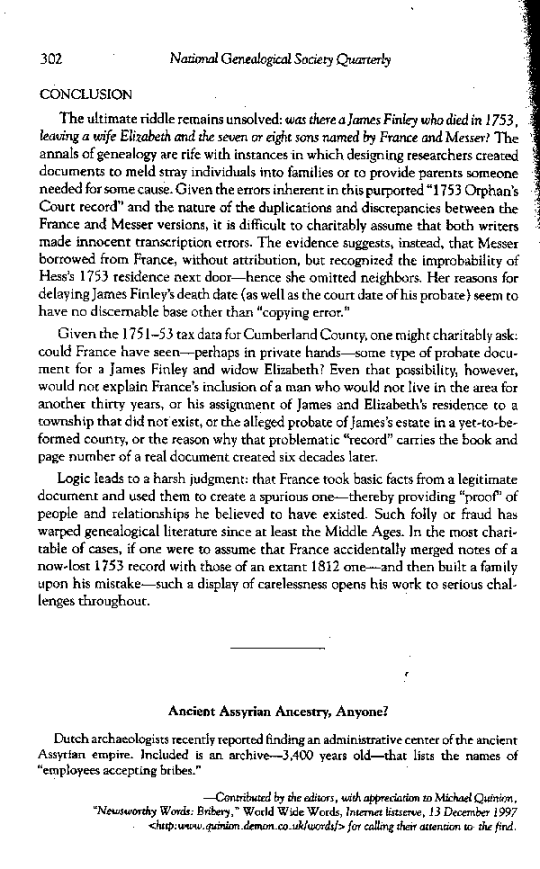
The ultimate riddle remains unsolved: was there a James Finley who died in 1753, leaving a wife Elizabeth and the seven or eight sons named by France and Messer? The annals of genealogy are rife with instances in which designing researchers created documents to meld stray individuals into families or to provide parents someone needed for some cause. Given the errors inherent in this purported “1753 Orphan’s Court record” and the nature of the duplications and discrepancies between the France and Messer versions, it is difficult to charitably assume that both writers made innocent transcription errors. The evidence suggests, instead, that Messer borrowed from France, without attribution, but recognized the improbability of Hess’s 1753 residence next door—hence she omitted neighbors. Her reasons for delaying James Finley’s death date (as well as the court date of his probate) seem to have no discernable base other than “copying error.”
Given the 1751–53 tax data for Cumberland County, one might charitably ask: could France have seen—perhaps in private hands—some type of probate document for a James Finley and widow Elizabeth? Even that possibility, however, would not explain France’s inclusion of a man who would not live in the area for another thirty years, or his assignment of James and Elizabeth’s residence to a township that did not exist, or the alleged probate of James’s estate in a yet-to-be-formed county, or the reason why that problematic “record” carries the book and page number of a real document created six decades later.
Logic leads to a harsh judgment: that France took basic facts from a legitimate document and used them to create a spurious one—thereby providing “proof” of people and relationships he believed to have existed. Such folly or fraud has warped genealogical literature since at least the Middle Ages. In the most charitable of cases, if one were to assume that France accidentally merged notes of a now-lost 1753 record with those of an extant 1812 one—and then built a family upon his mistake—such a display of carelessness opens his work to serious challenges throughout.
Ancient Assyrian Ancestry, Anyone?
Dutch archaeologists recently reported finding an administrative center of the ancient Assyrian empire. Included is an archive—3,400 years old—that lists the names of “employees accepting bribes.”
—Contributed by the editors, with appreciation to Michael Quinion, “Newsworthy Words: Bribery,” World Wide Words, Internet listserve, 13 December 1997 <http://www.quinion.demon.co.uk/words/> for calling their attention to the find.