

b16217342.html
Text Version
Notes and Documents
Original Naturalization Records:
A Reliable Source for Birth Dates?
By Carmen J. Finley, Ph.D., CG
Today’s skilled genealogists rightly insist on the importance of consulting original records as a basis for sound research. The National Genealogical Society’s third genealogical research standard urges researchers to “Seek original records, or reproduced images of them when there is reasonable assurance they have not been altered. . . .”1 Elizabeth Shown Mills, in her Evidence: Citation & Analysis for the Family Historian, states, “Original source material generally is more reliable than derivative material.”2 While recognizing the uncontested value of original records, experienced genealogists nevertheless acknowledge that they can be rife with error. Countless articles and lectures discuss mistakes in the census.3 In contrast, few authors and speakers have emphasized the notoriously high rate of inaccuracies in naturalization records.
The present article does not attempt a comprehensive analysis of the problems in naturalization records. Rather, it reports specific findings that emerged from a recently completed project of the Sonoma County Genealogical Society (SCGS). Volunteers spent three years abstracting original naturalization records and, in the process, observed conflicting information in them.4 Many inaccuracies, like arrival dates, ship names, and ports of departure, undoubtedly derive from im-
©Carmen J. Finley, Ph.D., CG; 4820 Rockridge Lane; Santa Rosa, CA 95404. Dr. Finley was director of the Sonoma County Genealogical Society project on which this analysis was based and was responsible for the accuracy and preparation of the final report. She chairs the NGS Family History Writing Contest and has authored a number of essays in this journal, The American Genealogist, The Virginia Genealogist, and elsewhere. Her Finleys of Early Sonoma County, California was published in 1997 by Heritage Books of Bowie, Md. She is the USGenWeb’s coordinator for Augusta County, Va.
1. National Genealogical Society, Genealogical Standards: Standards for Sound Genealogical Research, online <www.ngsgenealogy.org/cstandards/sound.htm>, previously published in hard copy NGS Quarterly 86 (March 1998): 50.
2. Elizabeth Shown Mills, Evidence: Citation & Analysis for the Family Historian (Baltimore: Genealogical Publishing Co., 1997), 48.
3. Admittedly, not all census records consulted by researchers qualify as “original.” Some are copies produced by the enumerators or others and are, therefore, derivative sources.
4. Sonoma County Genealogical Society, Naturalization Records in Sonoma County, California, Volume II, 1906–1950 (Bowie, Md.: Heritage Books, Inc., 2001).
NATIONAL GENEALOGICAL SOCIETY QUARTERLY 91 (MARCH 2003): 60–63
Original Naturalization Records: A Reliable Source for Birth Dates?
61
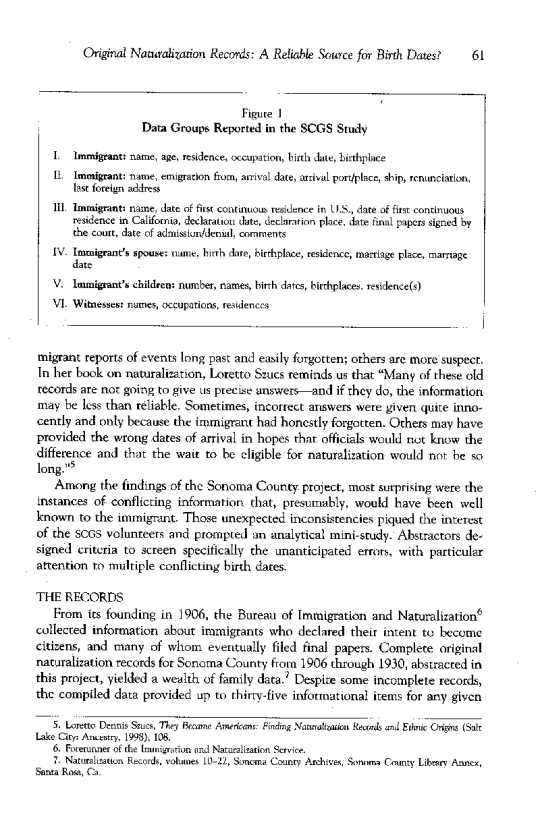
Figure 1
Data Groups Reported in the SCGS Study
I. Immigrant: name, age, residence, occupation, birth date, birthplace
II. Immigrant: name, emigration from, arrival date, arrival port/place, ship, renunciation, last foreign address
III. Immigrant: name, date of first continuous residence in U.S., date of first continuous residence in California, declaration date, declaration place, date final papers signed by the court, date of admission/denial, comments
IV. Immigrant’s spouse: name, birth date, birthplace, residence, marriage place, marriage date
V. Immigrant’s children: number, names, birth dates, birthplaces, residence(s)
VI. Witnesses: names, occupations, residences
migrant reports of events long past and easily forgotten; others are more suspect. In her book on naturalization, Loretto Szucs reminds us that “Many of these old records are not going to give us precise answers—and if they do, the information may be less than reliable. Sometimes, incorrect answers were given quite innocently and only because the immigrant had honestly forgotten. Others may have provided the wrong dates of arrival in hopes that officials would not know the difference and that the wait to be eligible for naturalization would not be so long.”5
Among the findings of the Sonoma County project, most surprising were the instances of conflicting information that, presumably, would have been well known to the immigrant. Those unexpected inconsistencies piqued the interest of the SCGS volunteers and prompted an analytical mini-study. Abstractors designed criteria to screen specifically the unanticipated errors, with particular attention to multiple conflicting birth dates.
THE RECORDS
From its founding in 1906, the Bureau of Immigration and Naturalization6 collected information about immigrants who declared their intent to become citizens, and many of whom eventually filed final papers. Complete original naturalization records for Sonoma County from 1906 through 1930, abstracted in this project, yielded a wealth of family data.7 Despite some incomplete records, the compiled data provided up to thirty-five informational items for any given
5 Loretto Dennis Szucs, They Became Americans: Finding Naturalization Records and Ethnic Origins (Salt Lake City: Ancestry, 1998), 108.
6 Forerunner of the Immigration and Naturalization Service.
7 Naturalization Records, volumes 10–22, Sonoma County Archives, Sonoma County Library Annex, Santa Rosa, Ca.
62
National Genealogical Society Quarterly
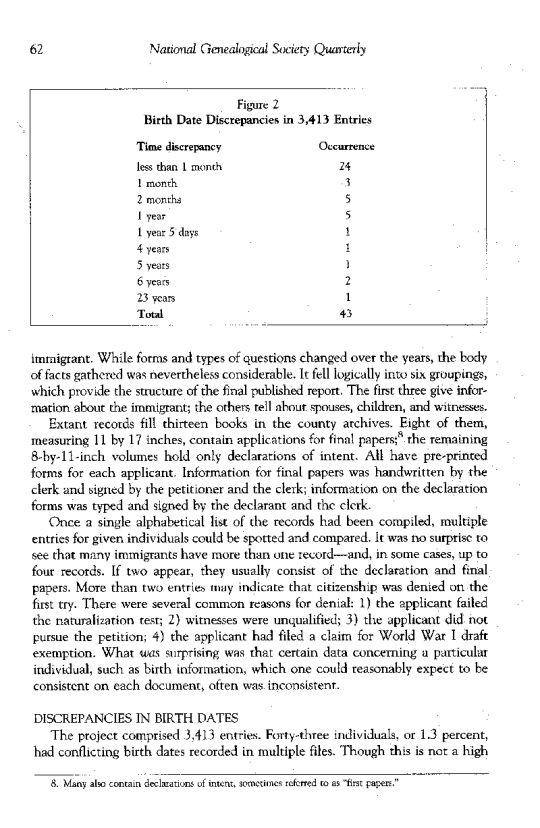
Figure 2
Birth Date Discrepancies in 3,413 Entries
| Time discrepancy | Occurrence |
|---|---|
| less than 1 month | 24 |
| 1 month | 3 |
| 2 months | 5 |
| 1 year | 5 |
| 1 year 5 days | 1 |
| 4 years | 1 |
| 5 years | 1 |
| 6 years | 2 |
| 23 years | 1 |
| Total | 43 |
immigrant. While forms and types of questions changed over the years, the body of facts gathered was nevertheless considerable. It fell logically into six groupings, which provide the structure of the final published report. The first three give information about the immigrant; the others tell about spouses, children, and witnesses.
Extant records fill thirteen books in the county archives. Eight of them, measuring 11 by 17 inches, contain applications for final papers;8 the remaining 8-by-11-inch volumes hold only declarations of intent. All have pre-printed forms for each applicant. Information for final papers was handwritten by the clerk and signed by the petitioner and the clerk; information on the declaration forms was typed and signed by the declarant and the clerk.
Once a single alphabetical list of the records had been compiled, multiple entries for given individuals could be spotted and compared. It was no surprise to see that many immigrants have more than one record—and, in some cases, up to four records. If two appear, they usually consist of the declaration and final papers. More than two entries may indicate that citizenship was denied on the first try. There were several common reasons for denial: 1) the applicant failed the naturalization test; 2) witnesses were unqualified; 3) the applicant did not pursue the petition; 4) the applicant had filed a claim for World War I draft exemption. What was surprising was that certain data concerning a particular individual, such as birth information, which one could reasonably expect to be consistent on each document, often was inconsistent.
DISCREPANCIES IN BIRTH DATES
The project comprised 3,413 entries. Forty-three individuals, or 1.3 percent, had conflicting birth dates recorded in multiple files. Though this is not a high
8 Many also contain declarations of intent, sometimes referred to as “first papers.”
Original Naturalization Records: A Reliable Source for Birth Dates?
63
error rate, it is important for genealogists to take the discrepancies into account. Researchers use a variety of sources to verify birth dates. When those alternative sources include naturalization records, this fact can be significant. More than half of the discrepancies indicated date differences from a few days to almost a month. In ten instances, differences ranged from one to six years, and one record showed a twenty-three-year variance. That case is almost certainly attributable to clerical error, because the “current date” appears where the applicant’s birth date should have been. Figure 2 shows date discrepancies exceeding one month.
CONCLUSION
With respect to one variable only—the birth date—the SCGS study supports Szucs’s assertion that naturalization records may not provide “precise answers” or, if they do, the information may be unreliable.9 The findings underscore the larger lesson that researchers need to view all historical records with a good dose of skepticism. When confronted with discrepancies, genealogists must seek the most rational explanation, drawing conclusions only after a careful analysis of all extant records, and considering how, when, why, and by whom the records were created.
9 Szucs, They Became Americans, 108.
Scenery as a Cure
[Missouri Republican, Saint Louis, 10 June, 1844.]
The Western Expositor of the 1st inst., says a company of young men started from this place a few days ago on a hunting excursion to the Rocky Mountains, for the purpose of regaining their health. Many of them looked more like tenants of the grave than living beings, and we trust that the resident of a few months in the mountains, breathing the purest atmosphere on earth and enjoying a never ending change of scenery, may have the effect of restoring them to good health again.
Captain Andrew W. Sublette is at the head of the expedition. The following is a list of the invalids: Capt. Andrew W. Sublette, James H. Marshall, C. C. Hyman, James P. Ketchum, James M. Cabrett, John F. Easton, Michael Daugherty, Jerome Brawner, C. J. Burk, Lewis Hume, St[.] Louis; Nelson Weston, Wm. L. Wynn, New Orleans; M. J. Bryan, Platte County, Missouri.
—Contributed by Marsha Hoffman Rising, CG, FASG