

b16217767.html
Text Version
Genealogy as
Historical Fiction
An Interview with Isle of Canes author, Elizabeth Shown Mills
By Carmen J. Finley, Ph. D., CG
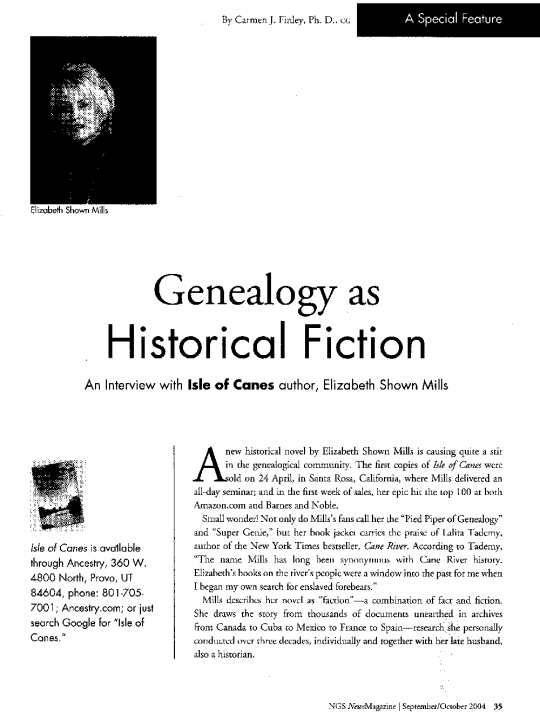
Elizabeth Shown Mills
Isle of Canes is available through Ancestry, 360 W. 4800 North, Provo, UT 84604, phone: 801-705-7001; Ancestry.com; or just search Google for “Isle of Canes.”
A new historical novel by Elizabeth Shown Mills is causing quite a stir in the genealogical community. The first copies of Isle of Canes were sold on 24 April, in Santa Rosa, California, where Mills delivered an all-day seminar; and in the first week of sales, her epic hit the top 100 at both Amazon.com and Barnes and Noble.
Small wonder! Not only do Mills’s fans call her the “Pied Piper of Genealogy” and “Super Genie,” but her book jacket carries the praise of Lalita Tademy, author of the New York Times bestseller, Cane River. According to Tademy, “The name Mills has long been synonymous with Cane River history. Elizabeth’s books on the river’s people were a window into the past for me when I began my own search for enslaved forebears.”
Mills describes her novel as “faction”—a combination of fact and fiction. She draws the story from thousands of documents unearthed in archives from Canada to Cuba to Mexico to France to Spain—research she personally conducted over three decades, individually and together with her late husband, also a historian.
NGS NewsMagazine | September/October 2004 35
A Special Feature
The Story
Described by Mills as “historically faithful,” the novel spans four generations and nearly two centuries along Louisiana’s Cane River. It is an epic account of a multiracial family that rose from slavery to rule the region’s fabled Isle—and a gripping account of racial conflict, economic ruin, and family pride, which the author summarizes this way in her introduction to the four generations:
The First Generation
François and Fanny
The African artisan and his princess, captured into slavery and brought to the wilds of Louisiana in 1735. He accepted their fate and insisted that she accept it, too.
The Second Generation
Coincoin
Beautiful, talented, and fiery, she swore over the dead bodies of her parents that one day their family would be free, rich, and proud. She kept her vow.
The Third Generation
Augustin
Half-African, half-French, he ruled over the Isle of Canes as patriarch of a legendary colony of creoles de couleur who live in pillared mansions yet toiled beside the 500 slaves who tilled their 18,000 acres.
The Fourth Generation
Perrine
Born to riches, she died in shame; but she never forgot the heritage of her family or the brutal Civil War that destroyed it. Through the persecutions of Reconstruction and Jim Crow, hers was a different vow: Never would her family forget who they were, until the day came that they could—and would—reclaim their pride and their Isle. She, too, kept her promise.
The Author
Mills, one of today’s most highly regarded genealogists, recently retired as editor of the National Genealogical Society Quarterly, where she was a major force in raising genealogical standards. As author of the genealogical bestseller Evidence! Citation & Analysis for the Family Historian and the driving force behind the tome Professional Genealogy: A Manual for Researchers, Writers, Editors, Lecturers, and Librarians, Mills holds two certifications and has been named a fellow of the American Society of Genealogists, the National Genealogical Society, and the Utah Genealogical Society. Considering these formidable credentials and her reputation as a genealogical scholar, it is no wonder that a historical novel bearing her byline would create a sensation in the genealogical world.
The Interview
Finley: Why did you decide to write a historical novel?
Mills: Ah, what writer can resist when a story cries to be told! Amid all the ethnic groups in America, so little is known about families like those on the Isle of Canes. In part, that’s because America has always tried to divide its population into white, black, and red; unlike other societies, “Anglo” America did not recognize multiracials as a separate caste. In part, history has ignored multiracial slave owners of the Old South because their existence raises issues our nation is uncomfortable with. On matters of slavery and race, we favor stereotypes; we grasp for black-and-white answers that are easier to deal with than shades of gray. But the society that once existed on Cane River’s Isle goes way beyond the gray-scale. That story paints the complexities of human life in glorious Technicolor that is both painful and inspiring.
Finley: How long did it take you to write it?
Mills: Would you believe, twenty-five years? I wrote the first draft in the spring of 1979, after seven years of research. But it was sidelined almost immediately by a fast-paced career, a return to school, and an academic thesis that called for reconstructing the origin, parentage, and lives of nearly three thousand individuals who settled Louisiana’s colonial frontier. Of course, that research project—and many more thereafter—provided rich insight into the varied cultures that took root along Cane River; and each of those, of course, fueled more rewrites of Isle of Canes.
Finley: What led you into this topic?
Mills: As a young wife and mother, I began studying the French-Spanish frontier in search of my children’s roots. With time, the Natchitoches preservation society asked me to conduct a historical-site documentation project. It had been given a plantation home and outbuildings that it hoped to place on
36 September/October 2004 | NGS NewsMagazine
the National Register. In the end, the story that emerged was so fantastic that the site (Melrose Plantation) was declared a National Historic Landmark.
That project led to a lifelong fascination with Louisiana’s Creoles—a term historians used originally to describe anyone born in the colonies of foreign ancestry. At every turn, amid work on my children’s ancestry, my husband, Gary, and I would find them interacting with the Isle family that built Melrose and a dozen other plantations of its ilk. Although we never could fit that family onto our own charts, we “adopted” it out of total fascination and a realization that we could never understand Cane River culture without understanding this family that defied all the stereotypes we had learned in history classes.
Finley: What did you do to prepare yourself for writing this story?
Mills: First, I began by putting the family’s genealogy into print. Novels, as a literary form, demand creative interpretation that genealogy does not tolerate. Despite the thousands of records we had found, no amount could ever chronicle all the intimate details of even one life, much less four generations. Yet readers expect storytellers to flesh out the gaps, color in the scenery, and present dynamic characters and action.
Because I’ve spent thirty-five years studying not just the Islanders but all the families with whom they lived, loved, labored, and sometimes feuded, I think I’ve portrayed my characters as faithfully as a storyteller possibly could. Still, I would never have been comfortable presenting this story as a novel without having first published the family’s genealogy and writing various parts of its story as traditional history.
Finley: I’m particularly curious about that “creative interpretation.” Would you elaborate?
Mills: Interpretation is actually a part of everything genealogists do. We have to interpret documents in the context of the law and the language used at the time. We have to interpret the nature of our ancestor’s character in order to strategize how he or she would have responded to a certain event. That’s one of the ways we generate clues to other records.
Novels require all this and more. While a genealogical history is essentially a series of biographies, linked together into thousands of family relationships, a novel must drastically streamline the family. The writer must distill the essence of each family’s story, define a plot and dominant themes, and then cull the cast of characters to a few who drive that story line.
Beyond this, we have to draw “supporting characters” from the neighborhood and develop all into vivid and robust individuals, with distinctive personalities. We draw dialog from actual records, ideally; but the supply can’t match all the needs. The dialog we create then has to be patterned upon the character and speech of each individual. Even beyond this, characters, dialog, scenery, and atmosphere all have to be painted richly enough to evoke all human senses.
Finley: How does a genealogist develop that kind of context?
Mills: It’s not that hard—just time consuming. Genealogists today are grounded in the idea that lives have to be put into historical context—accurately. We’ve long since learned that research on friends, associates, and neighbors can turn a genealogical stalemate into a breakthrough. From this standpoint, a good genealogist who decides to tell the family story as a story will have much of the context already needed.
My biggest help, otherwise, was my lifelong habit of maintaining a “context file.” Over the years, I’ve squirreled away contextual nuggets that cover all the senses—sight, smell, taste, touch, hearing, and emotions—as well as tidbits that describe animals, climate, clothing, customs, economy, food, health, housing, labor practices, landscape, laws, tools, transportation, and much more. We all encounter these in our research: curious descriptions in documents, interesting sidelights in newspapers, pithy quotes from regional characters, patterns that we observe. If there’s any cardinal rule for the genealogical writer it should be never use a source without getting something for your context file!
Finley: Do you find fiction writing harder to write than nonfiction, considering that you’ve done both on this family?
Mills: All writing is 5 percent inspiration and 95 percent perspiration, regardless of the format. Over the years, yes, I’ve written aspects of this story in various nonfiction formats, and each of those had its own rules
NGS NewsMagazine | September/October 2004 37
A Special Feature
to be followed and polished until a piece of writing shines.
Storytelling is also a craft with its own rules. For a non-genealogist, those rules are a wonderful license to be creative. For a genealogist, they are hard shackles, because so many aspects of the storyteller’s craft differ from genealogy’s emphasis upon raw, documented facts.
The greatest challenge—aside from learning the craft of fiction writing, of course—is to remain faithful to the character of each character. Each was a real human being with ideals and ideologies. When we ourselves are the subject of a piece of writing, we expect our thoughts and values to be portrayed accurately, even if the writer disagrees with us. It follows that when we dramatize the lives of real people from the past, we have to be true to the character of each of them—the actual character, as revealed by the records that document their lives.
Finley: You’ve been quoted as saying that genealogy provided the bones, flesh, heart, mind, and soul for all the characters in Isle of Canes. Why so?
Mills: Because genealogy is applied psychology, sociology, and history—but it’s history up close and personal. Studying the individual lives of historic people gives us a much clearer window through which to see the world. It shows us, so starkly, the human costs of decisions made by politicians and generals, and it leaves us with a much truer understanding of why our society is the way it is.
Finley: How did you decide on a publisher?
Mills: Over the years, I’ve discussed the novel with various major fiction houses, and almost signed with one. My big concern has always been that the integrity of the story not be compromised in the interest of marketing—a special concern with a book that involves several controversial issues. From that standpoint, the final decision was a no-brainer. Where else could an author be more assured that respect for the family and its story would be respected than at MyFamily.com?
Finley: How do you think the genealogical community will respond to a novel by you?
Mills: Oh, my! That question sounds like I’ve shattered a glass bubble or committed a sacrilege! Truth is, there is no more powerful way to present a family’s story than simply telling the story. By stripping away minutia and focusing upon the forces that made a family unique, one can create a powerful work.
Most genealogists unearth stories that beg to be told. An occasional story takes hold of us and refuses to let go until we’ve done that telling. As genealogists, we naturally put our stories into a genealogical format; but few people—our kin included—actually read genealogies except as a Lenten penance. If we are trained historians, we might craft a thematic family history, but even that is likely to be read only by other historians.
If, then, we have a story so powerful it could reshape the way the world thinks about a particular side of history, how do we find an audience? The reality is that the world likes the taste of history better when it’s served up as fiction.
What’s on the Horizon?
Finley: Now that Isle of Canes is published, what’s your next project?
Mills: What else does a genealogist do? Research, research, research! Write! Write! Write! There’s a world of brick walls and glass ceilings begging to be smashed!
My first encounter with Elizabeth Shown Mills was in 1987 when I submitted my first genealogical manuscript to the NGS Quarterly. She was the newly appointed editor, and I was a green genealogist. I learned much from that first submission, and others. She was a tough editor, but someone I survived. Then in 1991, I was appointed chair of the NGS Family History Writing Contest. Elizabeth was a judge and, as editor of NGSQ, published the paper of the winning contestant. It was a joy to work with her, and I value the lessons I have learned from her. I recently said to her, “You must either work all the time, or don’t sleep much, or both.” “Both,” she said. I considered it an honor when NGS NewsMagazine editor, Sharon DeBartolo Carmack, asked me to do this interview.
—Carmen Finley
38 September/October 2004 | NGS NewsMagazine