

wythe4.htm
Text version
JOHN FINLEY OF MONTGOMERY/WYTHE COUNTY, VIRGINIA:
ADDITIONAL CHILDREN IDENTIFIED
By Carmen J. Finley, C.G., Ph.D.
Santa Rosa, California
(Continued from V. 39, p. 212)
GENERATION FOUR
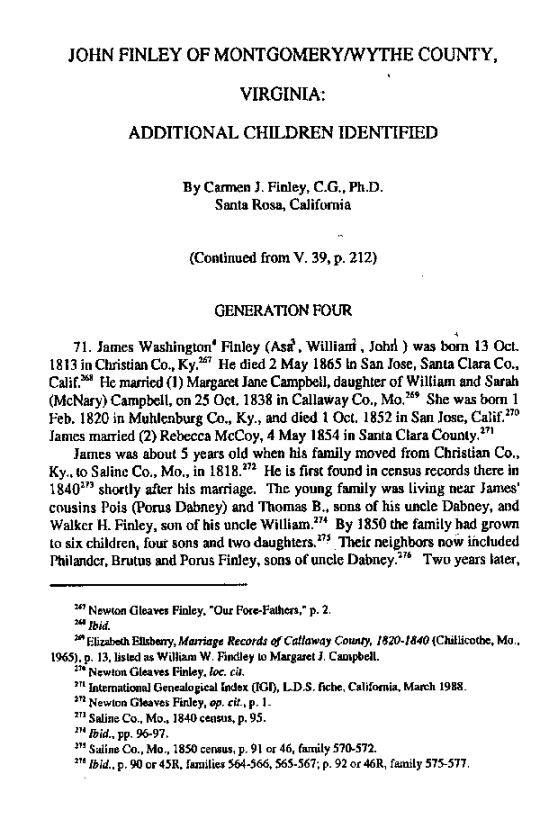
71. James Washington4 Finley (Asa3, William2, John1) was born 13 Oct. 1813 in Christian Co., Ky.;267 He died 2 May 1865 in San Jose, Santa Clara Co., Calif.268 He married (1) Margaret Jane Campbell, daughter of William and Sarah (McNary) Campbell, on 25 Oct. 1838 in Callaway Co., Mo.269 She was born 1 Feb. 1820 in Muhlenburg Co., Ky., and died 11 Oct. 1852 in San Jose, Calif.270 James married (2) Rebecca McCoy, 4 May 1854 in Santa Clara County.271
James was about 5 years old when his family moved from Christian Co., Ky., to Saline Co., Mo., in 1818.272 He is first found in census records there in 1840273 shortly after his marriage. The young family was living near James’ cousins Pois (Porus Dabney) and Thomas B. Dabney, and Walker H. Finley, son of his uncle William.274 By 1850 the family had grown to six children, four sons and two daughters.275 Their neighbors now included Philander, Brutus and Porus Finley, sons of uncle Dabney.276 Two years later,
267 Newton Cleaves Finley, “Our Fore-Fathers,” p. 2.
268 Ibid.
269 Elizabeth Ellsberry, Marriage Records of Callaway County, 1820-1840 (Chillicothe, Mo., 1965), p. 13, listed as William W. Findley to Margaret J. Campbell.
270 Newton Cleaves Finley, loc. cit.
271 International Genealogical Index (IGI), L.D.S. fiche, California, March 1988.
272 Newton Cleaves Finley, op. cit., p. 1.
273 Saline Co., Mo., 1840 census, p. 95.
274 Ibid., pp. 96-97.
275 Saline Co., Mo., 1850 census, p. 91 or 46, family 570-572.
276 Ibid., p. 90 or 45R, families 564-566, 565-567, p. 92 or 46R, family 575-577.
JOHN FINLEY OF MONTGOMERY/WYTHE COUNTY, VIRGINIA:
ADDITIONAL CHILDREN IDENTIFIED
By Carmen J. Finley, C.G., Ph.D.
Santa Rosa, California
(Continued from V. 39, p. 212)
GENERATION FOUR
71. James Washington4 Finley (Asa3, William2, John1) was born 13 Oct. 1813 in Christian Co., Ky.;267 He died 2 May 1865 in San Jose, Santa Clara Co., Calif.268 He married (1) Margaret Jane Campbell, daughter of William and Sarah (McNary) Campbell, on 25 Oct. 1838 in Callaway Co., Mo.269 She was born 1 Feb. 1820 in Muhlenburg Co., Ky., and died 11 Oct. 1852 in San Jose, Calif.270 James married (2) Rebecca McCoy, 4 May 1854 in Santa Clara County.271
James was about 5 years old when his family moved from Christian Co., Ky., to Saline Co., Mo., in 1818.272 He is first found in census records there in 1840273 shortly after his marriage. The young family was living near James’ cousins Pois (Porus Dabney) and Thomas B. Dabney, and Walker H. Finley, son of his uncle William.274 By 1850 the family had grown to six children, four sons and two daughters.275 Their neighbors now included Philander, Brutus and Porus Finley, sons of uncle Dabney.276 Two years later,
267 Newton Cleaves Finley, “Our Fore-Fathers,” p. 2.
268 Ibid.
269 Elizabeth Ellsberry, Marriage Records of Callaway County, 1820-1840 (Chillicothe, Mo., 1965), p. 13, listed as William W. Findley to Margaret J. Campbell.
270 Newton Cleaves Finley, loc. cit.
271 International Genealogical Index (IGI), L.D.S. fiche, California, March 1988.
272 Newton Cleaves Finley, op. cit., p. 1.
273 Saline Co., Mo., 1840 census, p. 95.
274 Ibid., pp. 96-97.
275 Saline Co., Mo., 1850 census, p. 91 or 46, family 570-572.
276 Ibid., p. 90 or 45R, families 564-566, 565-567, p. 92 or 46R, family 575-577.
JOHN FINLEY OF MONTGOMERY/WYTHE COUNTY
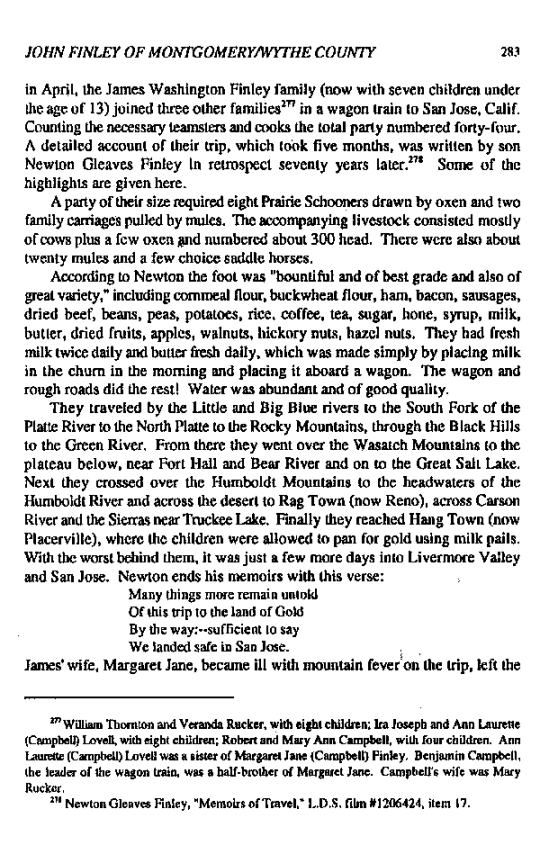
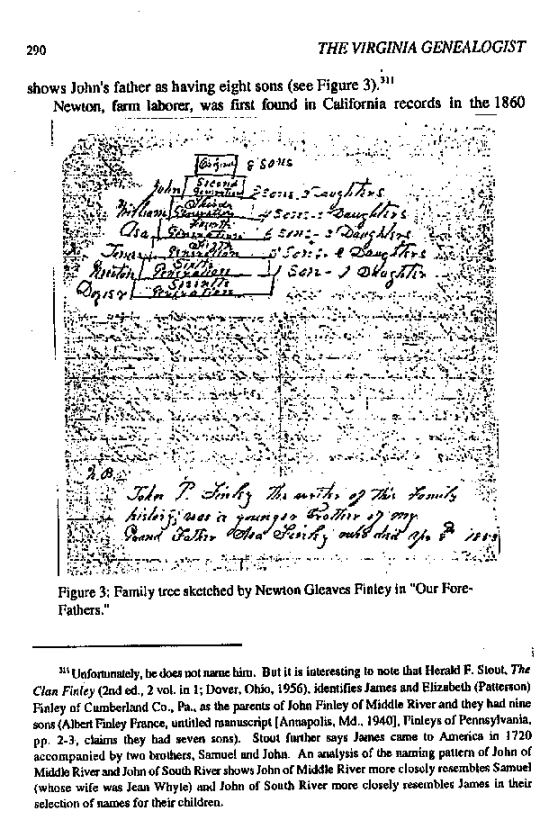
In April, the James Washington Finley family (now with seven children under the age of 13) joined three other families277 in a wagon train to San Jose, Calif. Counting the necessary teamsters and cooks the total party numbered forty-four. A detailed account of their trip, which took five months, was written by son Newton Cleaves Finley in retrospect seventy years later.278 Some of the highlights are given here.
A party of their size required eight Prairie Schooners drawn by oxen and two family carriages pulled by mules. The accompanying livestock consisted mostly of cows plus a few oxen and numbered about 300 head. There were also about twenty mules and a few choice saddle horses.
According to Newton the food was “bountiful and of best grade and also of great variety,” including cornmeal flour, buckwheat flour, ham, bacon, sausages, dried beef, beans, peas, potatoes, rice, coffee, tea, sugar, honey, syrup, milk, butter, dried fruits, apples, walnuts, hickory nuts, hazel nuts. They had fresh milk twice daily and butter fresh daily, which was made simply by placing milk in the churn in the morning and placing it aboard a wagon. The wagon and rough roads did the rest! Water was abundant and of good quality.
They traveled by the Little and Big Blue rivers to the South Fork of the Platte River to the North Platte to the Rocky Mountains, through the Black Hills to the Green River. From there they went over the Wasatch Mountains to the plateau below, near Fort Hall and Bear River and on to the Great Salt Lake. Next they crossed over the Humboldt Mountains to the headwaters of the Humboldt River and across the desert to Rag Town (now Reno), across Carson River and the Sierras near Truckee Lake. Finally they reached Hang Town (now Placerville), where the children were allowed to pan for gold using milk pails. With the worst behind them, it was just a few more days into Livermore Valley and San Jose. Newton ends his memoirs with this verse:
Many things more remain untold
Of this trip to the land of Gold
By the way--sufficient to say
We landed safe in San Jose.
James’ wife, Margaret Jane, became ill with mountain fever on the trip, left the
277 William Thornton and Veranda Rucker, with eight children: Ira Joseph and Ann Laurette (Campbell) Lovell with eight children; Robert and Mary Ann Campbell, with four children. Ann Laurette (Campbell) Lovell was a sister of Margaret Jane (Campbell) Finley, Benjamin Campbell, the leader of the wagon train, was a half-brother of Margaret Jane. Campbell’s wife was Mary Rucker.
278 Newton Cleaves Finley, “Memoirs of Travel,” L.D.S. film #1206424, item 17.
THE VIRGINIA GENEALOGIST
party at Stockton and went by ambulance to Santa Clara where she died shortly before the arrival of the rest of the party.279 She is buried in one of the first graves in Santa Clara Cemetery. James, with seven children under the age of 13, lost little time in finding another wife, Rebecca McCoy. They are found in the 1860 census of Santa Clara with all the (family still intact (except Sarah who had probably married by then), plus three more children of their own.280 James died 2 May 1865 in Santa Clara County.
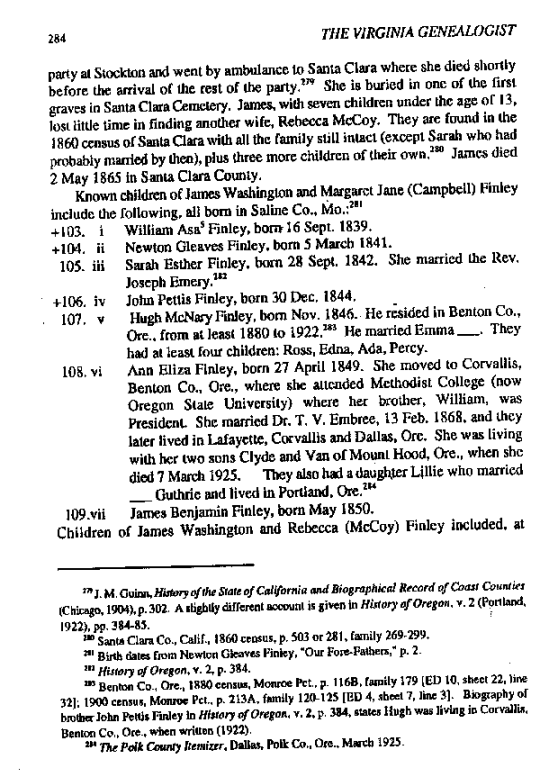
Known children of James Washington and Margaret Jane (Campbell) Finley include the following, all born in Saline Co., Mo.:281
+103. i. William Asa5 Finley, born 16 Sept. 1839.
+104. ii. Newton Cleaves Finley, born 5 March 1841.
105. iii. Sarah Esther Finley, born 28 Sept. 1842. She married the Rev. Joseph Emery.282
+106. iv. John Pettis Finley, born 30 Dec. 1844.
107. v. Hugh McNary Finley, born Nov. 1846. He resided in Benton Co., Ore., from at least 1880 to 1922.283 He married Emma _____. They had at least four children: Ross, Edna, Ada, Percy.
108. vi. Ann Eliza Finley, born 27 April 1849. She moved to Corvallis, Benton Co., Ore., where she attended Methodist College (now Oregon State University) where her brother, William, was President. She married Dr. T. V. Embree, 13 Feb. 1868, and they later lived in Lafayette, Corvallis and Dallas, Ore. She was living with her two sons Clyde and Van of Mount Hood, Ore., when she died 7 March 1925. They also had a daughter Lillie who married ____ Guthrie and lived in Portland, Ore.284
109. vii. James Benjamin Finley, born May 1850.
Children of James Washington and Rebecca (McCoy) Finley included, at
279 J. M. Guinn, History of the State of California and Biographical Record of Coast Counties (Chicago, 1904), p. 302. A highly different account is given in History of Oregon, v. 2 (Portland, 1922), pp. 384-85.
280 Santa Clara Co., Calif., 1860 census, p. 503 or 261, family 269-299.
281 Birth dates from Newton Cleaves Finley, “Our Fore-Fathers,” p. 2.
282 History of Oregon, v. 2, p. 384.
283 Benton Co., Ore., 1880 census, Monroe Pct., p. 116B, family 179 (ED 10, sheet 22, line 32); 1900 census, Monroe Pct., p. 213A, family 120-125 (ED 4, sheet 7, line 3). Biography of brother John Pettis Finley in History of Oregon, v. 2, p. 384, states Hugh was living in Corvallis, Benton Co., Ore., when written (1922).
284 The Polk County Itemizer, Dallas, Polk Co., Ore., March 1925.
JOHN FINLEY OF MONTGOMERY/WYTHE COUNTY
least:285
110. i. Thomas B. Finley, born about 1855 in Santa Clara Co., Calif.
111. ii. Margaret E. Finley, born about 1857, Santa Clara County.
112. iii. Joseph F. Finley, born 1860.
GENERATION FIVE
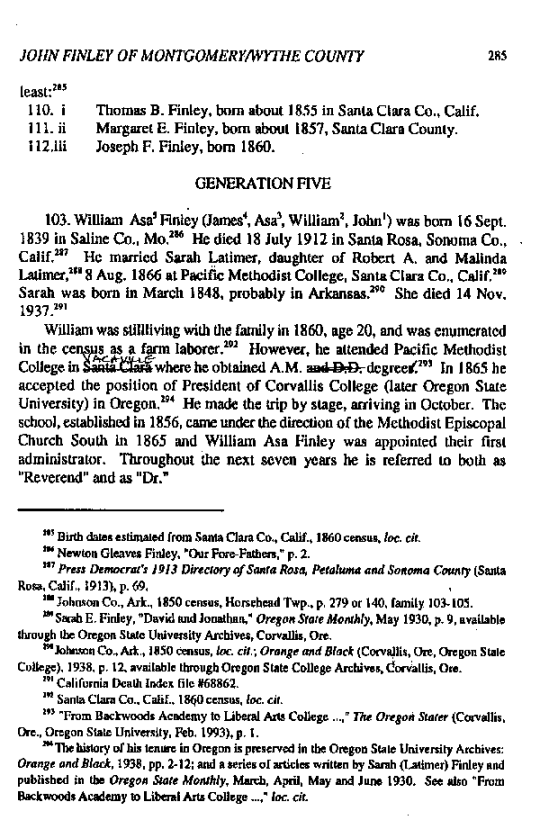
103. William Asa5 Finley (James4, Asa3, William2, John1) was born 16 Sept. 1839 in Saline Co., Mo.286 He died 18 July 1912 in Santa Rosa, Sonoma Co., Calif.287 He married Sarah Latimer, daughter of Robert A. and Malinda Latimer, 28 Aug. 1868 at Pacific Methodist College, Santa Clara Co., Calif.288 Sarah was born in March 1848, probably in Arkansas.289 She died 14 Nov. 1937.291
William was still living with the family in 1860, age 20, and was enumerated in the census as a farm laborer.292 However, he attended Pacific Methodist College in Santa Clara where he obtained A.M. and B.D. degree(s).293 In 1868 he accepted the position of President of Corvallis College (later Oregon State University) in Oregon.294 He made the trip by stage, arriving in October. The school, established in 1856, came under the direction of the Methodist Episcopal Church South in 1865 and William Asa Finley was appointed their first administrator. Throughout the next seven years he is referred to both as “Reverend” and as “Dr.”
285 Birth dates estimated from Santa Clara Co., Calif., 1860 census, loc. cit.
286 Newton Cleaves Finley, “Our Fore-Fathers,” p. 2.
287 Press Democrat, 19/13 Dictionary of Santa Rosa, Petaluma and Sonoma County (Santa Rosa, Calif., 1913), p. 69.
288 Johnson Co., Ark., 1850 census, Horsehead Twp., p. 279 or 140, family 103-105.
289 Sarah E. Finley, “David and Jonathan,” Oregon State Monthly, May 1930, p. 9, available through the Oregon State University Archives, Corvallis, Ore.
291 Johnson Co., Ark., 1850 census, loc. cit.; Orange and Black (Corvallis, Ore., Oregon State College), 1938, p. 12, available through Oregon State College Archives, Corvallis, Ore.
292 Santa Clara Co., Calif., 1860 census, loc. cit.
293 “From Backwoods Academy to Liberal Arts College …” The Oregon Stater (Corvallis, Ore., Oregon State University, Feb. 1903), p. 1.
294 The history of his tenure in Oregon is preserved in the Oregon State University Archives, Orange and Black, 1938, pp. 2-12 and a series of articles written by Sarah (Latimer) Finley and published in the Oregon State Monthly, March, April, May and June 1930. See also “From Backwoods Academy to Liberal Arts College …” loc. cit.
JOHN FINLEY OF MONTGOMERY/WYTHE COUNTY
least:285
110. i. Thomas B. Finley, born about 1855 in Santa Clara Co., Calif.
111. ii. Margaret E. Finley, born about 1857, Santa Clara County.
112. iii. Joseph F. Finley, born 1860.
GENERATION FIVE
103. William Asa5 Finley (James4, Asa3, William2, John1) was born 16 Sept. 1839 in Saline Co., Mo.286 He died 18 July 1912 in Santa Rosa, Sonoma Co., Calif.287 He married Sarah Latimer, daughter of Robert A. and Malinda Latimer, 28 Aug. 1868 at Pacific Methodist College, Santa Clara Co., Calif.288 Sarah was born in March 1848, probably in Arkansas.289 She died 14 Nov. 1937.291
William was still living with the family in 1860, age 20, and was enumerated in the census as a farm laborer.292 However, he attended Pacific Methodist College in Santa Clara where he obtained A.M. and B.D. degree(s).293 In 1868 he accepted the position of President of Corvallis College (later Oregon State University) in Oregon.294 He made the trip by stage, arriving in October. The school, established in 1856, came under the direction of the Methodist Episcopal Church South in 1865 and William Asa Finley was appointed their first administrator. Throughout the next seven years he is referred to both as “Reverend” and as “Dr.”
285 Birth dates estimated from Santa Clara Co., Calif., 1860 census, loc. cit.
286 Newton Cleaves Finley, “Our Fore-Fathers,” p. 2.
287 Press Democrat, 19/13 Directory of Santa Rosa, Petaluma and Sonoma County (Santa Rosa, Calif., 1913), p. 69.
288 Johnson Co., Ark., 1850 census, Horsehead Twp., p. 279 or 140, family 103-105.
289 Sarah E. Finley, “David and Jonathan,” Oregon State Monthly, May 1930, p. 9, available through the Oregon State University Archives, Corvallis, Ore.
291 Johnson Co., Ark., 1850 census, loc. cit.; Orange and Black (Corvallis, Ore., Oregon State College), 1938, p. 12, available through Oregon State College Archives, Corvallis, Ore.
292 Santa Clara Co., Calif., 1860 census, loc. cit.
293 “From Backwoods Academy to Liberal Arts College …” The Oregon Stater (Corvallis, Ore., Oregon State University, Feb. 1903), p. 1.
294 The history of his tenure in Oregon is preserved in the Oregon State University Archives, Orange and Black, 1938, pp. 2-12 and a series of articles written by Sarah (Latimer) Finley and published in the Oregon State Monthly, March, April, May and June 1930. See also “From Backwoods Academy to Liberal Arts College …” loc. cit.
THE VIRGINIA GENEALOGIST
Still unmarried when he accepted this position, he returned to Santa Clara the end of his first year to claim his bride, Sarah Latimer, who had been a college classmate. They were married 8 Aug. 1866 at their alma mater, Pacific Methodist College. Their return to Corvallis was by ship from San Francisco to Portland, and by river steamer from Portland to Corvallis. Wife Sarah, at the age of 80 wrote a series of four articles describing their experience at Corvallis. These were published in the Oregon State Monthly in the Spring of 1930.
During the school year 1866-67, the school had a faculty of five persons and 167 students, 86 males and 81 females. The small size required that he do a lot of teaching himself and his official title was “President of the College and Professor of Languages.” The high point of his tenure in Corvallis came in 1868, when the college was chosen over Willamette University as “the agricultural college of Oregon.”
It was truly a triumph, but the problems it brought soon proved almost impossible to handle. The grant required major additions to the curriculum in agriculture, science, foreign languages, and military exercises, to mention only a few. This, despite the college being deeply in debt and the state very slow and slight in its support. Teachers often went unpaid and had to support themselves with other work.295
William resigned his position on 4 May 1872, to take effect at the close of the academic year. He gave as his reason that the health of Mrs. Finley “demanded the continuous sunshine of a southern climate.” The article also pointed out that, “Singularly enough, while President Finley, who continued his professional career in California, died July 19, 1912, at the age of about seventy years, Mrs. Finley, whose frailty in 1872 led to his departure from Oregon, lived until November 14, 1937, approaching within four months of ninety years of age.”296
William and Sarah relocated in Santa Rosa, Sonoma Co., Calif., with one son, almost 2 years old. It is not clear what William did for the first few years, but by 1876 he was appointed President of Pacific Methodist College.297 In the Great Register of Voters for Sonoma County he is variously listed as a “minister” and “clerical teacher.”298 The Great Register of 1892 gave some
295 “From Backwoods Academy to Liberal Arts College …” loc. cit.
296 Orange and Black, 1938, p. 12.
297 Ernest Latimer Finley, ed., History of Sonoma County, California: Its People and Its Resources (Santa Rosa, Calif., 1937), p. 269.
298 The Great Registers contain a listing of people eligible to vote in the State of California, beginning in 1866, when enacted by the State Legislature. They can generally be found in the County Office of the Recorder or in the State Archives.
THE VIRGINIA GENEALOGIST
Still unmarried when he accepted this position, he returned to Santa Clara the end of his first year to claim his bride, Sarah Latimer, who had been a college classmate. They were married 8 Aug. 1866 at their alma mater, Pacific Methodist College. Their return to Corvallis was by ship from San Francisco to Portland, and by river steamer from Portland to Corvallis. Wife Sarah, at the age of 80 wrote a series of four articles describing their experience at Corvallis. These were published in the Oregon State Monthly in the Spring of 1930.
During the school year 1866-67, the school had a faculty of five persons and 167 students, 86 males and 81 females. The small size required that he do a lot of teaching himself and his official title was “President of the College and Professor of Languages.” The high point of his tenure in Corvallis came in 1868, when the college was chosen over Willamette University as “the agricultural college of Oregon.”
It was truly a triumph, but the problems it brought soon proved almost impossible to handle. The grant required major additions to the curriculum in agriculture, science, foreign languages, and military exercises, to mention only a few. This, despite the college being deeply in debt and the state very slow and slight in its support. Teachers often went unpaid and had to support themselves with other work.295
William resigned his position on 4 May 1872, to take effect at the close of the academic year. He gave as his reason that the health of Mrs. Finley “demanded the continuous sunshine of a southern climate.” The article also pointed out that, “Singularly enough, while President Finley, who continued his professional career in California, died July 19, 1912, at the age of about seventy years, Mrs. Finley, whose frailty in 1872 led to his departure from Oregon, lived until November 14, 1937, approaching within four months of ninety years of age.”296
William and Sarah relocated in Santa Rosa, Sonoma Co., Calif., with one son, almost 2 years old. It is not clear what William did for the first few years, but by 1876 he was appointed President of Pacific Methodist College.297 In the Great Register of Voters for Sonoma County he is variously listed as a “minister” and “clerical teacher.”298 The Great Register of 1892 gave some
295 “From Backwoods Academy to Liberal Arts College …” loc. cit.
296 Orange and Black, 1938, p. 12.
297 Ernest Latimer Finley, ed., History of Sonoma County, California: Its People and Its Resources (Santa Rosa, Calif., 1937), p. 269.
298 The Great Registers contain a listing of people eligible to vote in the State of California, beginning in 1866, when enacted by the State Legislature. They can generally be found in the County Office of the Recorder or in the State Archives.
JOHN FINLEY OF MONTGOMERY/WYTHE COUNTY
physical description. He was listed as 5’8” tall, with dark complexion, hazel eyes, and black hair. The 1890 Business Directory of Sonoma County listed him as President of the Santa Rosa Ladies College.
Sarah, daughter of a minister, also made her mark. While at Corvallis, she served as a music instructor, was active in the Methodist Church and operated a boarding house for women students. In addition to the articles she wrote for publication in the Oregon Monthly, a History of Sonoma County records her thusly:
Some of the most interesting stories, articles, essays, sketches and comments brightening newspaper pages, club papers and magazines for many years were the contributions of Sarah E. Latimer Finley, who from earliest adult life has ranked as an intellectual leader and uncompromising advocate of women’s rights. Her facile pen never faltered in urging support of the need of the moment in social or civic welfare. Mrs. Finley is the daughter of an old and distinguished Southern family. Her stories of life in the South “before the war” are regarded as classics. She made her home in Santa Rosa for more than a half century, dating from 1873; her later years have been spent in Oakland, California.299
Census records were located for them in Sonoma County in 1880, 1900 and 1910.300 Living with them in 1910 was Sarah’s 95 year old father, Robert A. Latimer.
As recently as Feb. 1993, The Oregon Stater carried a front page story featuring William and Sarah as a part of their 125th anniversary issue, saying “and we being with William L. [sic] Finley, whose work and vision led to Oregon State’s land-grant university status.”301 This was shortly after the publication of an issue featuring the Oregon Trail, with William and his picture an integral part of the historic route from Independence, Mo., to the shores of the Columbia River.302
Known children of William Asa and Sarah (Latimer) Finley were:
113. i. Ernest Latimer Finley, born Sept. 1870, Benton Co., Ore. He died 24 Oct. 1942 in Santa Rosa, Sonoma Co., Calif. He married Ruth Woolsey, daughter of Frank Woolsey, in 1912. She was born
299 Finley, History of Sonoma County, p. 57.
300 Sonoma Co., Calif., 1880 census (soundex, v. 16, ed 124, sheet 43, line 39); 1900 census, Santa Rosa City, p. 313B, family 290-304 (ED 174, sheet 14, line 71); 1910 census, Santa Rosa Twp., p. 12A, family 252-261 (ED 157, p. 261).
301 “From Backwoods Academy to Liberal Arts College …” loc. cit.
302 “The Oregon Trail,” The Oregon Stater (Corvallis, Ore., Oregon State University), Dec. 1992, p. 12.
THE VIRGINIA GENEALOGIST
in 1890 in Portland, Ore., and died in 1973 in Santa Rosa. He is best known as Santa Rosa’s long time editor and publisher of the Press Democrat, but also established the first radio station and was involved in many civic endeavors. He left a fortune which has been well managed by his son-in-law, Evert B. Person. The Ernest L. and Ruth W. Finley Foundation is, today, a flourishing philanthropic organization.303
114 ii. Willie C. Finley, born March 1882, Santa Rosa, Calif.304
104. Newton Cleaves5 Finley (James4, Asa3, William2, John1) was born 5 March 1841 in Saline Co., Mo.305 He died 21 June 1933 in Campbell, Santa Clara Co., Calif.306 He married (1) Mary Elizabeth Hicks, 20 Dec. 1866. She died in 1872, no issue.307 He married (2) Kate Rowena (Minnie) Dozier, 4 Aug. 1874 in Campbell. She was born 1 May 1848 in St. Louis, Mo., the daughter of Lewis Fort and Cynthia (Cames) Dozier. Rowena, as she was called, died 28 Dec. 1926 in Santa Clara County and is interred with her daughter at Chapel of Memories, Oakland, Calif.308
Newton was but 11 years old when the family made the five month trek by wagon train from Missouri to California, an impressionable age. The memoirs of that trip he wrote seventy years later were amazingly detailed and a testament to his alertness in his eighties. The eight-page account, written in 1922, was preserved by family members and submitted to the Family History Center in Salt Lake City in 1981 by Dr. Alton Lovell Aldermann.309
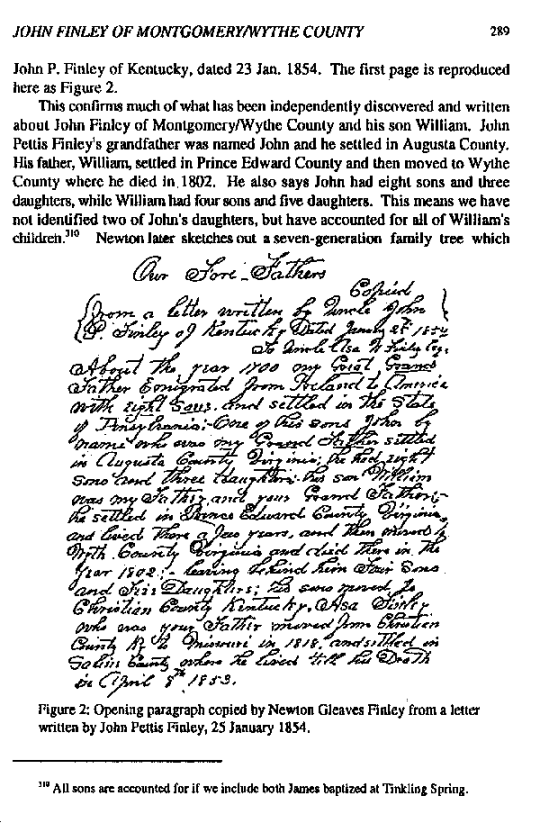
However, Newton’s interest in recording information about the family surfaced much earlier in life. In 1870, when he was 29 years old, he wrote “Our Fore-Fathers,” a five page document copied from letter written by his Uncle
303 Finley, History of Sonoma County, p. 376.
304 Sonoma Co., Calif., 1900 census, loc. cit.
305 Newton Cleaves Finley, “Our Fore-Fathers,” p. 2.
306 Newton C. Finley death certificate, State of California, Department of Health Services, #33-035630.
307 A handwritten account made by Newton Cleaves Finley dated 5 Oct. 1917 gives marriage date and states she died six years later (Cynthia [Finley] Elliott to author, 7 June 1993).
308 Rowena Finley death certificate, State of California, Department of Health Services, #26-061023.
309 Dr. Aldermann is no longer living, but his daughter, Mary Alice Ridgway, 511 N.W. Irish, Pendleton, Ore. 97801, indicated in 1990 that a member of the family will be continuing the work on their branch of the family. Dr. Aldermann had in his file a beautifully preserved picture of William Asa Finley (Mary Alice Ridgway to Carmen J. Finley, 5 July 1990).
JOHN FINLEY OF MONTGOMERY/WYTHE COUNTY
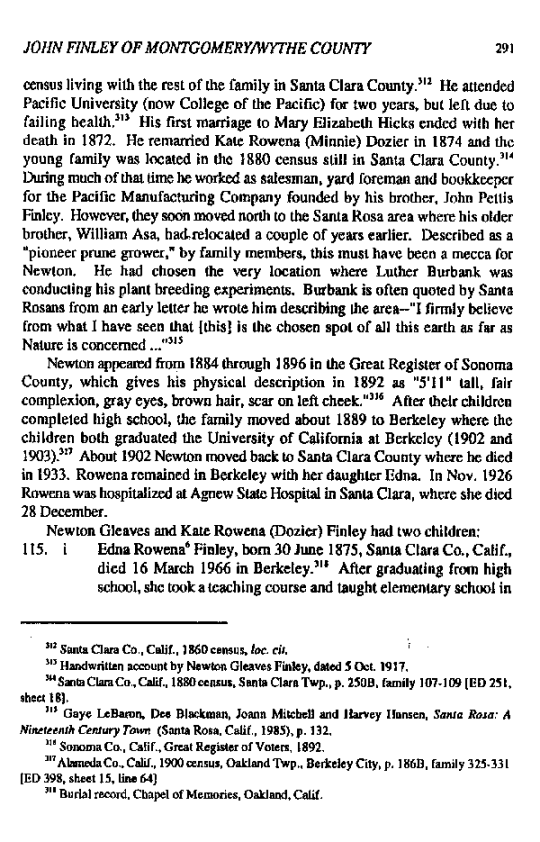
John P. Finley of Kentucky, dated 23 Jan. 1854. The first page is reproduced here as Figure 2.
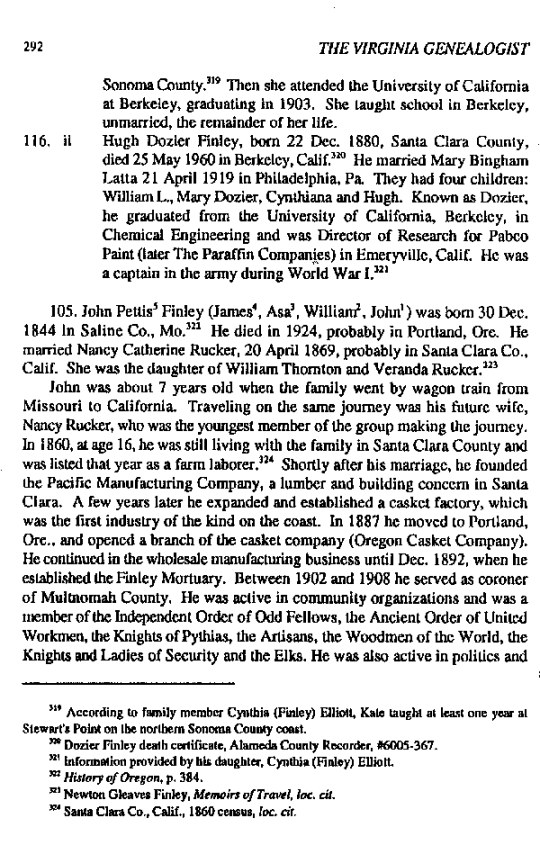
This confirms much of what has been independently discovered and written about John Finley of Montgomery/Wythe County and his son William. John Pettis Finley’s grandfather was named John and he settled in Augusta County. His father, William, settled in Prince Edward County and then moved to Wythe County where he died in 1802. He also says John had eight sons and three daughters, while William had four sons and five daughters. This means we have not identified two of John’s daughters, but have accounted for all of William’s children.310 Newton later sketches out a seven-generation family tree which
Figure 2 Opening paragraph copied by Newton Cleaves Finley from a letter written by John Pettis Finley, 25 January 1854.
310 All sons are accounted for if we include both James baptized at Tinkling Spring.
THE VIRGINIA GENEALOGIST
shows John’s father as having eight sons (see Figure 3).311
Newton, farm laborer, was first found in California records in the 1860
Figure 3: Family tree sketched by Newton Cleaves Finley in “Our Fore-Fathers.”
311 Unfortunately, he does not name him. But it is interesting to note that Herald F. Stout, The Clan Finley (2nd ed., 2 vol. in 1; Dover, Ohio, 1956), identifies James and Elizabeth (Patterson) Finley of Cumberland Co., Pa., as the parents of John Finley of Middle River and they had nine sons (Albert Finley France, untitled manuscript [Annapolis, Md., 1940], Finleys of Pennsylvania, pp. 2-3, claims they had seven sons). Stout further says James came to America in 1720 accompanied by two brothers, Samuel and John. An analysis of the naming pattern of John of Middle River and John of South River shows John of Middle River more closely resembles Samuel (whose wife was Jean Whyte) and John of South River more closely resembles James in their selection of names for their children.
JOHN FINLEY OF MONTGOMERY/WYTHE COUNTY
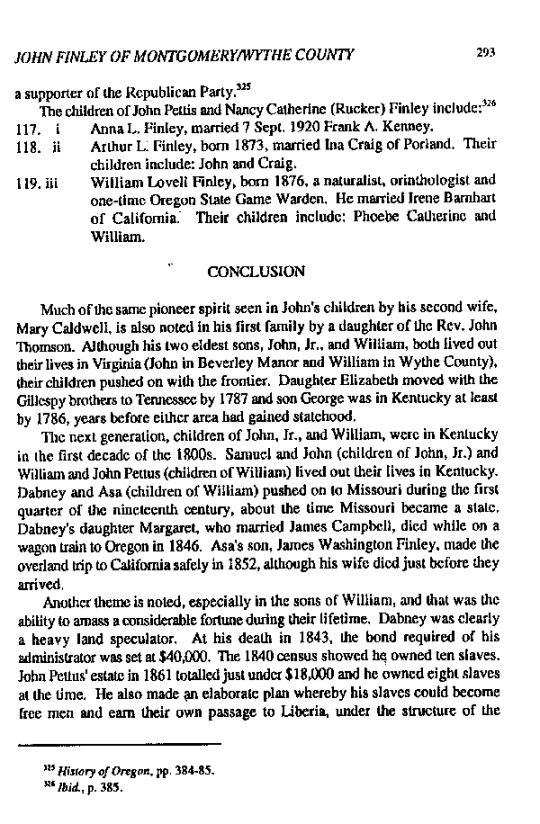
census living with the rest of the family in Santa Clara County.312 He attended Pacific University (now College of the Pacific) for two years, but left due to failing health.313 His first marriage to Mary Elizabeth Hicks ended with her death in 1872. He remarried Kate Rowena (Minnie) Dozier in 1874 and the young family was located in the 1880 census still in Santa Clara County.314 During much of that time he worked as salesman, yard foreman and bookkeeper for the Pacific Manufacturing Company founded by his brother, John Pettis Finley. However, they soon moved north to the Santa Rosa area where his older brother, William Asa, had relocated a couple of years earlier. Described as a pioneer prune grower, by family members, this must have been a mecca for Newton. He had chosen the very location where Luther Burbank was conducting his plant breeding experiments. Burbank is often quoted by Santa Rosans from an early letter he wrote him describing the area—“I firmly believe from what I have seen that [this] is the chosen spot of all this earth as far as Nature is concerned …”315
Newton appeared from 1884 through 1896 in the Great Register of Sonoma County, which gives his physical description in 1892 as “5'11" tall, fair complexion, gray eyes, brown hair, scar on left cheek.”316 After their children completed high school, the family moved about 1889 to Berkeley where the children both graduated the University of California at Berkeley (1902 and 1903).317 About 1902 Newton moved back to Santa Clara County where he died in 1933. Rowena remained in Berkeley with her daughter Edna. In Nov. 1926 Rowena was hospitalized at Agnew State Hospital in Santa Clara, where she died 28 December.318
Newton Cleaves and Kate Rowena (Dozier) Finley had two children:
115. i. Edna Rowena6 Finley, born 30 June 1875, Santa Clara Co., Calif., died 16 March 1966 in Berkeley.318 After graduating from high school, she took a teaching course and taught elementary school in
312 Santa Clara Co., Calif., 1860 census, loc. cit.
313 Handwritten account by Newton Cleaves Finley, dated 5 Oct. 1917.
314 Santa Clara Co., Calif., 1880 census, Santa Clara Twp., p. 250B, family 107-109 (ED 251, sheet 18).
315 Gayle LeBaron, Dee Blackman, Joan Mitchell and Harvey Johnson, Santa Rosa: A Nineteenth Century Town (Santa Rosa, Calif., 1985), p. 132.
316 Sonoma Co., Calif., Great Register of Voters, 1892.
317 Alameda Co., Calif., 1900 census, Oakland Twp., Berkeley City, p. 186B, family 325-331 (ED 398, sheet 15, line 64).
318 Burial record, Chapel of Memories, Oakland, Calif.
THE VIRGINIA GENEALOGIST
Sonoma County.319 Then she attended the University of California at Berkeley, graduating in 1903. She taught school in Berkeley, unmarried, the remainder of her life.
116. ii. Hugh Dozier Finley, born 22 Dec. 1880, Santa Clara County, died 25 May 1960 in Berkeley, Calif.320 He married Mary Bingham Latta 21 April 1919 in Philadelphia, Pa. They had four children: William L., Mary Dozier, Cynthia and Hugh. Known as Dozier, he graduated from the University of California, Berkeley, in Chemical Engineering and was Director of Research for Pabco Paint (later The Paraffin Companies) in Emeryville, Calif. He was a captain in the army during World War I.321
105. John Pettis5 Finley (James4, Asa3, William2, John1) was born 30 Dec. 1844 in Saline Co., Mo.322 He died in 1924, probably in Portland, Ore. He married Nancy Catherine Rucker, 20 April 1869, probably in Santa Clara Co., Calif. She was the daughter of William Thornton and Veranda Rucker.323
John was about 7 years old when the family went by wagon train from Missouri to California. Traveling on the same journey was his future wife, Nancy Rucker, who was the youngest member of the group making the journey. In 1860, at age 16, he was still living with the family in Santa Clara County and was listed that year as a farm laborer.324 Shortly after his marriage, he founded the Pacific Manufacturing Company, a lumber and building concern in Santa Clara. A few years later he expanded and established a casket factory, which was the first industry of the kind on the coast. In 1887 he moved to Portland, Ore., and opened a branch of the casket company (Oregon Casket Company). He continued in the wholesale manufacturing business until Dec. 1892, when he established the Finley Mortuary. Between 1902 and 1908 he served as coroner of Multnomah County. He was active in community organizations and was a member of the Independent Order of Odd Fellows, the Ancient Order of United Workmen, the Knights of Pythias, the Artisans, the Woodmen of the World, the Knights and Ladies of Security and the Elks. He was also active in politics and
319 According to family member Cynthia (Finley) Elliott, Kate taught at least one year at Stewart’s Point on the northern Sonoma County coast.
320 Dozier Finley death certificate, Alameda County Recorder, #6005-367.
321 Information provided by his daughter, Cynthia (Finley) Elliott.
322 History of Oregon, p. 384.
323 Newton Cleaves Finley, Memoirs of Travel, loc. cit.
324 Santa Clara Co., Calif., 1860 census, loc. cit.
JOHN FINLEY OF MONTGOMERY/WYTHE COUNTY
a supporter of the Republican Party.325
The children of John Pettis and Nancy Catherine (Rucker) Finley include:326
117. i. Anna L. Finley, married 7 Sept. 1920 Frank A. Kenney.
118. ii. Arthur L. Finley, born 1873, married Ina Craig of Portland. Their children include: John and Craig.
119. iii. William Lovel Finley, born 1876, a naturalist, ornithologist and one-time Oregon State Game Warden. He married Irene Barnhart of California. Their children include: Phoebe Catherine and William.
CONCLUSION
Much of the same pioneer spirit seen in John’s children by his second wife, Mary Caldwell, is also noted in his first family by a daughter of the Rev. John Thomson. Although his two eldest sons, John, Jr., and William, both lived out their lives in Virginia (John in Beverley Manor and William in Wythe County), their children pushed on with the frontier. Daughter Elizabeth moved with the Gillespy brothers to Tennessee by 1787 and son George was in Kentucky at least by 1786, years before either area had gained statehood.
The next generation, children of John, Jr., and William, were in Kentucky in the first decade of the 1800s. Samuel and John (children of John, Jr.) and William and John Pettis (children of William) lived out their lives in Kentucky. Dabney and Asa (children of William) pushed on to Missouri during the first quarter of the nineteenth century, about the time Missouri became a state. Dabney’s daughter Margaret, who married James Campbell, died while on a wagon train to Oregon in 1846. Asa’s son, James Washington Finley, made the overland trip to California safely in 1852, although his wife died just before they arrived.
Another theme is noted, especially in the sons of William, and that was the ability to amass a considerable fortune during their lifetime. Dabney was clearly a heavy land speculator. At his death in 1843, the bond required of his administrator was set at $40,000. The 1840 census showed he owned ten slaves. John Pettis’ estate in 1861 totalled just under $18,000 and he owned eight slaves at the time. He also made an elaborate plan whereby his slaves could become free men and earn their own passage to Liberia, under the structure of the
325 History of Oregon, pp. 384-85.
326 Ibid., p. 385.
THE VIRGINIA GENEALOGIST
American Colonization Society. The appraisal of Asa’s estate in 1853 totalled almost $32,000 and included four slaves. However, he had already given from $2,000 to $3,000 to each of his five older children.
Measures of financial and professional success are also seen in a number of Asa’s grandchildren (sons of James Washington Finley). William Asa Finley (1839-1912) became the first President of what is now Oregon State College in Corvallis, Ore. His son, Ernest Latimer Finley (1870-1942), developed the leading newspaper in Santa Rosa, Calif., The Press Democrat, established the first radio and TV stations and left a multi-million dollar Foundation, which just recently donated $6,000,000 for the establishment of Finley Park. John Pettis Finley (1844-1924) founded the Pacific Manufacturing Company in Santa Clara, including a casket factory, the first of its kind on the coast. In 1887 he moved to Portland, Ore., where he continued manufacturing caskets and established the Finley Mortuary. The latter is still being operated by his descendants.
Members of both families of John Finley, Elder of Tinkling Spring in Beverley Manor, Augusta County, made significant contributions to the development of a young and developing America.